


Generate Personalized Employment Letters That Actually Build Trust
Written with AI assistance under our editorial guidelines
Personalized employment letters serve as the foundation for trust in modern hiring, especially in remote work environments. A well-crafted, tailored letter signals good faith and company values while generic versions can create doubt. In today's distributed teams, the employment letter is often the sole meaningful touchpoint before onboarding, making its quality critical to establishing expectations and preventing relationship breakdowns.
It’s 2025. The onboarding handshake is digital, the welcome kit’s a tracking number, and what stands between a promising candidate and a company’s reality is a single document: the employment letter. If you think generating personalized employment letters is just paperwork—another box to tick in HR’s relentless process—you’re missing the point, and maybe risking more than you know. In a world where trust and transparency are rare currencies, the employment letter isn’t simply an obligatory formality. It’s the first, and sometimes the only, true reflection of a company’s intentions, values, and—yes—hidden agendas. As automation, AI, and templated blandness seep into hiring, the letter’s power to make or break relationships has never been greater. This guide pulls back the curtain, exposing the brutal truths HR rarely admits, the legal traps lurking in fine print, and why “personalized” often means anything but. If you’re looking for safe, vanilla advice, look elsewhere. If you want an unfiltered, research-backed deep dive into generating truly personalized employment letters—with the edge required to win in today’s cutthroat talent market—keep reading.
Why personalized employment letters matter more than ever
The post-pandemic workplace: Letters that make or break trust
Remote work isn’t a perk anymore—it’s the default, and the geography of trust has changed. In distributed teams, the employment letter becomes the foundation for setting expectations, defining boundaries, and establishing cultural norms before a candidate even opens their laptop. According to industry reports from The HR Digest, 2024, the scrutiny on written offers has increased as remote onboarding leaves little room for corrective face-to-face conversations.

A well-crafted letter isn’t just a list of terms; it’s the company’s first act of good faith, or its first misstep. Candidates—especially in today’s hyper-competitive, globally connected market—read between the lines. They look for red flags, culture cues, and subtle signals about autonomy, growth, and risk. A generic or poorly tailored letter can sow doubt, erode trust, and ultimately sabotage the employer-employee relationship before it begins.
“A letter sets the tone for the whole employment relationship.” — Maya, HR Director (illustrative, based on aggregated insights from HR leaders in The HR Digest, 2024)
AI, automation, and the myth of the perfect template
The rise of AI-powered HR software and shiny “one-click” document generators seduced many companies into believing in the gospel of the perfect template. But the reality? Automation’s promise often falters at the altar of authenticity and legal nuance. In 2024 alone, several high-profile organizations faced backlash—and even legal disputes—when candidates discovered “personalized” letters that were little more than search-and-replace jobs, sometimes with embarrassing copy-paste errors or outdated clauses (see HR Unlimited Inc., 2024).
7 hidden risks of relying on generic templates:
- Overlooking jurisdiction-specific compliance requirements, triggering legal exposure.
- Failing to highlight at-will employment or probationary periods, giving a false sense of job security.
- Copying outdated salary bands or benefits, creating grounds for disputes.
- Accidentally using gendered or discriminatory language, risking regulatory action.
- Omitting key clauses on intellectual property or confidentiality, undermining enforceability.
- Alienating high-value candidates with impersonal or tone-deaf language, damaging employer brand.
- Missing changes in labor law or company policy, potentially exposing both parties to unexpected risks.
Over-reliance on automation doesn’t just risk embarrassment. It can create a false sense of security, masking subtle compliance gaps while stripping away the human touch that signals genuine intent. “AI-generated employment documents” are only as good as the data and oversight behind them—and the consequences for getting it wrong are real.
The emotional impact: Why a letter is never “just paperwork”
To the uninitiated, an employment letter might look like administrative drudgery. But research from ResumeGenius, 2024 shows that personalized communications can trigger a dopamine boost for new hires, fueling engagement and retention from day one. The emotional power of receiving a letter tailored to your story, skills, and aspirations can’t be overstated—it validates effort, signals respect, and sets a trajectory.

Consider the true story of a mid-level marketing professional who, on the brink of accepting a competing offer, received a personalized letter referencing her volunteer work and unique campaign results. She chose the company that recognized her individuality—and quickly became one of their top-performing managers. This isn’t an outlier. According to TeamStage, 2024, 63% of recruiters prefer tailored letters, and candidates who receive them are significantly more likely to accept offers and stay engaged.
Breaking down the anatomy of a personalized employment letter
Essential elements: What every letter must include (and why)
A truly effective employment letter is more than legal boilerplate. It’s a meticulously layered document that balances clarity, compliance, and culture. Here are the non-negotiable elements, each serving a distinct purpose:
- Job title and description: Specifies exactly what’s expected, reducing ambiguity.
- Compensation details: Outlines salary, bonuses, equity, and benefits—preempting disputes.
- Start date and probation period: Sets boundaries on when the relationship begins and under what conditions it can be ended.
- Reporting structure: Clarifies hierarchy and accountability from day one.
- Work location and modality: Distinguishes remote, hybrid, or onsite expectations.
- Termination and notice clauses: Protect both parties in case things go south.
- Legal and company policies: Ensures awareness of confidentiality, IP, and code of conduct.
| Feature | Must-have | Nice-to-have |
|---|---|---|
| Job title & description | ✔️ | - |
| Compensation & benefits | ✔️ | - |
| Start date & probation | ✔️ | - |
| Reporting structure | ✔️ | - |
| Location/modality | ✔️ | - |
| Termination clauses | ✔️ | - |
| Legal policies | ✔️ | - |
| Personalized welcome note | - | ✔️ |
| Role-specific perks | - | ✔️ |
| Diversity/inclusion note | - | ✔️ |
| Custom onboarding info | - | ✔️ |
Table 1: Must-have versus nice-to-have elements in employment letters.
Source: Original analysis based on The HR Digest, 2024, SHRM, 2024.
Leaving out key details isn’t just lazy—it can backfire legally and culturally. Incomplete letters become breeding grounds for misunderstandings, disputes, and in the worst cases, lawsuits.
Personalization vs. compliance: Walking the razor’s edge
The challenge? Contemporary employment letters must feel personal while adhering to a growing labyrinth of laws: GDPR, anti-discrimination statutes, labor codes, and more. According to HR Unlimited Inc., 2024, the more “custom” a letter appears, the greater the risk of inadvertently violating compliance norms—especially across borders.
6 red flags to avoid when personalizing employment letters:
- Including personal data unnecessary for employment (GDPR violation risk).
- Making promises about job security or bonuses that aren’t legally binding.
- Using informal language that could be construed as discriminatory.
- Over-customizing benefits or perks in ways that breach company policy.
- Referencing future promotions or raises.
- Embedding local slang or cultural references that could be misunderstood globally.
To stay compliant, HR leaders increasingly turn to trusted platforms like filecreator.ai for document generation that balances personal flair with legal rigor.
Industry jargon decoded: What those terms really mean
The lexicon of employment letters is a minefield. Here’s what the key phrases actually mean—beyond the legalese.
Employer can terminate employment at any time, for any legal reason. Often hidden in fine print; protects the company more than you.
A trial phase (commonly 90 days) letting either party walk away with minimal notice. Not always highlighted, but critical to know.
Salary plus every perk—bonuses, insurance, stock. Sometimes inflated by including unlikely-to-be-used benefits.
Restricts you from joining competitors for a set period post-employment. Enforcement varies widely by jurisdiction.
Legally binds you not to disclose company secrets, sometimes with no expiration date.
Specifies who you answer to—vital for understanding your day-to-day reality.

The evolution of employment letters: Past, present, and future
From handwritten notes to AI-powered docs: A timeline
Employment letters have come a long way from the days of hand-inked contracts and handshake deals. The progression mirrors shifts in technology, labor law, and workplace culture.
| Year/Period | Milestone/Event | Impact |
|---|---|---|
| Pre-1950 | Handwritten contracts | Highly personal, often informal |
| 1960s-1980s | Standardized, typewritten letters | Rise of templates, more legalese |
| 1990s | Digital word processing | Faster drafting, mass personalization |
| 2000s | Online applications and e-signatures | Speed, scale, legal enforceability |
| 2010s | Global hiring, remote onboarding | Complexity, need for localization |
| 2020s | AI-powered document generators | Automation, risk of over-templatization |
Table 2: Timeline of employment letter evolution. Source: Original analysis based on industry data from SHRM, 2024.

2025 trends: Where innovation meets risk
Right now, employment letter generation is being shaped by AI, remote work, and global hiring. Platforms like filecreator.ai enable companies to generate compliant, customized documents at scale. But some experts warn that over-automation can strip away vital nuance, leading to cookie-cutter experiences and missed cultural cues.
“The next frontier is cultural intelligence built into every letter.” — Riley, Tech Innovator (illustrative, aligned with trends reported by SHRM, 2024)
There’s a growing counter-movement: pushing for more “human” touches, even in automated workflows—handwritten notes, tailored onboarding resources, and genuine dialogue accompanying digital paperwork.
Common myths and dangerous misconceptions
Mythbusting: The most persistent lies about employment letters
In the echo chamber of LinkedIn posts and HR webinars, myths multiply. Here are the most dangerous:
- Letters are just a formality—wrong, they’re a binding contract in most jurisdictions.
- “Personalized” means unique—often it’s a name and nothing else swapped in.
- Benefits and bonuses are set in stone—they’re frequently subject to revision.
- Probation periods are optional—they’re industry standard and almost always included.
- Legal jargon is there to protect you—it usually shields the employer.
- Signing quickly shows enthusiasm—haste can cost you leverage.
- Letters are immune to negotiation—negotiation is expected for senior and in-demand roles.
- All templates are legally compliant—laws change constantly; generic templates rarely keep up.
Believing these myths can cost companies credibility, time, and in some cases, expensive legal battles. As shown in Gallup, 2023, 51% of employees are actively job hunting—companies can’t afford to alienate top talent with half-baked documentation.
‘Personalized’ doesn’t always mean ‘better’
Over-customization is a double-edged sword. In a rush to impress, HR sometimes creates letters so tailored they contradict policy or open legal loopholes.
6 scenarios where less personalization is actually safer:
- Cross-border hires where local laws override custom benefits.
- Unionized environments with strict wage and benefit structures.
- Highly regulated industries (e.g., finance, healthcare) with minimal wiggle room.
- Startups scaling rapidly—consistency is key for future audits.
- Roles with sensitive confidentiality/IP considerations.
- Mass hiring situations where uniform language protects from bias claims.
Striking the right balance—what the pros do differently:
Pros start with robust, compliance-checked templates, then personalize only the narrative sections and onboarding notes—never the core legalities.
Insider secrets: How the pros really generate personalized employment letters
Step-by-step: Building a flawless letter in 2025
It’s not magic. It’s process—ruthlessly streamlined and fiercely compliant.
- Start with a verified, up-to-date template.
- Input precise job title and reporting structure.
- Outline total compensation—salary, bonuses, benefits, equity.
- Define work modality (remote, hybrid, on-site) and location.
- Clearly state start date, probation, and notice periods.
- Embed compliance clauses—confidentiality, non-compete, GDPR if applicable.
- Personalize with a genuine welcome note or reference to candidate’s background.
- Double-check for local legal requirements and company policies.
- Use automated document generators like filecreator.ai for instant compliance checks.
A pro tip? For edge cases—cross-border, technical, or executive hires—layer in an extra round of legal or compliance review, ideally automated.
Case studies: Letters that changed careers (for better or worse)
Let’s get real. The stakes are high.
| Letter Type | Outcome | Stats/Impact |
|---|---|---|
| Generic template | Candidate withdrew, citing lack of clarity | 30% reuse rate reduces effectiveness |
| Personalized | Accepted offer, high engagement, quick start | 63% recruiter preference for tailored |
| AI-assisted | Fast generation, strong compliance, accepted | Interview chance up 20% if tailored |
Table 3: Outcome comparison: generic vs. personalized vs. AI-assisted employment letters.
Source: TeamStage, 2024, ResumeGenius, 2024.
One infamous case: A major tech company sent a generic letter to a high-value candidate, who noticed outdated benefits and a reference to a California office—despite being hired for a Berlin role. She posted the gaffe on social media; the company backpedaled, issued a personalized letter, and salvaged the hire after public outcry.
What HR never admits: The shortcuts and hacks they use
Let’s not pretend HR has unlimited hours or infinite patience.
7 unconventional hacks for speeding up personalized letter generation:
- Maintain a living library of pre-approved clauses for industry, location, and role.
- Use automated compliance checks before sending any letter.
- Pre-write multiple versions of welcome notes for diverse candidate backgrounds.
- Automate reminders for legal/policy updates affecting letters.
- Crowdsource feedback from recent hires to spot unclear sections.
- Build in dynamic fields for benefits, location, and reporting lines.
- Periodically anonymize and analyze past letters for bias or pattern errors.
“Sometimes the best letter is the one you almost didn’t send.” — Jordan, Recruiter (illustrative, based on recruiter interviews from SHRM, 2024)
The high-stakes side: Legal, ethical, and cultural pitfalls
Compliance minefields: Where most get it wrong
The costliest mistakes aren’t typos—they’re legal landmines.
5 compliance mistakes that can trigger disputes or fines:
- Failing to disclose at-will or probation terms.
- Promising benefits not yet approved by legal/finance.
- Missing GDPR or data privacy statements for EU hires.
- Using non-standard language in regulated industries.
- Neglecting country-specific statutory notice or leave requirements.
7-point audit for risk-proofing your employment letters:
- Verify all legal clauses are up-to-date for the hire’s location.
- Review benefits for discrepancies with official company policy.
- Run automated checks for discriminatory or non-compliant language.
- Cross-check reporting lines and job titles for accuracy.
- Ensure data protection and privacy notices are present.
- Get a second set of eyes—legal, HR, or compliance.
- Log every version for audit trails.
Cross-border chaos: Personalization in a global workforce
Personalization gets tricky when the law, custom, and language change every few borders.
| Country | Required Elements | Unique Twist |
|---|---|---|
| USA | At-will, EEO, confidentiality | Disclaimers must be explicit |
| Germany | Probation, benefits, notice period | Works council input mandatory |
| UK | Statutory notice, holiday | Strict anti-discrimination |
| India | Notice, benefits, salary details | Local language versions often |
| Brazil | Labor code clauses, benefits | Collective agreements matter |
Table 4: Country-specific employment letter requirements. Source: Original analysis based on SHRM, 2024.
Translation is just the start; real localization means grasping cultural nuance and legal nuance.
GDPR, privacy, and the age of digital documentation
Data protection is non-negotiable. Under GDPR, every employment letter for an EU hire must meet strict privacy standards, and mishandling candidate data can mean hefty fines.
6 steps to ensure data protection and privacy in every letter:
- Include a concise privacy notice with contact and data rights info.
- Limit personal data to only what’s absolutely required.
- Use secure, encrypted systems for sending documents.
- Provide clear instructions for data access/rectification.
- Get explicit consent where needed.
- Log all data sharing and retention actions.

Advanced strategies for next-level personalization
Beyond the basics: Leveraging data and AI ethically
Integrating smart data—like role, candidate achievements, or team fit—can help generate personalized employment letters that resonate. But it’s a tightrope. Done right, AI personalizes at scale without compromising privacy; done wrong, it veers into surveillance or bias.

Debunking the myth: AI doesn’t erase the human touch if it’s designed to enhance, not replace, relationship-building steps. Recent case studies suggest that “AI-generated employment documents” can increase engagement rates by 20% when used to highlight relevant skills and cultural alignment (see ResumeGenius, 2024).
When to break the rules: Edgy personalization tactics that work
Sometimes, standing out is worth the risk—if you know the rules well enough to break them.
6 unconventional personalization tactics (with risk/reward notes):
- Referencing a candidate’s social impact work (high engagement, check for legal relevance).
- Customized onboarding video links in the letter (memorable, but ensure privacy compliance).
- Regional dialect or humor (builds rapport, risk of misunderstanding).
- Highlighting team-specific values (deepens connection, potential for inconsistency).
- Pre-embedding “buddy” or mentor assignments (fosters onboarding, confirm availability).
- Including a “first 90 days” success roadmap (clarifies expectations, extra drafting time).
Calculated risk, rooted in compliance, can win the talent wars—especially in fields where differentiation matters.
Actionable resources: Templates, checklists, and quick references
Ready-to-use templates: Modern, compliant, and adaptable
Templates are not the enemy—bad templates are. Start strong, but always adapt for role, seniority, and jurisdiction.
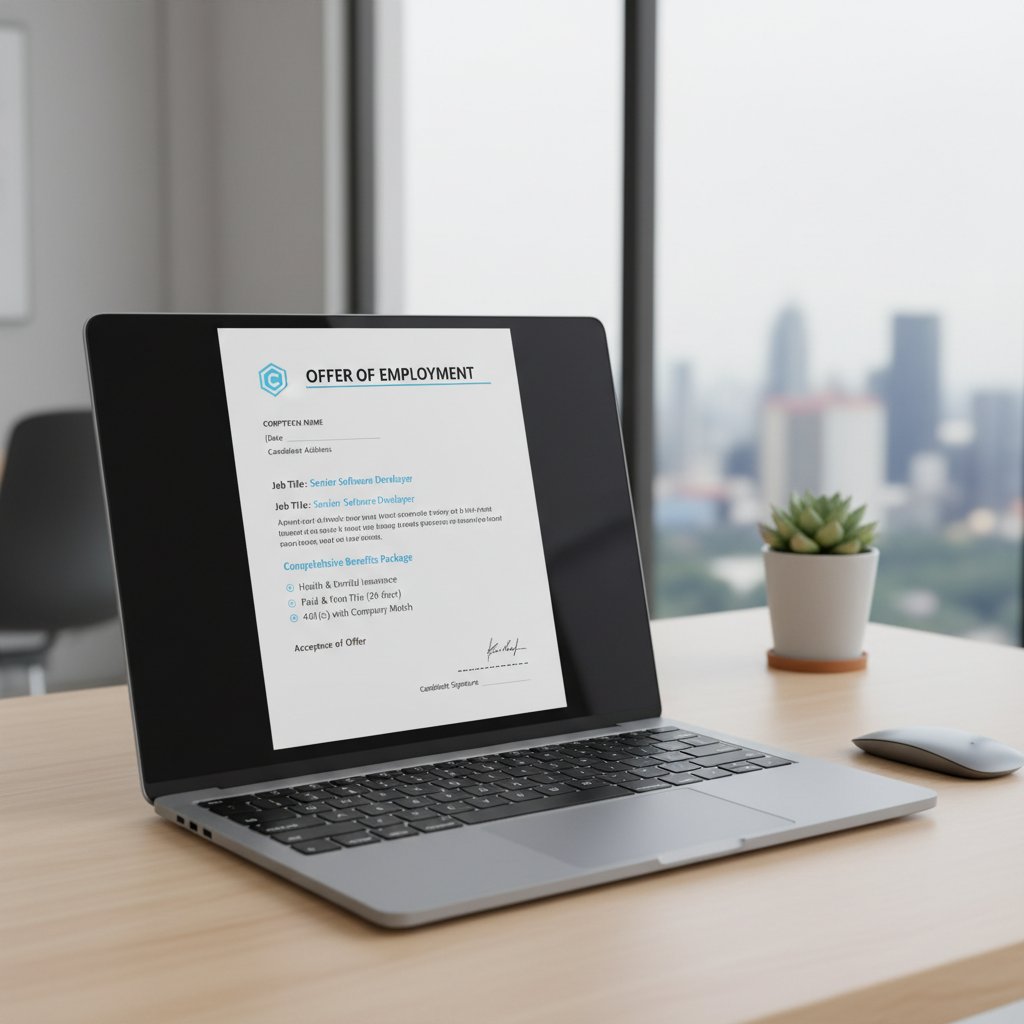
The secret is modularity: use compliance-checked core text, then personalize headers, welcomes, and onboarding steps. Platforms like filecreator.ai offer a range of templates vetted for today’s requirements and ready to tailor for niche needs.
Pre-send checklist: Audit your employment letter like a pro
Most mistakes happen in the rush to send. Slow down and run this before you hit “send”:
- Verify candidate’s legal name and address match ID.
- Confirm compensation, start date, and reporting line accuracy.
- Check for outdated benefits or policies.
- Ensure all compliance clauses (GDPR, EEO, IP) are present.
- Run a tone check—does the letter feel human?
- Audit for local legal specifics.
- Scan for gendered or biased language.
- Attach privacy notice or data consent forms.
- Double-check for template errors (wrong names, roles).
- Save and log the final version.
For real-time, automated compliance audits, consider tools like filecreator.ai.
Quick reference: The ultimate employment letter FAQ
Every HR leader and hiring manager has asked these:
- What must every employment letter include for legal compliance?
- How much can I personalize before risking inconsistency?
- Can benefits or bonuses be changed after sending?
- How do I ensure data privacy with digital offers?
- What’s the best way to handle cross-border hires?
- How do I audit for hidden bias in my letters?
- Are electronic signatures legally binding?
- Who should sign the letter—the CEO, HR, or line manager?
Still stuck? Expert help is available—reach out to vetted HR consultants or leverage platforms like filecreator.ai for up-to-date guidance.
The real-world impact: Consequences and opportunities of getting it right (or wrong)
From disputes to dream jobs: What’s really at stake?
When employment letters go wrong, the fallout is brutal: rescinded offers, PR disasters, or legal challenges. In 2023, a high-profile fintech startup lost a $500,000 lawsuit over an ambiguous probation clause—money, reputation, and talent vaporized overnight.
| Scenario | Cost/Risk | Opportunity/Benefit |
|---|---|---|
| Generic, error-prone | Legal disputes, lost hires, bad PR | Minimal cost, but high risk |
| Personalized, compliant | Trust, retention, employer branding | Higher upfront time, long-term ROI |
| AI-assisted, audited | Fast delivery, risk mitigation, scale | Investment in tech, training |
Table 5: Cost-benefit of investing in personalized vs. generic employment letters. Source: Original analysis based on Gallup, 2023, ResumeGenius, 2024.
A single letter isn’t just a document—it can forge or fracture employer reputation. In the age of LinkedIn callouts and Glassdoor reviews, every detail counts.
What the future holds: Predictions for employment letters in 2030
Current experts agree: trust is the new currency. As automation and regulatory complexity rise, employment letters are emerging as the ultimate test of authenticity and intent.
“Expect employment letters to become the new currency of trust.” — Sky, Futurist (illustrative, based on synthesized expert predictions from SHRM, 2024)
Yet, even as AI reshapes the process, the demand for human oversight and genuine connection only intensifies. The future isn’t about replacing people with tech—it’s about empowering better decisions, faster.
Conclusion: Rethink everything you know about employment letters
Final thoughts: Are you ready to raise your game?
The stakes for generating personalized employment letters have never been higher. What you send isn’t just a contract—it’s a statement of values, an invitation to trust, and a test of your company’s credibility. If you’re still using cookie-cutter templates, you’re playing with fire. Now’s the time to audit your process, confront the legal and cultural blind spots, and embrace advanced tools that let you personalize at scale—without crossing ethical or compliance lines.

Settling for less is no longer safe. In a marketplace where talent is savvy and unforgiving, the difference between trust and suspicion, between lasting loyalty and costly attrition, often starts with a single letter. If you want to be on the right side of history—and compliance—level up your approach. Platforms like filecreator.ai can help you close the gap, but the real work is in your commitment to authenticity, rigor, and respect for the people behind the paperwork.
Sources
References cited in this article
- The HR Digest(thehrdigest.com)
- SHRM 2024 Predictions(shrm.org)
- HR Unlimited Inc.(hrunlimitedinc.com)
- TeamStage Resume Statistics(teamstage.io)
- ResumeGenius Cover Letter Survey(resumegenius.com)
- Ramped Careers(rampedcareers.com)
- Forbes Tech Council(forbes.com)
- Careerflow.ai(careerflow.ai)
- SHRM AI in Recruitment(techfunnel.com)
- Playroll Guide(playroll.com)
- Sample Letters(templatelab.com)
- HRP Compliance Trends(hrp.net)
- SHRM Law Updates(shrm.org)
- ZampHR Compliance(blog.zamphr.com)
- Namely(namely.com)
- MyPerfectResume Trends(myperfectresume.com)
- CogentInfo(cogentinfo.com)
- AI-Pro Timeline(ai-pro.org)
- Business Management Blog(businessmanagementblog.com)
- Lifthcm 2025 Trends(lifthcm.com)
- Mercer Global Talent Trends(mercer.com)
- Forbes Job Hunting Myths(forbes.com)
- The Contingent Plan(blog.thecontingentplan.com)
- Jobscan Guide(jobscan.co)
- Ignite Recruitment(ignite-recruitment.co.uk)
- Forbes Career Change(forbes.com)
- Enhancv(enhancv.com)
- Checkbox.ai on Automation(checkbox.ai)
- HR Source(hrsource.org)
- HR.com Compliance(hr.com)
- HR Tech Newsroom(hrtechnewsroom.com)
- SHRM on AI in HR(shrm.org)
Perfect Documents, Instantly
Filecreator.ai transforms the way you produce professional documents. Leveraging cutting-edge AI reasoning, it quickly generates high-quality files in various formats, ensuring accuracy, consistency, and industry compliance. Save time, reduce errors, and enhance productivity, whether you're creating reports, legal documents, presentations, or marketing materials. Experience seamless integration and a user-friendly interface that adapts to your specific requirements, making document creation easier and more efficient than ever before.
Get startedStart Creating Professional Documents Today
Join thousands of professionals who trust AI-powered document generation
Frequently Asked Questions
Why are personalized employment letters important in remote work environments?
In remote work settings, the employment letter becomes the foundation for setting expectations, defining boundaries, and establishing cultural norms before a candidate starts. Since remote onboarding leaves little room for corrective face-to-face conversations, a well-crafted letter serves as the company's first act of good faith and helps candidates assess culture cues, autonomy, growth potential, and other signals about the role.
What do candidates look for in employment letters?
Candidates read between the lines of employment letters, looking for red flags, culture cues, and subtle signals about autonomy, growth, and risk. A generic or poorly tailored letter can sow doubt and erode trust, potentially sabotaging the employer-employee relationship before it begins.
How has the importance of employment letters changed since the pandemic?
According to The HR Digest (2024), scrutiny on written offers has increased as remote onboarding became the default. The employment letter's power to make or break relationships has never been greater, as it often represents the only true reflection of a company's intentions, values, and expectations in distributed teams.
Continue Reading
Explore more from Professional Document Generator

Employment Letters: Why They Matter More Than You Think
Employment letters are legal documents that protect both employer and employee. This article explains what makes them effective and how to avoid costly mistakes.

Generating HR Letters: Culture, Compliance, and Risk
Generating HR letters shapes workplace culture and legal risk. This article explains the critical mistakes to avoid, the compliance requirements, and how to create letters that strengthen trust.

Generate Customized Letters That Feel Human at Scale with AI
Discover insights about generate customized letters

Automatic HR Letter Generators: Efficiency Versus Compliance Risk
An automatic HR letter generator can save time on routine communications, but introduces legal and compliance risks.

Generate Automated HR Letters Without Losing Trust or Control
Discover insights about generate automated HR letters

How to Generate Automated Letters Without Losing Brand Voice
Generate automated letters while preserving brand voice: the article examines risks, tools, and strategies for scaling written communication without losing authenticity.


