


Generate Official Service Agreements That Actually Hold Up in Court
Written with AI assistance under our editorial guidelines
Official service agreements are critical in 2025's volatile business environment where poor contracts lead to costly litigation, broken partnerships, and reputational damage. Robust, enforceable agreements provide defined expectations, risk management, and dispute resolution protections. Businesses without them face opportunistic lawsuits and projects spiraling out of control.
Imagine sealing a million-dollar deal with nothing but a handshake and a generic template you downloaded in a hurry. Now picture that deal imploding, your business credibility in tatters, and legal bills stacking up higher than your quarterly profits. Welcome to the high-stakes reality of 2025, where to generate official service agreements is no longer a paperwork chore—it’s a matter of survival. Today’s business climate is a volatile cocktail: AI-fueled transformation, relentless regulatory shifts, supply chain chaos, and a digital-first ethos where mistakes are both instant and irreparable. In this landscape, service agreements either protect your business like an iron-clad vault or leave you bleeding at the first sign of trouble. This isn’t just legal paranoia—it’s a story written daily in courtrooms, boardrooms, and bankruptcy filings across the globe. Dive in as we unmask 7 brutal truths about crafting enforceable, resilient, and future-proof official service agreements in 2025—backed by hard data, harrowing case studies, and the kind of actionable insight you won’t find buried in the legal fine print.
Why official service agreements matter more than ever
The high stakes of getting it wrong
Financial and reputational risk isn’t theoretical. In 2025, the cost of a poorly drafted service agreement is counted not just in dollars, but in shattered partnerships, broken promises, and public embarrassment. Businesses operating without robust, enforceable agreements are easy targets for opportunistic lawsuits, delayed payments, and projects that spiral out of control. The legal system is littered with cautionary tales—deals that fell apart over a misunderstood clause or a missed deadline, and firms that spent more on litigation than the original contract was worth. According to Forbes Business Council, “Official service agreements ensure defined expectations, risk management, dispute resolution, and continuity.” Forbes, 2025.

Recent high-profile disputes are increasingly public, with digital contracts under scrutiny and courtroom drama making headlines. Case in point: global supply chain delays in aviation have exposed the weakness of boilerplate agreements, leaving major players to battle over delivery timelines and compensation. Reputations have been lost over a single missing clause.
"I've seen million-dollar deals crumble over a missing clause." — Alex, contract specialist
Legal challenges tied to service agreements have surged alongside regulatory complexity and labor shortages. In 2024, 89% of state and local government entities reported reopening recruitments due to ambiguous or insufficiently defined contracts, highlighting the cost of unclear deliverables and shifting responsibilities. The result? Projects derailed, budgets blown, and public trust undermined.
| Year | Number of Service Agreement Disputes | Average Cost per Dispute (USD) | Time to Resolution (Months) |
|---|---|---|---|
| 2020 | 17,200 | $68,000 | 9.2 |
| 2021 | 18,500 | $74,500 | 9.7 |
| 2022 | 23,100 | $79,000 | 10.4 |
| 2023 | 26,900 | $83,800 | 11.2 |
| 2024 | 31,500 | $89,400 | 12.6 |
| 2025 | 34,700 (est.) | $93,500 (est.) | 13.1 (est.) |
Table 1: Escalating costs and delays from service agreement disputes (Source: Original analysis based on Forbes, 2025, Sirion, 2025)
Modern businesses simply cannot afford generic or “good enough” agreements. When the stakes are this high, every word counts, every clause protects, and every oversight is a loaded gun pointed at your bottom line.
What makes an agreement 'official'?
Legally, an official service agreement is far more than just a signed document—it’s a meticulously constructed, enforceable promise between parties, setting out obligations, rights, and remedies in unambiguous language. To be official, a service agreement must clearly identify all parties, specify the scope of work, assign responsibilities, stipulate performance metrics (often via Service Level Agreements or SLAs), and address critical elements such as data privacy, compliance with AI regulations, and dispute resolution.
Key terms:
A legally binding contract, executed in accordance with jurisdictional requirements, containing all the elements necessary for enforcement.
An agreement including offer, acceptance, consideration, mutual intent, and legal capacity—recognized by courts as enforceable.
The act of signing and formally concluding a contract, whether with ink or through digital signature platforms, ensuring authenticity and intent.
Informal agreements—those created via email threads, handshakes, or generic downloads—lack the enforceability, clarity, and legal rigor of official documents. This difference matters: informal agreements often collapse under legal scrutiny, leaving businesses exposed to disputes and loss.
Rising compliance standards—especially around digital documentation and AI-powered contracts—demand explicit terms, secure digital signatures, audit trails, and regular contract reviews. In a world where regulators update data privacy and AI usage rules annually, only “official” means “safe.”
The hidden dangers of DIY and template agreements
Common pitfalls in template agreements
Generic templates and DIY solutions are a siren song for busy entrepreneurs, promising speed and simplicity. But beneath the surface, these shortcuts harbor risk: vague terms, missing clauses, and a fatal lack of customization. Templates rarely address industry-specific needs, regulatory requirements, or the fast-evolving world of digital compliance. Many businesses discover—too late—that their “free” agreement omitted crucial protections or left open dangerous loopholes.
The myth that “one-size-fits-all” agreements are safe is debunked every time a company lands in court over an ambiguous deadline or undefined deliverable. The law does not care if you meant well; it cares what’s written, signed, and enforceable.
- Hidden risks of DIY agreements:
- Vague deliverables leave room for endless scope disputes.
- Missing data privacy clauses violate new AI/data regulations.
- Inadequate termination rights lock you into toxic relationships.
- No indemnity provisions shift liability onto your business.
- Failure to specify governing law leaves you tangled in cross-border disputes.
- Lack of performance metrics (SLAs) means no basis for recourse.
- Ambiguous payment terms delay cash flow.
- Missing audit and compliance language risks regulatory fines.
- Absence of IP ownership clauses sparks ownership battles.
- No mechanism for amendment or review locks your agreement in the past.
A cautionary tale: A consulting firm, seduced by a free online template, faced litigation when their client disputed the scope of work. The template’s generic language left both parties unprotected. The legal costs doubled the original contract value, and the firm’s credibility took a permanent hit.
Why DIY solutions still dominate—and what you risk
Why do businesses keep reaching for DIY and templates, despite the risks? Psychology. The illusion of control, speed, and cost savings is seductive. Many entrepreneurs believe their “unique” situation is simple enough for a template or that legal disputes are a problem for bigger companies. This is wishful thinking, not risk management.
The real cost of “saving money” with free templates is often hidden until disaster strikes. Missed deadlines, unclear responsibilities, and regulatory oversights can trigger cascading failures, lost clients, and even regulatory investigations—costing exponentially more than a professionally generated agreement.

Data from industry research, including DocuSign, 2025, reveals that error rates in DIY and template agreements are significantly higher than those generated by AI-powered platforms or legal professionals. In 2024, over 70% of contract disputes reviewed by industry analysts stemmed from ambiguous language or missing terms—most traced back to templates and self-drafted agreements.
Inside the evolution: From paper to AI-powered contracts
A brief history of service agreements
The origins of service agreements can be traced to ancient civilizations—papyrus scrolls outlining trade promises in Egypt, cuneiform tablets in Mesopotamia. Over centuries, contracts evolved alongside commerce, law, and technology.
- Oral contracts in ancient trade.
- Written agreements on parchment and papyrus.
- Standardization in merchant law (Lex Mercatoria).
- Industrial Revolution: printed, multi-page contracts.
- 20th century: rise of legalese and complex clauses.
- Digital transformation: PDF/Word templates.
- E-signatures and email exchanges.
- Cloud-based contract management.
- AI-driven, blockchain-anchored smart contracts.
| Era | Contract Medium | Key Milestone | Impact |
|---|---|---|---|
| Ancient | Oral/Written (Papyrus) | First commercial records | Trust, commerce expansion |
| Medieval | Handwritten parchment | Legal formalization (Lex Mercatoria) | Cross-border trade |
| Industrial | Printed documents | Standardization, regulatory oversight | Mass commerce |
| 20th Century | Word processing | Automation, increased complexity | Volume, specialization |
| 21st Century | Digital, AI-powered | E-signatures, smart contracts, compliance | Speed, security, analytics |
Table 2: Timeline of service agreement evolution (Source: Original analysis based on Sirion, 2025)
The struggle between clarity, enforceability, and adaptability has persisted from the ink-and-parchment era to today’s AI-powered platforms.
How technology is rewriting the rules
The rules of agreement generation have been fundamentally rewritten by AI and automation. Platforms now scan for missing clauses, flag vague language, and ensure regulatory compliance in real time. Electronic signatures—once an edge case—are now the norm, backed by digital audit trails and cryptographic security.

AI can synthesize legalese, pull industry-best templates, and custom-tailor agreements in seconds. But the value isn’t just speed—it’s accuracy, consistency, and compliance. Platforms like filecreator.ai/service-agreement-template deliver professional-grade documents, instantly, adapting to shifting legal and industry standards.
Digital documentation is now expected to include robust security, permission controls, and compliance checks (such as adherence to 2025’s stricter EU/US data privacy and AI law). The digital transformation is not optional; it’s survival.
Anatomy of a bulletproof service agreement
Essential elements every agreement needs
A bulletproof service agreement isn’t just about legalese—it’s about risk mitigation and operational clarity. Every enforceable agreement should include:
A precise, unambiguous definition of deliverables, tasks, and exclusions. If you can debate what’s included, you will.
Specifies how and when parties can exit the agreement, with triggers, notice periods, and obligations.
Protects against losses arising from third-party claims or breaches—often the difference between a minor setback and financial catastrophe.
Regulators and courts look for specificity, clarity, and measurable standards. Vague, aspirational, or contradictory clauses are red flags. Agreements should also be tailored for context: healthcare contracts need HIPAA/GDPR compliance; IT agreements must address data sovereignty and uptime SLAs; service contracts in aviation must account for delivery delays and capacity constraints. Cookie-cutter language isn’t just lazy—it’s dangerous.
Spotting and fixing weak points
The most common weak spots? Overlooked details: undefined terms, missing performance metrics, and silent provisions on dispute resolution. These are not theoretical risks—real businesses lose money and time every day over them.
Self-assessment—Is your agreement at risk?
- Are deliverables defined with measurable outcomes?
- Are timelines and deadlines explicit and realistic?
- Is there a clear, fair dispute resolution clause?
- Have data privacy and compliance requirements been updated for 2025?
- Is liability allocation clear, and are indemnities in place?
- Does the agreement allow for regular reviews and amendments?
- Are all parties identified and authorized to execute?
- Is there a clear method for document execution (wet/digital signature)?
Strengthening existing documents means more than a quick edit. It means auditing for gaps, aligning with current regulations, and customizing for your business model. Periodic reviews—especially following regulatory changes or operational pivots—are not optional.

The dark side: What goes wrong when you cut corners
Real-world consequences of bad agreements
Consider the saga of a midsize logistics company that inked a “standard” agreement to expand into a new market. The contract lacked a force majeure clause and failed to define penalties for missed deadlines. When supply chain chaos hit, both parties blamed each other—and the project ground to a halt. Litigation followed, eating up 18 months and nearly triple the original contract value.
| Scenario | Robust Agreement Outcome | Flimsy Agreement Outcome |
|---|---|---|
| Delivery delays | Clear remedies, minimal dispute | Unclear, lengthy litigation |
| Payment disputes | Escalation pathway, swift resolution | Frozen cash flow, broken trust |
| Regulatory audit | Compliance clauses, pass inspection | Fines, reputational damage |
| Business interruption | Defined force majeure, flexibility | Blame games, project abandoned |
Table 3: Outcomes of robust vs. flimsy agreements (Source: Original analysis based on Sirion, 2025)
Contract disputes are more than financial—they are emotionally draining, distracting leadership from growth, and poisoning workplace morale.
"Our growth stalled for months because of one missing signature." — Jamie, operations manager
Red flags you can't afford to ignore
Flashing warning signs in service agreements should never be ignored:
- Vague definitions of scope or deliverables.
- Omitted timelines or milestone dates.
- No specified jurisdiction or governing law.
- Lack of clear dispute resolution process.
- No mention of data privacy or compliance.
- Absent indemnity or limitation of liability.
- Signatures missing or improperly executed.
Routine audits of your agreements, especially after major regulatory changes, can save careers, companies, and cash.

Case studies: Real businesses, real consequences
When a startup avoided disaster with automation
A fast-growing SaaS startup narrowly escaped disaster after a client dispute revealed gaps in their homemade agreement. Recognizing the risk, the founders pivoted to professional, automated agreement generation. They adopted an AI-driven solution that instantly integrated compliance updates, industry standards, and audit trails.
The impact was immediate: review cycles shrank, disputes dropped, and compliance with new privacy laws became routine. The business not only survived, but its reputation as a “process-forward” company attracted bigger, more risk-averse clients.

Efficiency soared—turnaround time for agreements dropped by 50%, and the number of client disputes requiring legal intervention fell to nearly zero, as documented in their internal compliance audits.
A cautionary tale: The lawsuit that should’ve been avoided
A midsize marketing agency trusted a legacy template for a major client engagement. An ambiguous “termination for cause” clause left both parties at odds when the project soured. The agency suddenly faced a lawsuit, legal costs spiraled, and the client walked. The post-mortem revealed sloppy customization, missed regulatory updates, and a fatal lack of performance metrics.
"We thought our template was enough—until it wasn’t." — Morgan, marketing director
The hard lesson? Professional agreement generation isn’t a luxury—it’s the cost of doing business in 2025.
The rise of AI and automation in agreement generation
AI vs. human drafting: Who wins?
AI-driven platforms and experienced legal professionals each bring strengths—and weaknesses—to contract generation. AI offers speed, consistency, and up-to-the-second compliance. Human lawyers deliver judgment, nuance, and negotiation savvy. Templates? Cheap, but often costly in the end.
| Feature | AI-Generated | Human-Drafted | Template-Based |
|---|---|---|---|
| Speed | Seconds-Minutes | Days-Weeks | Immediate |
| Accuracy | High, rule-based | High, with nuance | Low, error-prone |
| Compliance | Auto-updated | Manual, expert | Often outdated |
| Customization | High, rule-driven | Very high | Minimal |
| Cost | Low-Medium | High | Low |
Table 4: AI vs. human vs. template service agreements (Source: Original analysis based on DocuSign, 2025)
The hybrid approach—AI-generated drafts reviewed by human experts—delivers the best of both worlds: efficiency meets expertise.

The role of platforms like filecreator.ai
AI-powered platforms are fundamentally reshaping business workflows, setting new expectations for speed, accuracy, and compliance. Businesses now expect professional documents in minutes—fully compliant, industry-tailored, and error-free.
"AI isn’t just faster—it’s raising the bar for accuracy." — Taylor, technology consultant
This shift is more than technological; it’s cultural. As AI adoption accelerates, the definition of a “professional” agreement is changing—setting new benchmarks for clarity, protection, and adaptability. Staying competitive means embracing these tools and processes.
How to future-proof your agreements (with step-by-step guide)
Step-by-step guide to generating bulletproof agreements
A proactive approach is your only defense in an era where legal, technological, and market threats move at digital speed. Here’s how to master official service agreement generation:
- Research applicable laws and regulatory requirements relevant to your sector and location.
- Define the scope of work and measurable deliverables with your team.
- List all parties and authorized signatories with complete, accurate details.
- Draft performance metrics and SLAs to set clear standards and penalties.
- Include data privacy and compliance clauses reflecting current AI/data laws.
- Specify payment terms, milestones, and remedies for late payment.
- Set clear terms for termination, amendments, and dispute resolution.
- Allocate risk with transparent liability and indemnity clauses.
- Review with legal/industry experts or use AI platforms for compliance checks.
- Execute the agreement digitally or with wet signature as required—and store securely.
Each step is a critical decision point. Skipping any is like leaving the vault unlocked.

Priority checklist for implementation
Audit your existing agreements ruthlessly:
- Are all deliverables and responsibilities clear and measurable?
- Do SLAs, penalties, and performance standards exist and reflect current realities?
- Is data privacy language fully up-to-date for 2025 AI/data rules?
- Are termination, dispute resolution, and amendment mechanisms present and robust?
- Have risk allocation and indemnity sections been reviewed by professionals?
- Are there clear audit trails and digital signature records?
- Is the governing law/jurisdiction specified and correct?
- Are all parties correctly identified, with proper execution?
- Do you have a regular review and update process in place?
- Are your templates or platforms (like filecreator.ai) maintaining compliance automatically?
If you find risks, act immediately: update, review with experts, or implement automated solutions. For ongoing compliance, subscribe to regulatory updates and maintain a regular contract audit schedule.
Myths, misconceptions, and the truth about digital agreements
Debunking the top digital agreement myths
Digital and AI-generated agreements are plagued by myths—many rooted in outdated thinking or outright misinformation.
- 5 myths holding your business back:
- “Digital agreements aren’t legally enforceable”—Courts have upheld e-signatures and digital contracts for over a decade.
- “AI can’t draft complex contracts”—Modern platforms outperform many humans on routine, compliance-driven agreements.
- “Templates are fine for simple deals”—Most “simple” deals become complex when money or risk is on the line.
- “Digital agreements are less secure”—Digital audit trails, encryption, and access controls offer superior protection.
- “Only lawyers can create contracts”—Legal review is critical, but technology now handles the grunt work.
Skepticism around AI and legal enforceability is understandable, but reality (and court precedent) say otherwise. Digital agreements, when professionally generated, are more secure, consistent, and auditable than stacks of paper ever were.
What digital agreements can (and can’t) do
Current technology can generate, execute, and audit enforceable agreements at scale. AI-driven platforms can adapt to regulatory changes and flag missing clauses. But they can’t (yet) replace nuanced negotiation or human oversight for truly complex, high-stakes deals.
Successful digital agreements: A regional bank used an AI platform to standardize vendor agreements, slashing turnaround from weeks to hours and eliminating compliance errors. Failed digital agreements: A retailer cut corners with a free template, resulting in a multi-million-dollar dispute over IP ownership.
Legally binding electronic mark or authentication method (often governed by ESIGN, eIDAS, or UETA), widely accepted in courts.
Self-executing agreement with the contract terms directly written into code, anchored to blockchain technology.
Secure, timestamped record of every action taken on a document—crucial for legal defensibility and compliance.
Expert insights: What the pros won’t tell you
Insider tips from industry veterans
Experts know that choosing the right agreement generation tool is less about bells and whistles, more about clarity, compliance, and adaptability. Ask for audit trails, regular updates to templates, and seamless integration with your workflow.
"The real risk isn’t automation—it’s apathy." — Riley, contract manager
Veterans also stress: Regularly review your agreements, get legal review on critical deals, and never underestimate the cost of complacency. Even Fortune 500 companies have been burned by outdated templates and missed compliance deadlines.
Questions every business should ask before generating agreements
Due diligence separates survivors from casualties in the contract game.
- Have you researched all relevant legal and regulatory requirements?
- Are your templates updated and tailored for your industry?
- Are digital signatures and audit trails in place and secure?
- Is your agreement generation process regularly reviewed by professionals?
- Are you allocating risk and liability transparently?
- Does your solution update for regulatory shifts (AI, data, privacy)?
- Who is accountable for regular audits and updates?
Use these questions to vet platforms, vendors, and internal processes. Actionable next steps: review your current agreements, identify gaps, and implement a proactive, automated review schedule.
Actionable checklist: Are your service agreements putting you at risk?
Quick reference guide for self-assessment
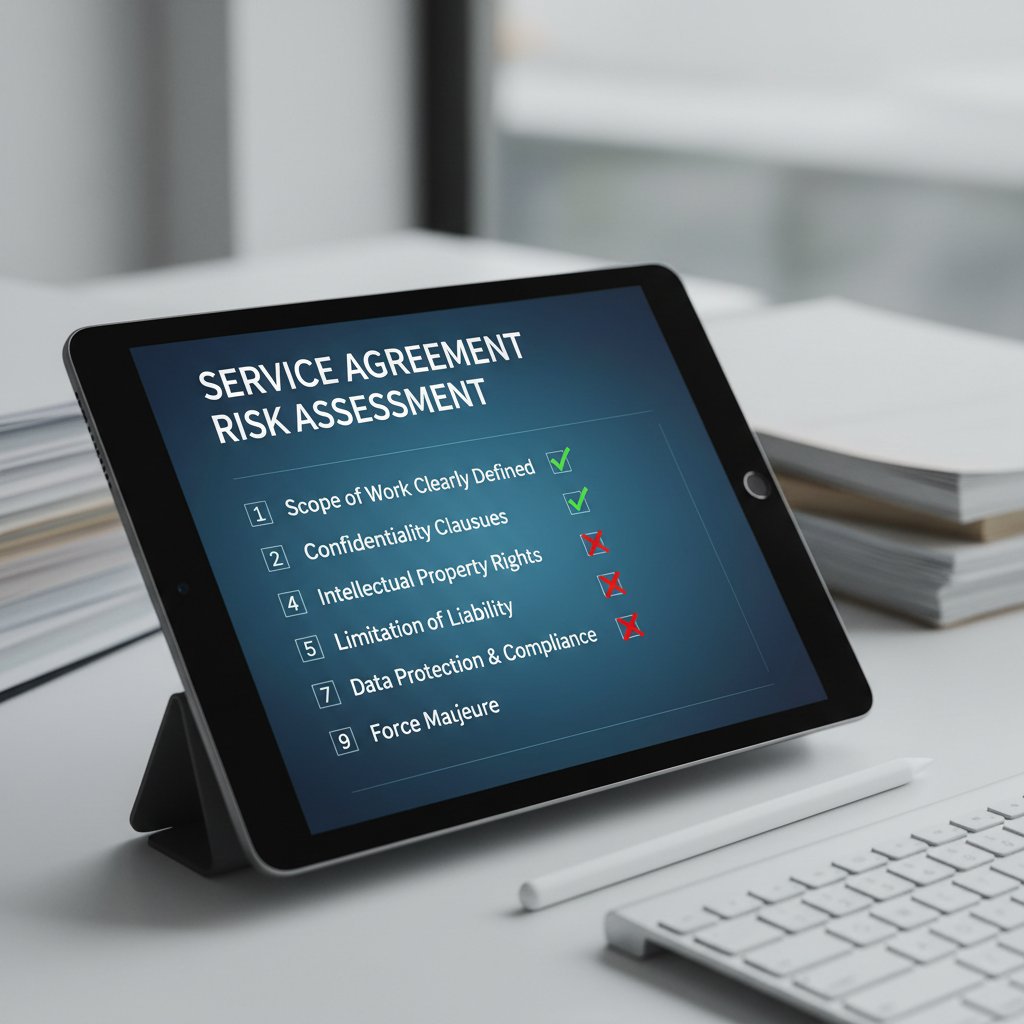
A contract risk checklist is your early warning system.
Service agreement risk factors:
- No clear definition of scope or deliverables.
- Missing performance standards or deadlines.
- Outdated compliance or data privacy language.
- No indemnity or limitation of liability.
- Vague dispute resolution process.
- No termination clause or unclear exit provisions.
- Unspecified governing law/jurisdiction.
- Unauthorized or missing signatures.
- No digital audit trail or secure storage.
- Templates not reviewed or updated in last 12 months.
If you check any of these boxes, don’t wait—update your agreements or seek professional help.
When to call in the experts
Professional guidance is essential when stakes are high, regulations shift, or agreements cross borders. Platforms like filecreator.ai/generate-official-documents are an excellent starting point, but periodic expert review keeps you truly bulletproof.
Even with automation, regular legal or compliance audits are a small investment compared to the cost of just one bad agreement.
The future: Smart contracts, compliance, and beyond
Emerging trends in agreement technology
Smart contracts—self-executing, blockchain-anchored agreements—are gaining traction in industries from finance to logistics, delivering unprecedented transparency and automation. Regulatory shifts, especially around AI and data privacy, are forcing businesses to rethink both the language and technology in every agreement.
| Sector | Smart Contract Adoption Rate (2025) | Typical Use Cases |
|---|---|---|
| Finance | 43% | Payment automation, KYC |
| Logistics | 37% | Shipment verification |
| Real Estate | 29% | Title transfers |
| IT Services | 56% | SLA management, compliance |
Table 5: Smart contract adoption rates by sector (Source: Original analysis based on DocuSign, 2025)

How to stay ahead of the curve
The only constant is change. To future-proof your service agreement process:
- Invest in continuous learning for your team and yourself.
- Adopt AI-driven platforms that update for new regulations automatically.
- Regularly audit and review all agreements for compliance and clarity.
- Document every step—securely, with digital trails.
- Prioritize clarity, transparency, and adaptability over boilerplate tradition.
Today’s winners are those who treat every contract as a living, evolving shield against both chaos and complacency.
"Tomorrow’s winners are preparing their agreements today." — Jordan, risk consultant
Conclusion
The brutal truths about service agreement generation aren’t meant to scare—they’re meant to shake you out of complacency. In 2025, to generate official service agreements is to defend your business, reputation, and future. Shoddy templates, overlooked clauses, and stagnant processes are invitations for disaster. But with the right tools, vigilance, and a commitment to clarity, you can turn your agreements from a weak spot to an unbreakable shield. Leverage platforms like filecreator.ai for instant, professional-grade documents; audit and review regularly, and never accept “good enough.” The cost of getting it wrong is rising, but the playbook for bulletproof service agreements has never been clearer. Don’t wait for the next dispute to find out where your contracts stand—act now, and make every word count.
Sources
References cited in this article
- Sirion: Service Agreements 2025(sirion.ai)
- DocuSign: 2025 Contract Management Trends(docusign.com)
- Forbes, 2025(forbes.com)
- Sprintlaw UK, 2025(sprintlaw.co.uk)
- FL Patel Law, 2025(flpatellaw.com)
- Concord: Contracting Trends 2025(concord.app)
- Vakilsearch: History of SLAs(vakilsearch.com)
- ArchTech: SLAs History(archtechus.com)
- Harrison-Stein: Bulletproof Agreements(harrison-stein.com)
- BuildOps: Anatomy of a Service Agreement(buildops.com)
- BlueNotary: Service Agreement Templates(bluenotary.us)
- Contracting Business: 2024-2025 Outlook(contractingbusiness.com)
- Qualtrics: Bad Customer Service(qualtrics.com)
- Compliance Week: Ethics Fails 2024(complianceweek.com)
- breached.company(breached.company)
- mofo.com(mofo.com)
- thesoftwarepractice.com(thesoftwarepractice.com)
- Tietoevry: Intelligent Automation 2024(tietoevry.com)
- Microsoft: AI Agreement Management(blogs.microsoft.com)
- Richmond JOLT: AI in Contract Drafting(jolt.richmond.edu)
- ContractsCounsel: Service Agreement Cost(contractscounsel.com)
- Docue: Service Provider Contract Guide(docue.com)
- BerrySmith: Future-Proofing Contracts 2025(berrysmith.com)
- ServiceTitan: Maintenance Agreements Guide 2025(servicetitan.com)
Perfect Documents, Instantly
Filecreator.ai transforms the way you produce professional documents. Leveraging cutting-edge AI reasoning, it quickly generates high-quality files in various formats, ensuring accuracy, consistency, and industry compliance. Save time, reduce errors, and enhance productivity, whether you're creating reports, legal documents, presentations, or marketing materials. Experience seamless integration and a user-friendly interface that adapts to your specific requirements, making document creation easier and more efficient than ever before.
Get startedStart Creating Professional Documents Today
Join thousands of professionals who trust AI-powered document generation
Frequently Asked Questions
Why are official service agreements so critical for businesses in 2025?
Official service agreements protect businesses by defining expectations, managing risks, enabling dispute resolution, and ensuring continuity. In 2025's volatile business climate marked by AI transformation, regulatory shifts, and digital-first operations, a poorly drafted agreement can lead to costly litigation, payment delays, and project failures that exceed the contract's original value.
What are the main risks of using generic templates for service agreements?
Generic templates leave businesses vulnerable to opportunistic lawsuits, delayed payments, and uncontrolled project scope. The article highlights that courtroom cases and bankruptcy filings show deals frequently collapse over misunderstood clauses or missed deadlines, and firms often spend more on litigation than the original contract was worth.
Can you give an example of how weak service agreements have caused real business problems?
The article cites global supply chain delays in aviation where boilerplate agreements exposed weaknesses in delivery timelines and compensation disputes, resulting in lost reputations. The article also notes that high-profile public disputes increasingly involve digital contracts under scrutiny, with cases showing that a single missing clause can cause million-dollar deals to crumble.
Continue Reading
Explore more from Professional Document Generator

Why Service Agreements Fail and How to Prevent It
Service agreements often contain hidden risks that trigger disputes. This article explains how to generate service agreements that address ambiguous language and prevent costly legal failures.

Generating Professional Agreements: Why Precision Matters in 2025
Generating professional agreements requires precision and care in 2025. This article explains why generic templates fail, what risks to avoid, and how to protect your business.

Official Automated Agreements: What Actually Holds Up in Court
Generating official automated agreements carries real legal risks. This article explains what makes an agreement enforceable, which common mistakes undermine validity, and how to ensure compliance.

Generating Official Agreements: What Actually Holds Up Legally
Generating official agreements has become easier but riskier. This article examines common pitfalls in modern contract creation and how to protect your interests.

How Automatic Service Agreement Generators Reshape Contract Management
Automatic service agreement generators use AI to streamline contract creation. This article explains how they work, their key benefits, and the pitfalls businesses encounter when deploying them.

Generating Legal Agreements Online: Risks and Reality
Generate legal agreements online comes with hidden risks. This article examines security breaches, AI errors, and whether digital contracts withstand court scrutiny.