


Generate Employment Agreements Without the Hidden Legal Traps
Written with AI assistance under our editorial guidelines
Employment agreements are far more than routine paperwork—they directly impact workplace power dynamics and legal risk. Mistakes in these contracts can cost businesses over $100,000 in litigation fees, lost productivity, and reputational damage. Common flaws include missing noncompete clauses, vague termination definitions, and intellectual property ambiguities. Understanding what to watch for when drafting or signing employment agreements is critical to avoiding costly disputes and legal exposure.
The corporate handshake has evolved—now it’s a contract, sometimes pages long, other times conjured up by an algorithm in under a minute. But don’t let the “Welcome to the team!” fool you. Generating employment agreements isn’t clerical drudgery; it’s the frontline of power in the workplace, where every clause is a chess move and every omission a potential landmine. HR’s smiling face might frame it as routine, but beneath the surface, these documents shape careers, shield companies, and—yes—leave employees exposed to risks nobody talks about. In this article, we rip open the glossy cover of employment agreements, exposing the primal logic, the pitfalls, and the cunning strategies HR rarely utters aloud. Whether you’re drafting your first contract, automating your workflow with AI tools, or signing on the dotted line, welcome to the real rulebook. It’s complicated. It’s consequential. And if you don’t know what to watch for, you’re playing blind. So let’s make sure the next agreement you generate isn’t your own undoing.
Why employment agreements matter more than you think
The hidden costs of getting it wrong
The myth that a “bad hire” only costs a few onboarding hours is as quaint as it is dangerous. Mistakes in employment agreements don’t just bruise egos—they can bleed your balance sheet. According to research from Inc.com, 2023, employment litigation costs U.S. businesses billions each year, with a single dispute often running $100,000 or more when you tally legal fees, lost productivity, and reputational fallout. And the risk isn’t abstract: even a missing noncompete clause or a fuzzy definition of “cause” can set the stage for years of legal limbo or viral LinkedIn drama.

| Litigation type | Average cost (USD) | Typical duration | Percentage due to contract flaws |
|---|---|---|---|
| Wrongful termination | $120,000 | 12 months | 55% |
| Breach of noncompete | $90,000 | 10 months | 63% |
| Intellectual property disputes | $150,000 | 18 months | 48% |
| Wage/hour compliance | $60,000 | 8 months | 41% |
Table 1: Recent statistics on average U.S. litigation costs tied to employment agreements
Source: Original analysis based on Inc.com, 2023, Godfreys Law, 2024
The fallout isn’t just financial. A single contract dispute can send waves through your company culture, tank morale, and label you as a litigation magnet in the talent market. If you’re tempted to copy-paste your next agreement, remember: the hidden cost of “good enough” is often catastrophic.
The psychological weight of signing
There’s a unique anxiety that comes with the moment you sign—whether you’re the boss or the new hire. For many, the act feels less like mutual consent and more like a trust fall without a net. Research from Paperclip Law, 2024 reveals that over 60% of employees experience significant anxiety before signing a contract, concerned about hidden clauses and job security.
"A contract isn’t just paper—it’s a power play." — Lisa, HR Director, quote
That tension is rarely accidental. Contracts don’t just codify pay and duties; they set the stage for what’s considered fair play—and who holds the cards when things go bad. When employment agreements reinforce mistrust, they poison working relationships from day one. At their best, though, they can create clarity, security, and even mutual respect—if both sides know what’s really in the deal.
How filecreator.ai is disrupting legacy approaches
The rise of AI-powered tools like filecreator.ai is rewriting the rules of contract generation. No longer the exclusive turf of high-priced law firms or HR lifers, document creation has become fast, customizable, and—if you’re careful—error-resistant. According to recent industry analysis, over 30% of mid-sized businesses now use some form of automated contract generator, and satisfaction rates have doubled in the past two years.
But not everyone’s convinced. Old-guard HR managers sometimes bristle at the idea of an algorithm drafting the fine print, worried about compliance gaps and losing that “human touch.” Yet, as the pressure mounts to do more with less, even skeptics are adopting AI tools to reduce manual mistakes, streamline updates, and ensure every agreement checks the right legal boxes. In short: automation isn’t just the future, it’s the present—if you want to avoid becoming a cautionary tale.
A brief history of employment agreements: from handshakes to AI
How we got here: the evolution nobody talks about
Employment agreements didn’t start as ten-page documents full of legalese and digital signatures. In the early industrial era, a handshake or a terse note was often enough—until the first lawsuits proved otherwise. As the stakes grew, so did the contracts. By the mid-20th century, the rise of unionization, anti-discrimination laws, and IP protection fueled ever-thicker agreements.
| Year | Key milestone | Impact on agreements |
|---|---|---|
| 1920s | Rise of written contracts | Formalized job terms |
| 1940s | Unionization and collective bargaining | Added employee protections |
| 1960s | Civil Rights Act (US) | Anti-discrimination clauses |
| 1980s | Boom in noncompete and confidentiality | Growing company protections |
| 2000s | Digital signatures and remote work | Faster, paperless agreements |
| 2020s | AI-powered contract generation | Speed, customization, automation |
Table 2: Timeline of key milestones in employment contract law
Source: Original analysis based on Godfreys Law, 2024, Paperclip Law, 2024

When handshake deals still ruled
Before digital everything, job agreements were casual, ambiguous, and—unsurprisingly—risky. As Frank, a veteran hiring manager, puts it:
“Verbal agreements were always a gamble.” — Frank, retired HR manager, quote
Stories abound of workers promised the moon, only to find the details evaporate when disputes arose. The modern contract, for all its faults, is at least a written record—if you know how to read between the lines.
The AI revolution: automation meets legal risk
Today, AI-generated employment agreements are the new normal. Services like filecreator.ai can produce highly tailored documents in minutes, drastically reducing human error and manual effort.
But speed brings new vulnerabilities. According to Go1, 2024, automated templates can miss local compliance requirements or fail to flag unusual risks, especially in multi-jurisdictional hiring. For HR, this means that while AI can handle the heavy lifting, the final review still needs human eyes—or you risk trading one set of mistakes for another.

The anatomy of a bulletproof employment agreement
Must-have clauses—and the ones that get you sued
Every employment agreement needs more than just rate of pay and start date. A bulletproof contract includes:
- Job title and duties: Precisely defined to avoid scope creep or dispute.
- Compensation and benefits: Clarity here prevents pay-related lawsuits.
- Termination conditions: “At-will” isn’t universal—define what counts as “cause.”
- Confidentiality/NDA: Protects sensitive information long after the exit interview.
- Noncompete/restrictive covenants: Essential for protecting IP, but regularly challenged in court.
- Intellectual property: Who owns the work product? Spell it out.
- Dispute resolution: Arbitration vs. litigation, location of jurisdiction.
- Performance improvement plan protocols: Increasingly used as a prelude to termination.
Hidden clauses that separate amateurs from pros:
- Post-employment restrictions that are enforceable in your state/country
- Specifics on remote work, equipment, and data handling
- “Garden leave” provisions (paid time off during notice periods)
- Explicit carve-outs for side projects or prior inventions
According to Medium, 2023, the clauses most often litigated are noncompetes, ambiguous termination language, and NDAs with overbroad scope.
Customization vs. cookie-cutter: which side are you on?
The internet is flooded with free employment agreement templates, but one-size-fits-all is a dangerous myth. The best agreements are tailored to your business, your jurisdiction, and the peculiarities of the job at hand. Compare the options:
| Feature | Template-based | Manual drafting | AI-generated (filecreator.ai) |
|---|---|---|---|
| Customization | Low | High | High (with guided input) |
| Compliance checks | Limited | Manual, depends on skill | Automated, can flag missing clauses |
| Error risk | High | Medium (depends on lawyer) | Low (if reviewed) |
| Time to draft | Fast | Slow | Fast |
| Cost | Free/Low | High | Moderate/Low |
Table 3: Comparing approaches to generating employment agreements
Source: Original analysis based on Go1, 2024, Paperclip Law, 2024
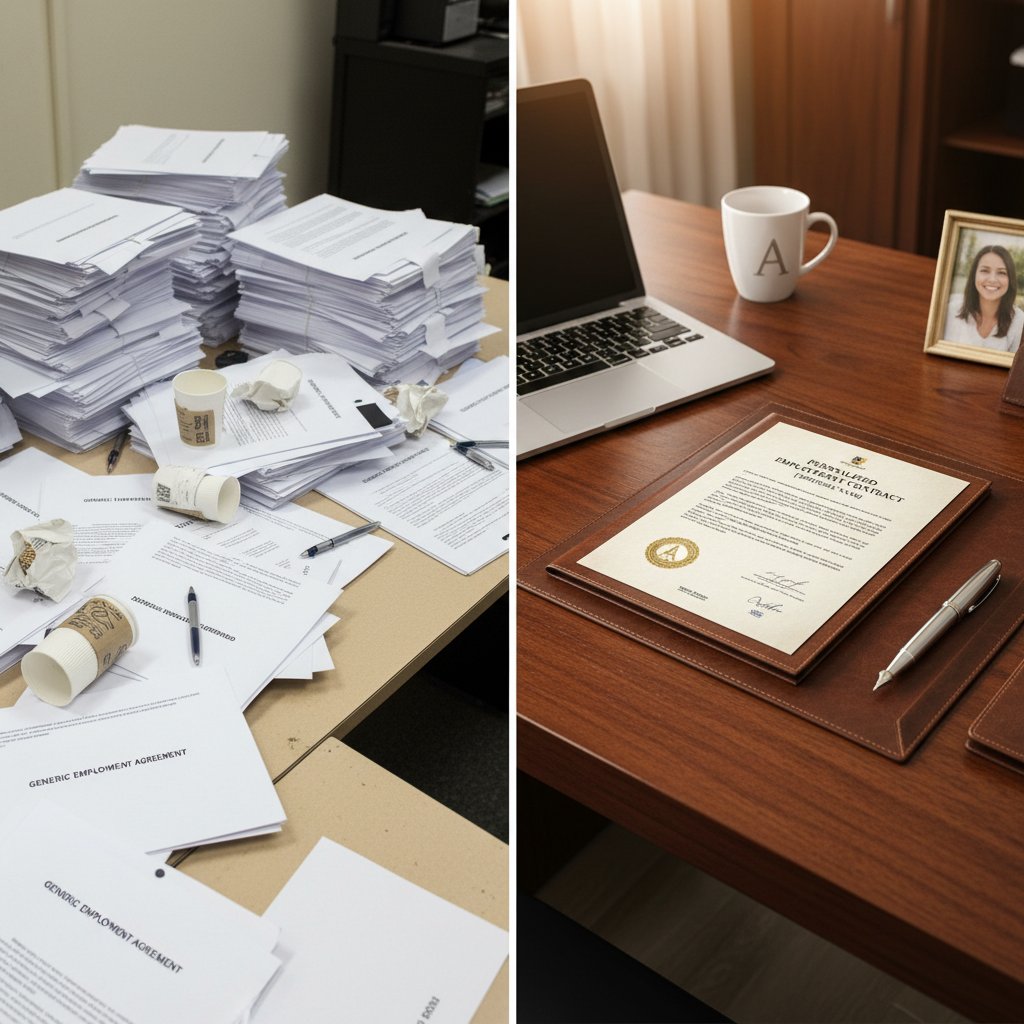
Debunking common myths about employment agreements
Too many guides peddle dangerous half-truths about contract generation. Here are the myths HR wishes you’d stop believing:
- Myth 1: “Standard” contracts cover everything. Reality: Jurisdictions, roles, and business models demand custom language.
- Myth 2: Templates from the internet are safe. Many are outdated, incomplete, or miss key regional compliance features.
- Myth 3: HR is on your side. HR’s primary loyalty is to the company, not the employee (Medium, 2023).
- Myth 4: Confidentiality is automatic. If it’s not in writing, it’s not enforceable.
Don’t let these myths lull you into a false sense of security—each is a lawsuit in waiting.
The myth of the perfect template: what most guides get wrong
Why most free templates are a lawsuit waiting to happen
Most free templates you download online look fine—until reality hits. They often lack local legal compliance, miss industry-specific clauses, or include outdated terms. One real-world example: A fast-growing tech startup used a “standard” template, only to discover after a messy exit that their IP clause didn’t cover remote work. The former employee walked out with proprietary code, and the ensuing dispute cost months of wrangling and thousands in legal fees.
- Audit steps for a template:
- Check if it’s current (updated within the last year).
- Review for jurisdiction-specific language.
- Ensure inclusion of confidentiality, IP, and noncompete clauses.
- Crosscheck benefits, leave, and termination terms against local laws.
- Get a legal review before using.
The illusion of ‘standard’ clauses
Industry “standards” are a crutch. According to Maya, a contract specialist:
“There’s no such thing as standard when every business is different.” — Maya, contract specialist, quote
Standardization sounds safe, but the devil is in the details—what’s “normal” in financial services may be disastrous in creative industries. Always adapt.
How to spot a red flag in any agreement
A solid employment agreement is a fortress, not a sandcastle. Here’s what to watch for:
- Overly broad NDAs that limit your future job prospects.
- Noncompetes so restrictive they’re likely unenforceable.
- Ambiguous terms like “reasonable notice” or “other duties as assigned.”
- No clear statement on IP ownership.
- Outdated law references or missing local compliance.
Red flags that spell trouble:
- Clauses that penalize resignation with repayment demands
- Lack of clear dispute resolution process
- Confidentiality clauses with no expiration date
- Templates with blank or incomplete sections
How to actually generate employment agreements in 2025
Step-by-step: from decision to signature
Generating employment agreements today is about blending digital speed with human judgment. The modern workflow:
- Define the role and requirements. Get crystal clear on duties, reporting lines, and expectations.
- Choose your generation tool. Use filecreator.ai for AI-powered drafts, or consult a legal team for high-complexity roles.
- Customize for compliance. Tailor the document to the job, company policies, and jurisdiction.
- Review for hidden risks. Scrutinize noncompete, NDA, and termination language.
- Collaborate and negotiate. Share with stakeholders for feedback and revisions.
- Finalize and sign. Use secure digital signature solutions.
- Document storage and access. Archive in a secure, searchable format.

Checklist: what to double-check before you hit ‘send’
Here’s a pragmatic checklist to ensure your agreement is bulletproof:
- Review all clauses for completeness and clarity.
- Confirm legal compliance with jurisdiction-specific regulations.
- Ensure all pay, benefits, and leave terms are explicit.
- Double-check IP, confidentiality, and restrictive covenant clauses.
- Verify notice periods and termination protocols.
- Include dispute resolution mechanisms.
- Get a final review from HR/legal before distribution.
When to bring in a human (and when to trust the AI)
AI-powered tools can handle the heavy lifting of document generation, but nuance, strategy, and negotiation still require human judgment. As Jordan, a legal advisor, puts it:
“AI is great—until nuance matters.” — Jordan, legal advisor, quote
Trust automation for boilerplate and compliance checks; bring in experts for bespoke roles, high-risk hires, or when the stakes are existential for your business.
Case studies: the good, the bad, and the ugly of employment agreements
Disaster stories from the HR trenches
Consider the case of a regional tech firm that skipped legal review to save a few bucks. Their templated agreement lacked a proper IP clause—and when a star developer defected to a competitor, the lawsuit that followed was ugly, public, and expensive. The entire dev team lost trust, and competitors poached top talent amid the chaos.

The lesson? The money you “save” with a bad agreement is a rounding error compared to the cost of failure.
When a smart agreement saved the day
On the flip side, a mid-sized marketing agency used a professionally generated agreement that included a detailed confidentiality clause, well-defined duties, and a robust dispute resolution process. When a project manager challenged their termination, the clear contract terms allowed for swift, fair arbitration—saving both parties time, money, and dignity.
It was the specificity in the clauses—especially around deliverables and termination “for cause”—that made litigation unnecessary. Sometimes, the smartest move is prevention.
What startups can teach legacy firms
Startups, often strapped for time and cash, have become masters of leveraging AI-powered contract tools. They use employment agreements for more than just hiring—they build partnerships, share equity, and incentivize innovation.
Unconventional uses for employment agreements in startups:
- Equity vesting schedules tied to milestones, not just time.
- IP carve-outs for side hustles.
- Flexible remote work and “work from anywhere” clauses.
- Rapid iteration and updates as the business pivots.
Agility and customization are their not-so-secret weapons.
Expert takes: what industry insiders wish you knew
What HR leaders really look for in a contract
Behind the HR curtain, the real focus isn’t just legality—it’s leverage. As Sam, an HR executive, puts it:
“It’s not just about legality—it’s about leverage.” — Sam, HR executive, quote
Negotiating power shifts depending on the clarity, enforceability, and completeness of the agreement. Savvy HR pros look for loopholes, potential ambiguity, and places where “standard” language might protect the company at the employee’s expense. If you want a fair deal, you need to know the playbook.
Effective negotiation strategies? Ask for clarification on every ambiguous term. Push for mutual confidentiality, not just one-way. Never assume HR’s role is to advocate for you; their loyalty, as research shows, is firmly with the company (Medium, 2023).
The compliance minefield: staying out of trouble in 2025
Compliance isn’t a static target—it morphs with new laws, court rulings, and industry trends. For example, as of 2024, up to 18% of U.S. workers are still bound by noncompete agreements, despite increasing regulatory scrutiny (LinkedIn, 2023).
| Industry | Top compliance risks | Common pitfalls |
|---|---|---|
| Tech | IP ownership, remote work | Outdated noncompete clauses |
| Healthcare | Data privacy, licensing | Missing confidentiality terms |
| Finance | SOX, AML, background checks | Vague termination policies |
| Creative | IP for work product | No carve-outs for side projects |
Table 4: Industry compliance requirements and pitfalls
Source: Original analysis based on Go1, 2024, Godfreys Law, 2024
Tech is playing an ever-growing role in compliance, from automated clause checking to digital signature tracking. But tools alone can’t fix ignorance—education, process, and regular reviews are critical to staying lawsuit-proof.
The future of employment agreements: more human or more machine?
The contract of tomorrow is shaped by the friction between automation and personalization. AI brings speed, accuracy, and consistency, but the human element—negotiation, empathy, and creative problem-solving—remains irreplaceable. The most successful organizations are those that blend both, leveraging tech for scale and insight, while keeping the final say (and the nuance) in human hands.

Glossary: employment agreement jargon decoded
At-will employment
A contractual relationship in which either party can terminate employment at any time, for any lawful reason (or no reason). Common in the U.S., but heavily regulated in some jurisdictions. Misunderstood as “no rights”—in reality, anti-discrimination and retaliation protections still apply.
Restrictive covenant
A clause that limits an employee’s actions during or after employment—typically noncompetes, non-solicits, or NDAs. Enforceability varies by state/country; overly broad terms are frequently struck down in court.
Noncompete agreement
Bans an employee from joining competitors for a set time/geography after leaving. Used to protect trade secrets, but controversial and often legally challenged. According to current statistics, about 18% of U.S. workers are bound by noncompetes (LinkedIn, 2023).
Boilerplate
Standardized legal language repeated in many contracts (e.g., “severability,” “entire agreement”). Often overlooked but can have significant legal impact—don’t ignore these sections.
Understanding these terms isn’t just CYA—it’s your best defense against nasty surprises, whether you’re writing, negotiating, or signing.
Conclusion: why the future of employment agreements is up for grabs
The case for rethinking your approach—today
Employment agreements are more than paperwork—they are the power structure of the modern workplace. As the research and stories above reveal, the risks are real, the stakes are huge, and the “standard” playbook is dangerously outdated. Whether you’re an employer protecting your IP or an employee safeguarding your future, it pays to scrutinize every clause, challenge every myth, and demand customization over complacency.

If you haven’t reviewed your agreements lately, now is the time—before risk becomes reality. The tools exist, the best practices are clear, and ignorance is no longer an excuse.
Your next move: take control of your agreements
Don’t let inertia or legacy processes dictate your fate. Take a hard look at your current contracts, audit them for hidden dangers, and harness AI-powered solutions like filecreator.ai to bring your document game up to speed. Whether you’re scaling a startup or fortifying a Fortune 500, smart, customized agreements aren’t optional—they’re existential. The new rules are here. Use them, or be used by them.
Sources
References cited in this article
- Medium: The Brutal Truth—HR Wants What’s Best for the Company, Not for You(medium.com)
- LinkedIn: Noncompete Agreements, Career Restrictions, and What HR Won’t Tell You(linkedin.com)
- Inc.com: 10 Things HR Doesn't Want You to Know(inc.com)
- Paperclip Law: Why Employment Agreements Matter(papercliplaw.com)
- Godfreys Law: How Important Are Employment Agreements?(godfreyslaw.co.nz)
- Go1: Why Employment Contracts Matter for Your Business(go1.com)
- WTW: Employment Practices Liability 2023–2024(wtwco.com)
- Littler: 2024’s Top Stories in Unfair Competition and Trade Secrets Law(littler.com)
- Employco: 2023 Wage and Hour Violations Case Studies(employco.com)
- Frontiers in Psychology: Psychological Contract and Employee Engagement(frontiersin.org)
- PMC: Psychological Contract Breach and Outcomes(pmc.ncbi.nlm.nih.gov)
- EngageEmployee: Psychological Contract(engageemployee.com)
- i-Agree: The History of Agreements(i-agree.io)
- Elevate Law: The Evolution of Contracting(elevate.law)
- Sdocs: How AI Is Transforming Digital Agreements(sdocs.com)
- Wikipedia: Handshake Deal(en.wikipedia.org)
- D Magazine: The Art of the Handshake Deal(dmagazine.com)
- V7 Go: Automate Employment Agreement Review(v7labs.com)
- Spellbook: AI for Employment Lawyers(spellbook.legal)
- National Law Review: AI and Employment Law(natlawreview.com)
- Jacko Law Group: Anatomy of an Employment Agreement(jackolg.com)
- Chambers: Employment 2024(practiceguides.chambers.com)
- National Law Review: 2024 Employment Law Updates(natlawreview.com)
- Isaboke Law: Why Cookie-Cutter Contracts Can Hurt Your Business(isabokelaw.com)
- Forbes: Decoding Employment Contracts(forbes.com)
- Monjur: Why Cookie-Cutter Agreements Don’t Work(monjur.com)
- Synchrony Law: Employment Contracts—Common Mistakes(synchronylaw.com)
- LegalGPS: Employment Agreements Explained(legalgps.com)
- QualitySolicitors: Common Mistakes with Employment Contracts(qualitysolicitors.com)
- American Bar Association: McLaren Macomb—Review Standard Agreements(americanbar.org)
- Legal Newsfeed: NLRB Activity Prompts Review(legalnewsfeed.com)
- Law Society of Ontario: Key Clauses 2024(hicksmorley.com)
- Callidus AI: AI Meets Employment Law(callidusai.com)
- DocuSign: 2025 Agreement Tech Predictions(docusign.com)
- Pocketlaw: Best Legal AI Tools 2025(pocketlaw.com)
- Takelegal.in: Employment Contract Guide 2024(takelegal.in)
- Hackler Flynn: 2024 Employment Law Updates Checklist(hacklerflynnlaw.com)
- LP Legal: 2024 Employment Law Checklist(lplegal.com)
- Plaintiff Magazine: Best and Worst Employment Cases of 2024(plaintiffmagazine.com)
- Employment Law Worldview: Recent Cases(employmentlawworldview.com)
Perfect Documents, Instantly
Filecreator.ai transforms the way you produce professional documents. Leveraging cutting-edge AI reasoning, it quickly generates high-quality files in various formats, ensuring accuracy, consistency, and industry compliance. Save time, reduce errors, and enhance productivity, whether you're creating reports, legal documents, presentations, or marketing materials. Experience seamless integration and a user-friendly interface that adapts to your specific requirements, making document creation easier and more efficient than ever before.
Get startedStart Creating Professional Documents Today
Join thousands of professionals who trust AI-powered document generation
Frequently Asked Questions
How much can employment litigation cost businesses?
According to the article, employment litigation costs U.S. businesses billions each year, with a single dispute often running $100,000 or more when accounting for legal fees, lost productivity, and reputational fallout. Specific litigation types range from $60,000 for wage/hour compliance issues to $150,000 for intellectual property disputes.
What are the main risks of poorly drafted employment agreements?
The article identifies several key risks, including missing noncompete clauses, fuzzy definitions of termination 'cause,' and contract flaws that can lead to years of legal disputes, wrongful termination claims, breach of noncompete litigation, and wage/hour compliance issues.
Why do employment agreements matter more than just routine HR paperwork?
Employment agreements are described as the frontline of power in the workplace where every clause is a strategic decision and every omission is a potential liability. They shape careers, shield companies, and can leave employees exposed to risks—making them far more consequential than simple administrative documents.
What percentage of employment disputes are due to contract flaws?
According to the table in the article, contract flaws account for a significant portion of litigation: 55% of wrongful termination cases, 63% of breach of noncompete cases, 48% of intellectual property disputes, and 41% of wage/hour compliance issues.
Continue Reading
Explore more from Professional Document Generator

Employment Contracts: What Actually Protects You
Generating employment contracts requires understanding hidden risks and legal pitfalls. This article explains what makes contracts effective and how to avoid common mistakes.

How to Generate Official Employment Contracts Properly
This article explains how to generate official employment contracts that protect your business. It covers compliance requirements, common pitfalls in template use, and modern best practices.

How Automatic Employment Agreement Generators Are Changing HR
An automatic employment agreement generator uses AI to create HR contracts fast. This article examines how automation is changing employment agreements and the risks involved.

Why Customized Employment Contracts Matter More in 2025
Customized employment contracts protect businesses from legal risk. This article explains why generic templates fail and how to generate contracts suited to your jurisdiction and workforce.

Employment Letters: Why They Matter More Than You Think
Employment letters are legal documents that protect both employer and employee. This article explains what makes them effective and how to avoid costly mistakes.

Employment Documentation: Why It Matters Beyond Compliance
Employment documentation protects companies from legal liability. This article explains why proper documentation matters, what regulatory risks exist, and how to build a stronger HR playbook.


