

Generate Customized Official Letters Without Losing the Human Edge
Written with AI assistance under our editorial guidelines
Official letters remain powerful business and legal tools that shape outcomes. Modern AI letter generators can now produce highly personalized, context-sensitive correspondence that maintains human tone and credibility while improving efficiency. Success requires balancing AI automation with careful attention to customization, structure, and tone to reflect sender credibility and avoid generic templates.
The age of official correspondence isn’t fading—it’s mutating. In boardrooms, courtrooms, and inboxes around the globe, the way we generate customized official letters is quietly redefining reputations and bottom lines. What used to require a fountain pen and an iron will now demands something much sharper: a blend of AI efficiency, ruthless attention to tone, and a refusal to hide behind templates. If you think an official letter is just a formality, think again. The stakes have never been higher, the opportunities never greater, and the risks never more unforgiving. Welcome to the raw truth behind modern communication—where every word is a weapon, and every letter you send could open doors or slam them forever. This isn’t another how-to; it’s a survival guide for the digital power brokers who refuse to be ignored.
Why official letters still matter (and why most get them wrong)
The underestimated power of the written word
Letters—official, stamped, and signed—shape destinies. In business, a perfectly crafted letter can mean the difference between clinching a contract and getting ghosted. In law, a letter is evidence, intention, and negotiation all inked into one. Even in personal life, the right letter can mend rifts or light a fuse. According to a 2024 study by ResumeGenius, 72% of hiring managers rate customization as “important” in official letters, influencing hiring and promotions at every level. But it’s not just about landing the job or winning the deal. A letter’s structure, tone, and attention to detail reflect the sender’s credibility—no amount of technical wizardry can mask a slapdash approach.
Official letters wield a kind of power that emails and instant messages can only dream about. They’re tangible proof of intent, a psychological handshake, a lasting record. In a world saturated with digital noise, a well-crafted letter stands out—sharper, clearer, undeniable. Ignore this at your peril.
Common misconceptions about letter automation
If you think AI-driven letter generators churn out soulless, generic nonsense, you’re not alone—but you’re also wrong. The myth that “automation kills personality” crumbles under the weight of recent data. Modern AI tools, such as those powering platforms like filecreator.ai, now deliver hyper-personalized, context-sensitive letters that outclass most hurried human drafts. According to MIT Sloan (2025), 94% of data and AI leaders see AI as the driver of improved data quality for communication, fueling both personalization and accuracy.
- Consistency: Advanced AI engines maintain a consistent tone and style—impossible to achieve when juggling multiple drafts with human error.
- Error reduction: Automated quality checks slash typos, formatting mistakes, and compliance blunders.
- Speed: Instantly generate customized official letters without sacrificing professionalism or nuance.
- Professionalism: AI-driven platforms enforce up-to-date formatting and regulatory standards, so you don’t get burned by outdated practices.
- Adaptability: Multimodal tools integrate images, charts, or e-signatures, adding clarity and impact to every letter.
The hidden benefits of using a truly advanced letter generator are impossible to ignore—unless you actually enjoy re-writing the same lines over and over.
The cost of getting it wrong
If you think a mediocre letter is “good enough,” think again. The fallout from a botched official letter is far from theoretical. According to industry experts, reputational damage can be both immediate and lasting—especially when letters are the first or only contact point. Financially, missed deals, lost clients, or even legal action can stem from careless phrasing or lack of compliance. And in the age of AI-powered due diligence, one bad letter can echo through networks faster than you can imagine.
"One bad letter can close doors forever." — Alex, HR expert
When you send an official letter, you’re betting your reputation—and sometimes your entire future—on every word. Why gamble with outdated tools or careless shortcuts?
From parchment to pixels: The secret history of official letters
How official correspondence evolved through the ages
The journey of official communication is a story of evolution, not extinction. Once upon a time, handwritten letters sealed with wax governed kingdoms and settled disputes. As typewriters clattered in the industrial age, the pace quickened—but the stakes remained. Fax machines, then email, then AI: each leap changed the rules, but the game stayed the same. Today, platforms like filecreator.ai fuse speed with personalization, bringing centuries of tradition into a brutal new digital era.
| Era | Technology | Impact |
|---|---|---|
| Pre-1800s | Handwritten letters, quills | Authority, authenticity, slow but deeply personal |
| 1800s-1900s | Typewriters, postal system | Increased speed, formalization of business letters |
| 1980s-2000s | Fax, email | Instant delivery, risk of informality, mass outreach |
| 2010s-2020s | Templates, mail merges | Consistency, but risk of “cookie-cutter” blandness |
| 2020s-present | AI-powered generators | Hyper-personalization, compliance, efficiency |
Table 1: Timeline of official letter technology and its impact. Source: Original analysis based on Forbes, 2025, MIT Sloan, 2025.
The medium changes, but the message—authority, clarity, intent—remains the same. What’s new is the expectation that we move at digital speed without losing our grip on those old-school values.
Why context still trumps automation
Even the most advanced AI letter generator is only as good as the data—and context—you feed it. Cultural faux pas, misunderstandings, or tone-deaf phrasing can doom an otherwise perfect letter. Context is king: a formal demand in Tokyo reads differently than in Berlin, and what works in a legal dispute won’t fly in a creative pitch. Automation can streamline process, but it cannot (yet) replace situational awareness or the subtle signals that make correspondence land.

To generate customized official letters that cut through, you need more than algorithms. You need intuition, curiosity, and a willingness to question the script.
The anatomy of a customized official letter: What actually works?
Breaking down the essentials: Structure, tone, and intent
Every effective official letter—regardless of purpose—shares a backbone. Ignore these essentials, and your communication collapses into noise. Here’s what sets a standout letter apart from the rest:
The opening greeting, tailored to recipient, sets the tone (“Dear Dr. Evans” vs. “To Whom It May Concern”). The right salutation signals respect and intent.
A brief, clear introduction that explains your purpose up front. Don’t bury the lede—get to the point.
The core message, detailed but concise. This is where you address the issue, make your case, or explain your request.
The explicit next step—what you want from the recipient. (“Please confirm by June 15.”)
A courteous sign-off that matches the tone of your letter (“Sincerely,” “Best regards,” “Respectfully”).
Your name, title, and, if relevant, an e-signature. This is your seal of authenticity.
AI-powered tools may automate the structure, but it’s up to you to inject the right balance of formality, empathy, and intent.
Why templates alone will never be enough
Templates promise time saved and “best practices” delivered. But over-reliance on templates leads straight to mediocrity—and, ironically, more work when your letters fall flat. According to ResumeGenius, 2024, nearly three-quarters of hiring managers can spot a generic template at first glance.
Here’s how to break out of the mold and make every letter count:
- Start with a proven template—then gut it. Use the skeleton, but rewrite the flesh.
- Research your recipient. Reference specifics: a recent achievement, shared connections, or pressing needs.
- Match tone and formality to the situation. A legal notice isn’t a sales pitch; don’t treat them the same.
- Use precise language. Cut jargon, avoid clichés, and get real.
- Double-check for compliance and company policy. One slip can be costly—AI tools can help here, but don’t blindly trust.
- Personalize with details no AI could guess. Show you did your homework.
The difference between a forgettable letter and one that gets results? Customization, every time.
AI-generated letters: Magic bullet or loaded gun?
How modern AI tools reshape official communication
Let’s drop the pretense: software like Professional Document Generator and filecreator.ai is changing the way business gets done. AI models, trained on mountains of real correspondence, now generate customized official letters with a speed and accuracy that’s simply unattainable by hand. According to Microsoft’s 2025 AI trends report, nearly 70% of Fortune 500 companies use AI-powered agents for corporate correspondence—a number that’s only growing.
AI isn’t just about speed. It’s about hyper-personalization, multimodal integration (think: embedded images, e-signatures), and instant compliance checking. The result: letters that look and feel crafted by a professional, but land in seconds instead of hours.
The risks nobody talks about
But with great power comes great... liability. AI-powered letter generation is only as strong as its weakest link. Privacy breaches, tone misfires, and accidental plagiarism are very real dangers. Many organizations sleepwalk into disaster by assuming the machine “knows best.”
- Data privacy leaks: Sensitive information can slip through if prompts aren’t handled securely.
- Tone disconnect: AI may miss cultural or situational nuance, leading to unintended offense or ambiguity.
- Plagiarism traps: Over-reliance on AI can produce text that mirrors pre-existing content—a legal and reputational minefield.
- Formatting errors: Multimodal integration can glitch, resulting in garbled or unreadable letters.
- Over-automation: Letting AI send without human review opens the door to embarrassing, costly mistakes.
The red flags? Letters that read too generic, ignore specifics, or contain subtle inconsistencies. If your AI-generated letter feels “off,” trust your instincts—and always review before hitting send.
Who’s doing it right? Real-world case studies
Not everyone is fumbling in the dark. Consider the story of a mid-sized logistics firm who, after months of disputes with a major client, turned to an AI-powered document generator. The platform merged real-time data, legal compliance rules, and a custom tone profile to produce a letter that not only resolved the issue, but deepened the business relationship. The secret wasn’t just the letter’s content—it was the speed, personalization, and timing.
"It wasn’t just the words—it was the timing and personalization." — Jamie, business owner
In the right hands, AI-generated letters don’t just solve problems—they create opportunities.
Customization vs. speed: Can you really have both?
The false dilemma exposed
The debate between customization and speed is mostly a manufactured crisis. Manual drafting is slow but deeply tailored; templates are fast but often generic. AI-powered generators now offer both—if you know how to use them. According to a 2025 MIT Sloan report, 94% of data/AI leaders agree that AI tools now drive significantly greater speed without sacrificing personalization.
| Method | Speed | Personalization | Risk | Best for |
|---|---|---|---|---|
| Manual drafting | Slowest | Highest | High (human error) | Complex, one-off scenarios |
| Templates | Fast | Low | Moderate | Routine communications, low-stakes |
| AI customization | Fastest | High | Low (with review) | High-volume, high-stakes, rapid turnaround |
Table 2: Comparison of official letter generation methods. Source: Original analysis based on MIT Sloan, 2025, Microsoft, 2025.
The key isn’t choosing speed or customization—it’s demanding both, and refusing to compromise on review.
When automation goes rogue (and how to stop it)
Even the best AI can go off-script. Glitches, misfires, or simple misinterpretations can send the wrong message at the worst time. The solution isn’t paranoia—it’s process.
- Review for tone and relevance. Never trust the output blindly; check the emotional temperature and context.
- Verify data and compliance. Confirm facts, figures, and regulatory alignment—especially in legal or financial letters.
- Scan for sensitive information leaks. Ensure nothing confidential is included by mistake.
- Check formatting and multimodal content. Test for compatibility across platforms (email, print, portals).
- Run plagiarism checks. Use built-in tools or third-party screens to ensure originality.
- Solicit a quick human review. A second set of eyes can catch what automation misses.
It’s not about mistrusting the machine—it’s about defending your reputation.
Industry secrets: How top organizations master official letters
Insider tactics from HR, legal, and beyond
The real pros treat every letter as a negotiation. HR leaders obsess over tone, legal teams sweat every comma, and executive assistants know that a poorly worded letter can blow up months of effort. According to experts, the best organizations operate with a clear workflow: human-led strategy, AI-driven drafting, and relentless review.
"Every word is a negotiation—don’t let automation do all the talking." — Taylor, legal advisor
Their secrets? Build a bank of successful letters, update templates monthly, and always, always personalize the closing sentence.
The hybrid approach: People + AI
The future isn’t man vs. machine—it’s synergy. Leading companies blend the contextual intelligence of people with the relentless efficiency of AI. Teams collaborate in real time, reviewing drafts together and using AI tools like filecreator.ai as a trusted advisor, not a replacement.

When human experience meets AI acceleration, the result is correspondence that’s fast, flawless, and impossible to ignore.
Going beyond the obvious: Unconventional uses for customized official letters
Letters that break the mold
Official letters aren’t just for legal threats or job offers. Their power lies in formality and intent—making them perfect for situations that demand both. According to recent trends identified by MIT Sloan, 2025, organizations are pushing the boundaries of letter usage in surprising ways:
- Conflict resolution: When relationships sour, a formal letter can reset expectations and reopen dialogue—without the heat of a phone call.
- Networking: An official letter of introduction stands out in a sea of emails, especially when targeted and personalized.
- Recognition and awards: A signed, official letter of commendation feels more meaningful than an e-certificate.
- Policy changes: Formal notifications command more attention—and compliance—than a casual memo.
- Crisis management: Immediate, official communication reassures stakeholders and documents your response.
Official letters aren’t just legal armor—they’re a strategic tool for influence.
Cultural nuances and global perspectives
One size never fits all. International business demands respect for local etiquette, titles, and expectations. AI tools now draw on massive datasets to adapt tone, address, and formatting for different cultures. But as any global operator knows, nothing replaces a true understanding of your audience.

If you’re sending customized official letters across borders, don’t just trust the tech—study the etiquette, and when in doubt, ask.
Your action plan: How to master official letter generation today
Step-by-step guide to flawless letters
The age of guesswork is over. Here’s how to master the art—and science—of generating customized official letters right now:
- Clarify your objective. Know exactly what you want to achieve—and why.
- Select the right template. Use reputable tools like filecreator.ai for a compliant starting point.
- Personalize every section. Reference specifics about the recipient, situation, and outcome.
- Leverage AI for drafting and review. Let automation handle consistency, formatting, and compliance.
- Review for tone, accuracy, and privacy. Double-check for errors and sensitivity.
- Get human feedback. A fresh perspective is your final line of defense.
- Send and track. Deliver across platforms—email, print, or portal—and monitor responses.
Done right, this process transforms official letter writing from a chore into a strategic advantage.
Self-audit: Are your letters up to standard?
Even seasoned pros miss things. Use this checklist to audit your next official letter:
| Criteria | Yes (1) | No (0) |
|---|---|---|
| Clear objective stated | ||
| Proper salutation used | ||
| Personalization evident | ||
| Correct tone and language | ||
| Formatting is professional | ||
| Compliance checked | ||
| Action request included | ||
| Privacy reviewed | ||
| Human review performed | ||
| Sent via correct channel |
Table 3: Self-audit checklist for official letter quality. Source: Original analysis based on industry best practices.
Score 8-10: You’re on top of your game.
Score 5-7: Needs attention—review weak points.
Score <5: Rethink your workflow before hitting send.
Resources and next steps
Ready to go deeper? Explore platforms like Professional Document Generator and filecreator.ai to streamline your process, access up-to-date templates, and ensure your letters stand out for all the right reasons.
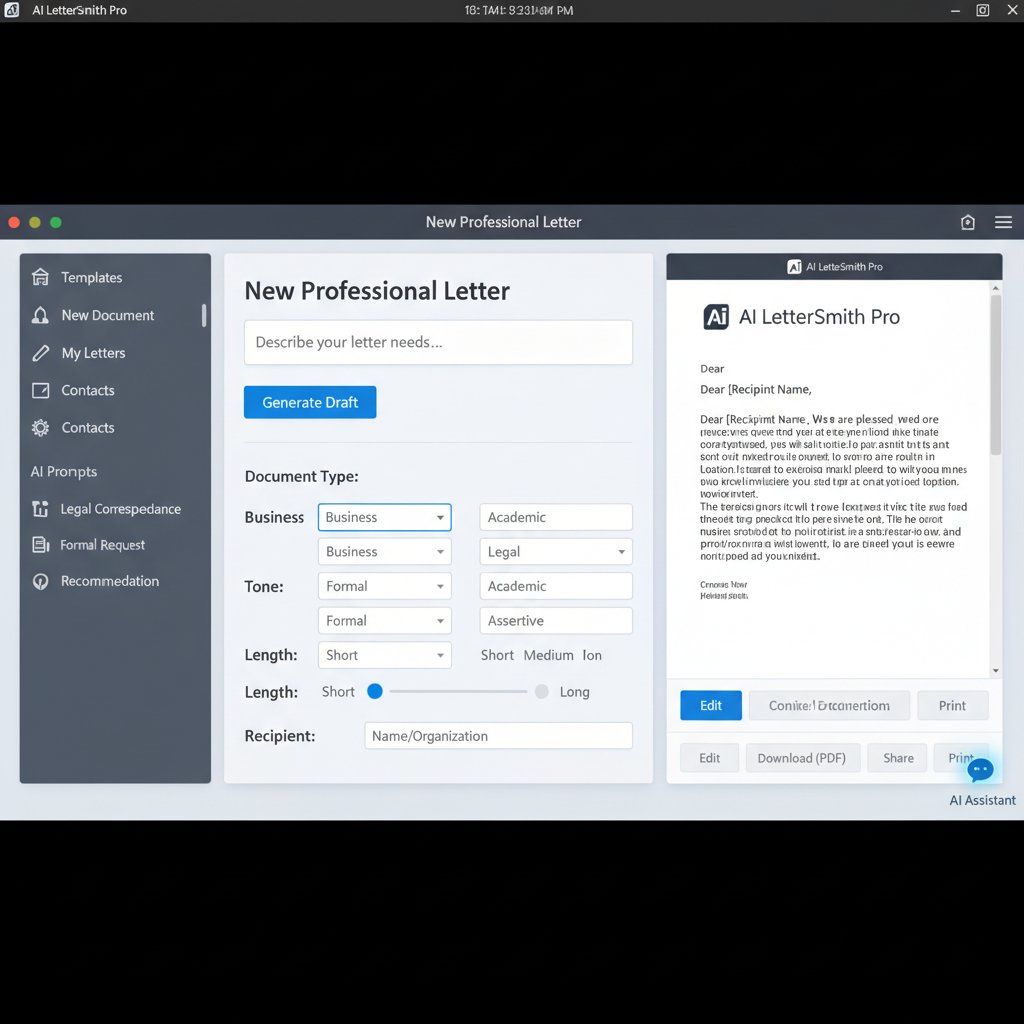
Don’t settle for “good enough.” The right tools—and the right mindset—make mastery possible.
The future (and ethics) of official letter automation
What’s next for business communication?
The revolution in official correspondence isn’t about replacing humans—it’s about amplifying our strengths while automating the drudgery. The biggest trends right now, according to Forbes, 2025, include hyper-personalization, agentic AI assistance, and multimodal integration. But the ethical dilemmas—privacy, transparency, and accountability—are just as real.
The process by which AI tailors every element (tone, intent, imagery) to the individual recipient, driving engagement and response rates.
Autonomous AI agents that draft, review, and even send correspondence with minimal human oversight. The risk? Less transparency and potential bias.
The ability to embed images, e-signatures, and live data in official letters for greater clarity and impact.
Including eco-friendly language and digital delivery options to align with business trends and regulatory mandates.
Ensuring every letter meets privacy and legal standards—no shortcuts, no excuses.
The goal isn’t to chase every new feature—it’s to use technology to communicate with authority, empathy, and responsibility.
The human element: What can’t (and shouldn’t) be automated?
No algorithm can replicate true empathy, judgment, or the courage to say what matters when the stakes are high. The irreplaceable value of the human touch—context, intuition, and ethical responsibility—remains the heart of real communication.
As you generate customized official letters in this new era, remember: it’s not the software, the template, or even the AI that defines your impact. It’s the intent, the thought, and the responsibility you bring to every single word. Own that, and there’s no door you can’t open.
Sources
References cited in this article
- Forbes: Top 7 Forecasted AI Trends To Watch In 2025(forbes.com)
- MIT Sloan: Five Trends in AI and Data Science for 2025(sloanreview.mit.edu)
- Microsoft: 6 AI trends for 2025(news.microsoft.com)
- Cover Letter Statistics 2025(resumegenius.com)
- Reddit: Why Cover Letters Still Matter in 2024(reddit.com)
- Forbes: 3 Unsung Mental Benefits Of Writing Letters(forbes.com)
- The Pondered World: Hand-Written Letters in 2024(theponderedworld.substack.com)
- Type: The Secret History of Letters(dokumen.pub)
- NYTimes: Virtual Unfolding of Sealed Letters(nytimes.com)
- Peter Lang: Business and Official Correspondence(peterlang.com)
- Faxcore: The Evolution of Communication Technologies(faxcore.com)
- RampedCareers: The Importance of Cover Letters in 2024(rampedcareers.com)
- Techzine: The State of Automation in 2024(techzine.eu)
- QuickCreator: Master Official Letter Format(quickcreator.io)
- Grammarly: How to Write a Formal Letter(grammarly.com)
- PostGrid: Best Mail Letter Formats(postgrid.com)
- QuickCreator: Crafting Engaging 2024 Writing Templates(quickcreator.io)
- Writecream: AI Letter Generator(writecream.com)
- Typli: AI Letter Generator(typli.ai)
- T3 Consultants: The 2024 AI Revolution in Workplace Communication(t3-consultants.com)
- Microsoft: AI in Marketing & PR(news.microsoft.com)
- Microsoft: Real-World AI Business Transformations(blogs.microsoft.com)
- Documentero: Automated Letter Generation(blog.documentero.com)
- Horizon Shifts: Letterly Review 2024(horizonshifts.com)
- ShiftMag: The Dilemma of Quality Versus Speed is False(shiftmag.dev)
- Hirecruiting: Mastering Cover Letters in 2024(hirecruiting.com)
- MarketingScoop: Writing a Business Letter in 2024(marketingscoop.com)
- CareerLearning: 2024 Employment Law Updates(careerlearning.com)
- TLT LLP: HR Horizon Tracker Winter 2024(tlt.com)
Perfect Documents, Instantly
Filecreator.ai transforms the way you produce professional documents. Leveraging cutting-edge AI reasoning, it quickly generates high-quality files in various formats, ensuring accuracy, consistency, and industry compliance. Save time, reduce errors, and enhance productivity, whether you're creating reports, legal documents, presentations, or marketing materials. Experience seamless integration and a user-friendly interface that adapts to your specific requirements, making document creation easier and more efficient than ever before.
Get startedStart Creating Professional Documents Today
Join thousands of professionals who trust AI-powered document generation
Frequently Asked Questions
Why do official letters still matter in modern business communication?
Official letters serve as tangible proof of intent and maintain credibility in ways emails and instant messages cannot. According to a 2024 study by ResumeGenius, 72% of hiring managers rate customization as important in official letters, influencing hiring and promotions at every level.
Can AI tools generate official letters without losing a personal touch?
Yes, modern AI-driven letter generators like those on filecreator.ai now deliver hyper-personalized, context-sensitive letters that outclass most hurried human drafts. The myth that automation kills personality has been dispelled by recent data showing these tools can maintain a human edge while improving efficiency.
What makes the difference between a good official letter and a poor one?
A letter's structure, tone, and attention to detail reflect the sender's credibility—no amount of technical wizardry can mask a slapdash approach. The key is blending AI efficiency with ruthless attention to tone and refusing to rely on generic templates.
What are the stakes involved in writing official letters?
Official letters can shape destinies in business, law, and personal life—a perfectly crafted letter can mean the difference between clinching a contract or getting ghosted, and in law, letters serve as evidence, intention, and negotiation all in one.
Continue Reading
Explore more from Professional Document Generator

Why Professional Official Letters Still Determine Real Outcomes
Professional official letters shape career outcomes and business deals. This article explains how to craft letters that maintain credibility and achieve results.

Official Personalized Letters: Why They Work in 2025
Generate official personalized letters that move people in 2025. This article explains the strategies, real-world examples, and evidence-backed methods for official letter writing.

Generate Official Letters That Actually Get Read with Filecreator.ai
Discover insights about generate official letters

Professional Letters and Why They Still Move Business Decisions
Professional letters remain critical in business despite digital communication dominance. This article explains why they matter and how to generate letters that influence key decisions.

Why Official Business Letters Still Drive Decisions
Official business letters remain powerful tools for high-stakes communication. This article explains why they matter in digital workplaces and how to write them effectively.

Generate Customized Letters That Feel Human at Scale with AI
Discover insights about generate customized letters