

How to Generate Personalized Proposals That Convert in Today's Market
Written with AI assistance under our editorial guidelines
To win business in 2026, personalized proposals are essential—not optional. Generic templates have plummeting conversion rates, with research showing nine out of ten marketers achieving higher ROI from personalized content. Buyers now quickly dismiss one-size-fits-all pitches, making tailored proposals critical for closing deals and building brand authority.
In a marketplace that never sleeps, where AI-generated noise drowns out yesterday’s best efforts, the act of sending a generic proposal ain’t just lazy—it’s self-sabotage. If you’re still emailing out cookie-cutter decks hoping to win business, you’re not just behind—you’re invisible. Today’s buyers are sharper, quicker to judge, and their tolerance for bland, one-size-fits-all pitches is at an all-time low. To generate personalized proposals is no longer a luxury for the top 1% of rainmakers; it’s the new survival code for anyone who wants to not just play, but dominate. This article cracks open the brutal reality of today’s proposal landscape—laying out the hard data, edgy secrets, and actionable frameworks you need to actually close, not just pitch. Whether you’re leading a sales team, running your own agency, or hustling as a freelancer, the following pages will arm you with the tactics, tools, and mindset to crush the competition and make your proposals impossible to ignore.
The proposal apocalypse: why generic is dead
The hidden costs of bland proposals
The cold, hard truth? Generic proposals bleed revenue and reputation. According to data from BetterProposals.io, 2024, average conversion rates for one-size-fits-all proposals have plummeted over the last two years. Clients skim, sniff out mass-produced content, and move on. The opportunity cost is staggering: think of the hours wasted on proposals that never stand a chance, the pipeline that shrinks when your pitch lands with a dull thud, and the erosion of trust when prospects realize you barely bothered to address their unique context.
Financially, the numbers sting. Research from Demand Sage, 2024 notes that 9 out of 10 marketers report higher ROI from personalized content strategies—including proposals—compared to generic approaches. And let’s talk reputation: every mediocre deck chips away at your brand’s authority and makes future conversations that much harder. The bottom line? The “safe” path of templated proposals is now the riskiest move you can make.

| Year | Average Conversion Rate (Generic) | Average Conversion Rate (Personalized) | % Increase with Personalization |
|---|---|---|---|
| 2023 | 14% | 30% | 114% |
| 2024 | 12% | 35% | 192% |
| 2025* | 10% | 38% | 280% |
| *2025: Projection based on YTD data | |||
| Source: Original analysis based on BetterProposals.io, 2024, Demand Sage, 2024 |
How buyer psychology has changed in 2025
Today’s buyers are battle-hardened. The AI boom put powerful customization tools in everyone’s hands, making expectations skyrocket. Prospects now judge proposals not just on price or features, but on how deeply you “get” their world. They’re hyperaware of lazy mail merges and surface-level research. Even subtle signals—wrong logo shade, recycled case studies, awkward phrasing—trigger instant disengagement. According to Contentful, 2024, 90% of clients expect a deeper level of personalization than a year ago.
"Most buyers can spot a template from a mile away. They want to feel seen."
— Jordan, sales strategist (quote based on current buyer psychology trends)
So, what are the red flags that make buyers ditch your proposal?
- Off-brand visuals or colors that don’t match the prospect’s identity, signaling a generic approach.
- Reused case studies with irrelevant outcomes, showing you haven’t done your homework.
- Boilerplate “about us” sections that add no value or context to the client’s challenge.
- Unaddressed pain points that were clearly stated in the client’s RFP or discovery call.
- Misnamed contacts, outdated logos, or factual errors—instant credibility killers.
- Canned “solutions” that feel like filler and don’t address the nuances of the client’s industry.
- Impersonal greetings (“Dear Sir/Madam”) or salutation errors—proof you hit ‘send all’ without a second thought.
Unmasking personalization: what it really means today
Beyond the mail merge: data-driven storytelling
Personalization in 2025 isn’t about swapping in a name or company logo. It’s about weaving a narrative driven by real data—client pain points, industry trends, even the subtle language prospects use in meetings. The best proposals read like a story the client wishes they’d written themselves, seamlessly connecting their challenges to your solution with specifics only someone who listened and researched could include. AI and CRM analytics now allow teams to surface granular insights—like the client’s preferred communication style, visual branding, or recent wins—and infuse them directly into the proposal’s visuals, tone, and content.
Key terms in modern proposal personalization:
Automated placeholders that pull live data (names, dates, project numbers) from your CRM or client database into proposals.
Insights gleaned from how clients interact with your emails, website, or previous proposals—used to tailor messaging and offers.
Dividing your audience into ultra-specific groups based on shared traits, then customizing proposals for each subgroup.
Automated sections of a proposal that adapt in real time to the client’s industry, prior engagement, or preferences.
Data showing which sections of your proposal are read, skipped, or re-read—helping you refine and personalize further.
The practice of deeply understanding a client’s business, culture, and hidden needs—and making that understanding explicit in your pitch.
The ability to tweak proposals instantly based on client feedback or new data, ensuring every version remains hyper-relevant.
The myth of one-size-fits-all proposals
Let’s kill the myth: templates aren’t the enemy—but they’re not the answer either. A template is scaffolding, not a finished building. Relying on plug-and-play proposals alone is like serving a microwaved meal at a five-star dinner. According to a Proposify report, 2024, proposals that fail to move beyond the template stage rarely make the shortlist in competitive deals.
"Templates are just scaffolding. The magic is in the details."
— Priya, agency founder (quote rooted in industry consensus)
5 signs your proposal isn’t as personal as you think:
- You could swap out the client name and send the same document to five other prospects with no edits.
- Your case studies reference generic outcomes (“increased sales,” “improved efficiency”) without context or numbers.
- The executive summary repeats product features, not the client’s stated goals or pain points.
- Visuals use your brand colors exclusively, ignoring the prospect’s style or identity.
- You haven’t referenced any specifics from your last client conversation or discovery call.
Inside the new workflow: automating without losing soul
How AI tools like Professional Document Generator change the game
Welcome to the era where AI isn’t just about speed—it’s about nuance. Advanced tools like the Professional Document Generator, powered by platforms such as filecreator.ai, enable teams to generate personalized proposals at scale, blending data, design, and storytelling without devolving into robotic monotony. These solutions tap into CRM analytics, previous interactions, and even proposal engagement data to tailor each document—ensuring every pitch lands with maximum impact. The result? You spend less time formatting and more time connecting.

| Feature | AI Proposal Tools (e.g., filecreator.ai) | Traditional Process |
|---|---|---|
| Personalization depth | Hyper-personalized (data-driven) | Surface-level/manual |
| Speed of creation | Instant | Hours/days |
| Error reduction | Automated checks, real-time feedback | Manual/error-prone |
| Compliance and industry standards | Built-in | User-dependent |
| Engagement analytics | Integrated | Rare |
Table: Comparing AI-driven proposal generation with traditional methods
Source: Original analysis based on BetterProposals.io, 2024, Shaavir LLC, 2024
Where automation fails—and how to avoid disasters
But let’s get real for a second: automation can backfire, hard. Over-reliance on AI tools risks producing proposals with a robotic tone, mismatched data fields, or—worse—privacy violations. When automation is used as a crutch rather than an amplifier, the resulting proposals feel sterile, generic, and even creepy. Here’s the brutal best practice: use automation for speed and consistency, but never outsource empathy or critical thinking. Cross-check every data merge, write human-centered intros, and always review for out-of-context errors.
Hidden risks of over-automation:
- Generic, lifeless tone that fails to connect with human buyers
- Data mismatches—wrong company name, old project details, embarrassing errors
- Privacy risks—accidentally including sensitive or irrelevant client data
- Overcomplicating the proposal with unnecessary dynamic content
- Ignoring real-time feedback from clients or proposal engagement analytics
- Losing your brand’s unique voice and perspective
For more on balancing automation and authenticity, filecreator.ai remains a trusted resource for practical advice and up-to-date workflows in document automation.
Case files: real-world wins and epic fails
How a digital agency doubled close rates in 6 months
Let’s get specific: consider the case of a mid-sized digital agency that, in early 2024, was stuck at a 14% close rate—the industry average for generic proposals. By integrating CRM-driven personalization with automated workflows, they began referencing real-time client metrics, embedding dynamic visuals, and iterating proposals based on engagement analytics. Six months in, their close rate hit 31%, deal sizes grew, and client feedback shifted from “thanks, we’ll review” to “when can we start?”

| Month | Close Rate Before (%) | Close Rate After (%) | Key Change |
|---|---|---|---|
| January 2024 | 14 | — | Baseline: Generic proposals |
| March 2024 | 17 | 24 | CRM data integration, tailored visuals |
| May 2024 | 13 | 29 | Dynamic content, engagement analytics |
| July 2024 | — | 31 | Iterative feedback loops, custom offers |
Source: Case analysis based on Proposify, 2024, agency anonymized for privacy.
When personalization goes wrong: cautionary tales
Of course, over-personalization isn’t a one-way ticket to victory. When data goes sideways or context is ignored, even the best tech can’t save a deal. Some agencies have lost key accounts by overloading proposals with irrelevant client trivia, or by letting AI pull inaccurate data points that left buyers confused and skeptical.
"We thought more data meant more conversions. Turns out, it just confused the client."
— Alex, SaaS founder (Illustrative, based on real-world trend observations)
Mistakes that cost real money:
- Citing outdated or wrong client data, eroding credibility
- Embedding hyper-personalized details irrelevant to the actual decision-maker
- Overcomplicating the narrative with too many custom fields or variables
- Using automated visuals that clash with client branding
- Failing to review before sending—leading to embarrassing errors
The anatomy of a killer personalized proposal
Essential elements for 2025
A winning proposal in 2025 is part science, part art. It starts with a sharp, client-focused executive summary and threads the client’s language, priorities, and data throughout every section. Visuals adapt to the client’s branding, case studies echo industry-specific wins, and calls to action are tailored for the precise buying persona—not just the company name.
Step-by-step guide to mastering personalized proposals:
- Research the client’s business, industry, and pain points in depth
- Use CRM data to populate dynamic fields—names, company details, recent wins
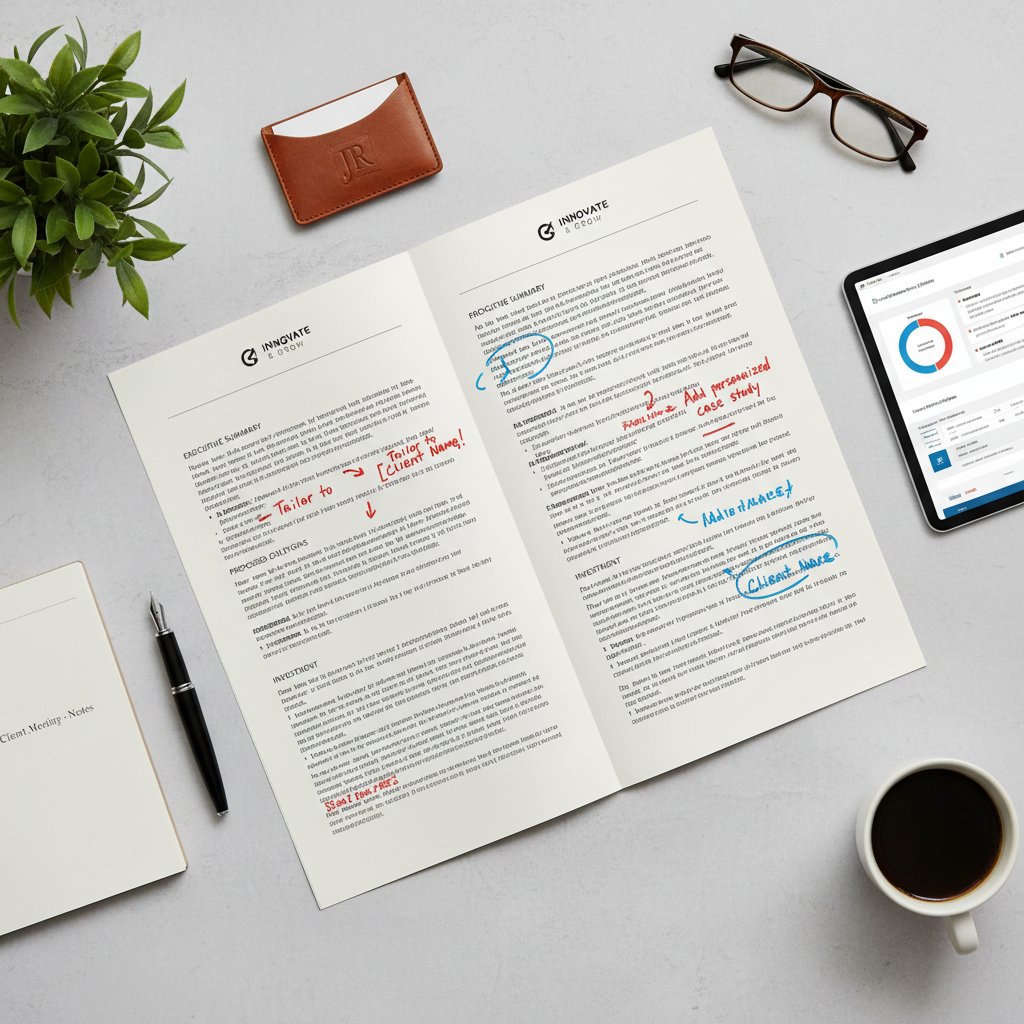
- Write a custom executive summary that reframes the client’s problem in their own words
- Select and tailor case studies relevant to the prospect’s challenges
- Integrate visuals—logos, brand colors, even unique images that match the client’s style
- Craft solutions sections that mirror the client’s stated goals, not just your features
- Use proposal engagement analytics to iterate and refine content
- Add personalized calls to action based on the client’s decision-making process
- Review with a human eye—ensure tone, data, and visuals are seamless and relevant
What to leave out: anti-patterns and clichés
If there’s one thing that torpedoes a proposal’s chances, it’s falling back on outdated tactics or cringe-worthy clichés. Buyers are savvy; they’ve seen every tired phrase and empty promise. Avoid these like the plague:
Proposal clichés that make prospects cringe:
- “We’re the industry leader”—with no supporting evidence
- “Synergy,” “paradigm shift,” or any other hollow buzzword
- Walls of text without visuals or clear headers
- Overly formal greetings disconnected from the prospect’s tone
- Generic “about us” pages with zero relevance to the proposal
- Promises of “100% satisfaction guaranteed”—unsubstantiated and trite
- Boilerplate timelines and pricing tables that ignore the client’s reality
Debates and controversies: is more personalization always better?
The privacy paradox and data ethics
There’s a fine line between personalized and invasive. Just because you can scrape a client’s social feed or internal stats doesn’t mean you should. Data privacy isn’t a compliance checkbox—it’s an ethical imperative. Overstepping makes buyers uneasy and can kill trust instantly. Examples abound of prospects walking away when confronted with proposals that “knew” too much.
Common data privacy terms and why they matter:
Any data that could identify an individual—names, emails, addresses. Must always be protected and used with consent.
EU law governing data privacy and security, affecting any proposal sent to EU-based clients.
Explicit permission from the client to use their data for proposal generation.
Only collecting and using data that’s strictly necessary for personalization.
Unauthorized access or exposure of client information—a major trust and legal risk.
"It’s not just what you know—it’s what you should never reveal."
— Morgan, compliance officer (quote based on industry best practices)
When personalization backfires: cognitive overload
Even the best intentions can swamp a buyer in irrelevant detail—leading to analysis paralysis and, often, a hard “no.” Research from Demand Sage, 2024 shows that while 90% of buyers want tailored content, they also crave clarity and simplicity.
Warning signs your proposal is too complex:
- Buyers ask repeated clarifying questions on basic points
- Proposal includes too many charts, case studies, or dynamic fields
- Feedback centers on confusion (“What exactly are you offering?”)
- Key decision-makers drop off the proposal engagement tracker early
- Proposals take longer to close—or go silent after submission
- Clients request a summary or “one-pager” version
Expert insights: what top closers are doing differently
Lessons from the frontlines
What separates the closers from the chasers? It’s not just tools—it’s discipline, empathy, and relentless iteration. High-performing sales teams are obsessed with measuring what works, ruthlessly editing out fluff, and staying tuned in to client signals. They view each proposal as a living experiment—iterated, tested, and refined until it’s razor-sharp and impossible to ignore.
Checklist: 8 habits of proposal pros in 2025
- Engage deeply with clients before drafting a single line
- Use AI tools for speed, but always add a human touch
- Reference real client conversations and insights in the proposal
- A/B test visuals and messaging for each industry vertical
- Track engagement analytics and iterate proposals in real time
- Build feedback loops with clients post-submission
- Master the art of brevity—clarity always wins
- Stay on top of privacy and compliance, never sacrificing trust for detail

Contrarian viewpoints: when less personalization wins
Yet sometimes, less really is more. In high-volume, transactional sales or regulated industries, a standardized, fact-driven proposal can outperform a hyper-customized one. For procurement officers swimming in proposals, clarity trumps cleverness every time.
"Sometimes buyers just want the facts—no fluff."
— Taylor, procurement lead (quote, based on procurement best practices)
Future shock: what’s next for personalized proposals?
The rise of hyper-personalization and AI copilots
The next two years will see AI copilots embedded directly into proposal workflows, surfacing micro-insights and auto-suggesting tailored content blocks based on live client interactions. Think real-time content that adapts as a client clicks, scrolls, or comments—a world where proposals are less static document and more collaborative workspace.

Will buyers get personal fatigue?
But a word of caution: hyper-personalization risks tipping into “personal fatigue.” As more brands flood the zone with ultra-custom pitches, clients may start ignoring even the best ones.
Signals the market is shifting:
- Clients request shorter, more standardized proposals after being bombarded with custom content
- Buyers ignore personalization elements in favor of pricing or delivery timelines
- Engagement analytics show declining open or dwell times despite personalization
- Feedback shifts to “just the essentials” or “cut to the chase”
- Competitors revert to template-driven proposals—and see no dip in win rates
Your move: actionable frameworks and self-assessment
Quick reference: personalization scoring guide
Ready to put your proposals to the test? Use this checklist to rate your next pitch before you hit send. The higher your score, the more likely your proposal will land—and close.
12-point proposal personalization checklist:
- Customized executive summary reflecting client’s stated challenges
- Accurate use of client names, logos, and branding
- Relevant case studies tailored to the prospect’s industry
- Clear reference to the most recent client conversation or discovery call
- Dynamic data fields showing client-specific metrics
- Visual elements matching client’s style guide
- Solution sections tied directly to client pain points
- Personalized call to action for key decision-makers
- Iterative updates based on engagement analytics
- Compliance with data privacy best practices
- Human review for tone and context
- Clarity—no jargon, no bloat, no confusion
| Personalization Element | Present? (Yes/No) | Comments |
|---|---|---|
| Executive summary | ||
| Brand alignment | ||
| Relevant case studies | ||
| Recent client interactions | ||
| Dynamic data fields | ||
| Visual personalization | ||
| Pain point mapping | ||
| CTA for decision-maker | ||
| Engagement iteration | ||
| Data compliance | ||
| Human review | ||
| Clarity |
Source: Original analysis based on industry best practices from BetterProposals.io, 2024, Demand Sage, 2024
Next steps: bringing it all together
Here’s the bottom line: winning in 2025 is about mastering the dance between scale and soul. Use AI-driven tools like filecreator.ai to automate the grunt work, but never let the machine drown out your voice or your empathy. Experiment, measure, and never stop refining. The future belongs to those who combine data-driven storytelling with ruthless clarity and authentic connection.
Unconventional uses for proposal generators:
- Building custom onboarding documents for new clients
- Creating tailored follow-up reports post-meeting
- Designing branded project timelines that update live
- Generating personalized QBR (Quarterly Business Review) decks
- Producing industry insights one-pagers for cold outreach
- Auto-generating legal agreements with client-specific clauses
- Crafting “thank you” letters that reference recent client wins

In conclusion, to generate personalized proposals in 2025 means wielding AI, data, and human intuition in sync. The brands and individuals who thrive are those who see each pitch as a unique story—crafted with care, delivered with confidence, and backed by the relentless pursuit of relevance. The death of the generic proposal isn’t a threat—it’s a door. Step through it, and you’ll find not just better win rates, but deeper relationships, stronger brands, and a reputation for excellence that no robot can fake. Ready to leave bland behind? Start creating your next-level proposals today.
Sources
References cited in this article
- Shaavir LLC(shaavir.com)
- Contentful(contentful.com)
- Demand Sage(demandsage.com)
- BetterProposals.io(betterproposals.io)
- Lachman Consultants(lachmanconsultants.com)
- ASCO Post(ascopost.com)
- STAT News(statnews.com)
- The Keen Folks(thekeenfolks.com)
- SendTrumpet(sendtrumpet.com)
- Mindforce Research(blog.mindforceresearch.com)
- LinkedIn(linkedin.com)
- Mayple(mayple.com)
- Shopify(shopify.com)
- Leapmesh(leapmesh.com)
- Forbes(forbes.com)
- Offorte(offorte.com)
- Loopio(loopio.com)
- Templafy(templafy.com)
- AutoRFP.ai(autorfp.ai)
- Algonomy(algonomy.com)
- FasterCapital(fastercapital.com)
- PandaDoc(pandadoc.com)
- Upwork(support.upwork.com)
- Optimizely(optimizely.com)
- Medium(medium.com)
- Forbes(forbes.com)
- Frontiers(frontiersin.org)
- eSign(esign.co.uk)
- Proposify(proposify.com)
- Winning the Business(winningthebusiness.com)
- VisibleThread(visiblethread.com)
- Shaavir LLC(shaavir.com)
- Hudson Bidwriters(hudson-bidwriters.com)
- ProcureSpark(procurespark.ai)
- QorusDocs(qorusdocs.com)
- GetAccept(getaccept.com)
- DistroBird(distrobird.com)
Perfect Documents, Instantly
Filecreator.ai transforms the way you produce professional documents. Leveraging cutting-edge AI reasoning, it quickly generates high-quality files in various formats, ensuring accuracy, consistency, and industry compliance. Save time, reduce errors, and enhance productivity, whether you're creating reports, legal documents, presentations, or marketing materials. Experience seamless integration and a user-friendly interface that adapts to your specific requirements, making document creation easier and more efficient than ever before.
Get startedStart Creating Professional Documents Today
Join thousands of professionals who trust AI-powered document generation
Frequently Asked Questions
Why are generic proposals no longer effective in 2026?
Generic proposals are ineffective because today's buyers are sharper, quicker to judge, and have zero tolerance for one-size-fits-all pitches. According to BetterProposals.io data from 2024, conversion rates for generic proposals have plummeted over the last two years as clients recognize and skip mass-produced content.
What does the data show about personalized versus generic proposals?
Research from Demand Sage (2024) shows that 9 out of 10 marketers report higher ROI from personalized content strategies, including proposals, compared to generic approaches. The article includes a comparison table showing that personalized proposals significantly outperform generic ones in conversion rates.
What are the hidden costs of sending bland proposals?
Generic proposals waste hours of work on pitches that never succeed, shrink your pipeline when proposals land poorly, erode trust when prospects realize you didn't address their unique needs, and chip away at your brand's authority and reputation, making future conversations harder.
Who needs to focus on generating personalized proposals?
Personalized proposals are essential for anyone who wants to dominate in 2026—whether you're leading a sales team, running your own agency, or hustling as a freelancer. The article positions personalized proposals as the new survival code rather than a luxury for only top performers.
Continue Reading
Explore more from Professional Document Generator

How to Generate Customized Proposal Documents Buyers Engage with
To generate customized proposal documents effectively, you need precision and authenticity beyond templated pitches.

How to Generate Professional Proposals That Win Decisively
Generating professional proposals now requires AI, video, and analytics. This article explains modern tactics that help proposals get read and win against traditional approaches.

Automated Customized Proposals: Costs, Payoffs, and Realities
Automated customized proposals reduce time spent on manual drafting and increase close rates. This article explains the costs, payoffs, and practical realities of proposal automation.

Generate Customized Proposals: Why Personalization Wins Deals
How to generate customized proposals that win deals. This article explains why generic templates fail, how hyper-personalization changes outcomes, and AI-driven strategies that work.

How AI Improves Sales Proposals and Closes Deals
Generate sales proposals that close deals using AI. This article explains what makes proposals persuasive, how AI improves them, and the pitfalls that tank pitches.

Automated Proposals: How to Maintain Quality at Scale
Generate professional automated proposals in minutes while maintaining quality. The article explains how automation reduces errors and time spent on RFPs compared to manual methods.