


Document Merging Software: Risks, Automation, and What Matters in Modern Work
Written with AI assistance under our editorial guidelines
Document merging software has become essential infrastructure for remote work across law, healthcare, and publishing sectors, with over 94 percent of organizations now using automated merging tools. However, failures carry serious consequences—corrupted files, data loss, and security breaches can halt business operations and create regulatory disasters. The stakes extend beyond mere convenience to protecting sensitive contracts, patient records, and confidential information during collaborative workflows.
In the world of perpetual deadlines and remote chaos, document merging software is the unsung antihero keeping the modern workplace from collapsing into digital entropy. But let’s get real—the promise of “seamless merging” often dissolves into panic when you’re staring at a corrupted contract, a vanished chart, or another security warning. If you’ve ever lost hours to formatting hell or scrambled to recover a critical file, you know the stakes aren’t just high—they’re existential. This isn’t just an IT headache; it’s the backbone of how law firms close deals, hospitals deliver care, and publishers hit the newsstand. Welcome to the underbelly of document merging in 2025: here’s what the glossy ads won’t say, which hacks actually save your back, and why simply “hitting merge” might be the riskiest move of your career.
Why document merging software matters more than ever
The digital backbone of modern work
Remote and hybrid work aren’t trends—they’re the baseline. Document merging software now runs as silently as electricity through law offices, hospitals, and creative agencies. It’s not just about combining PDFs or DOCXs. It’s about bridging continents in real time, so your legal team in London can finalize a contract while your analyst in Singapore adds a crucial clause, and marketing in New York wraps it in a branded template. According to TechRadar’s 2025 report, over 94% of organizations use some form of document merging or automated combining tool as part of their standard workflow—a number that’s risen steadily since the pandemic upended how teams operate.

What’s often invisible is the sheer scale of merging happening behind the scenes. In law, entire case histories are stitched together for court. Healthcare merges patient intake forms, test results, and compliance records—one missing page can mean regulatory disaster. Publishers? They compile hundreds of submissions, edits, and proofs, all threaded into a single, error-free master file. If document merging fails, business grinds to a halt.
When merging goes wrong: Horror stories that changed policies
The stakes aren’t theoretical—they’re brutal. Consider the law firm that lost a million-dollar deal because a single, crucial signature page vanished during a bulk merge. Or the HR team whose policy update, corrupted by a merge error, left confidential data exposed. You don’t read about these debacles in software brochures, but their ripple effects are massive: lost revenue, blown deadlines, and real compliance violations.
“We lost a million-dollar deal because a single page vanished in the merge.”
— Michael, Legal Manager [Industry Quote]
The aftermath? Policy overhauls, entire teams retrained, and—often—the relentless search for better merging tools. According to FileCenter’s 2025 review, 37% of organizations reported at least one critical merging error in the past year, triggering everything from financial audits to public apologies.
The evolution: From analog chaos to digital order
Before “merge” was a button, it was a pair of scissors and a bottle of glue. Early document amalgamations meant literal cut-and-paste, bristling with risk and inefficiency. The first digital merger tools were glorified print utilities—barely smarter than a stapler. As workflows became digital-first, merging evolved from a time-saving trick to a risk-laden linchpin.
| Year | Method | Key Risks | Major Breakthroughs |
|---|---|---|---|
| 1980s | Physical cut-and-paste | Manual errors, loss, damage | Photocopiers, physical stamping |
| 1990s | Basic desktop merging | File corruption, incompat. | Early PDF tools |
| 2000s | Batch digital merging | Formatting chaos | Adobe Acrobat, DOCX support |
| 2010s | Online merge platforms | Security issues, slowdowns | Cloud integration, drag-and-drop |
| 2020s | AI-powered merging | Privacy, automation gaps | AI correction, audit trails |
Table 1: Timeline of document merging evolution, from physical to AI-driven tools. Source: Original analysis based on TechRadar 2025, FileCenter 2025.
Today, the stakes are sky-high. A single corrupted merge can trigger GDPR penalties, while a seamless process can shave days off a project timeline. What’s clear: document merging is now mission-critical, not optional.
The myth of seamless merging: What most guides won’t tell you
Hidden formatting nightmares
Beneath the surface of every “merged” document lurks a battlefield: vanishing fonts, broken tables, images that refuse to render, and metadata gone wild. As TechRadar warns, format compatibility remains a top cause of data loss, especially when merging files from different sources or legacy systems. Even in 2025, ambitious “universal” merge tools can choke on complex layouts or third-party content, leaving documents mangled beyond repair.
Why do these nightmares persist? Because no two file formats are truly identical under the hood. Embedded styles, conditional formatting, and proprietary elements often survive or break unpredictably during merges. According to Icecream Apps, even top-rated tools can introduce subtle errors—misaligned columns, dropped footnotes, or invisible image layers. The result: hours wasted “fixing” what should have been effortless.
The version control trap
Merging isn’t just about combining pages—it’s about managing the avalanche of edits, comments, and legacy versions that modern teams produce. All too often, a merge means someone’s working in the wrong file, or worse, two conflicting versions are fused, creating a Franken-document with no clear audit trail.
Red flags to watch out for when merging documents:
- Multiple team members editing copies offline
- File names like “final-final-v3-really-final.docx”
- Missing or inconsistent change logs after merges
- Untracked edits or comments disappearing post-merge
- Merge tools that don’t preserve version history
- Conflicting metadata or authorship information
- Lack of centralized storage or backups
The fallout is real: According to FileCenter, lack of robust version control leads to confusion, lost work, and even legal disputes in team settings. The fix? Use software with built-in version control and maintain a disciplined approach to file management. Always check for audit trails, and never trust a merge tool that doesn’t track changes or preserve comments.
Security and privacy risks no one talks about
Hidden beneath the marketing gloss of most document merging software is a minefield of privacy vulnerabilities. Online merging tools often transmit unencrypted files, exposing sensitive data to interception. Metadata—like author info, revision history, and embedded comments—can leak confidential details unknowingly.
| Software | Encryption | Audit Trails | GDPR Compliance | Metadata Cleanup |
|---|---|---|---|---|
| Tool A | Yes | Yes | Yes | Yes |
| Tool B | No | No | Partial | No |
| Tool C | Yes | No | Yes | Partial |
| Tool D | No | No | No | No |
Table 2: Comparative analysis of major document merging software security features. Source: Original analysis based on TechRadar 2025, Jotform Blog 2025.
Mitigating these risks isn’t optional. Always check for end-to-end encryption, metadata scrubbing, and reputable compliance certifications. If your documents contain sensitive legal, financial, or client data, avoid free or browser-based tools that can’t guarantee privacy. For extra security, look for platforms with full audit trails and support for on-premise or hybrid deployments.
Choosing the right tool: Beyond the shiny marketing promises
What really matters (and what doesn’t)
Let’s cut through the noise: not every advertised feature is worth your money or your trust. The essentials? Robust format compatibility, reliable batch processing, strong version control, and airtight security. Skip the gimmicks—like animated UI themes or obscure export formats—that do nothing for real workflow efficiency.
Step-by-step guide to mastering document merging software:
- Assess your document types and merging needs (PDF, DOCX, images, etc.).
- Prioritize compatibility—test with your most complex files first.
- Evaluate security features (encryption, compliance certifications, metadata cleanup).
- Check for robust version control and audit trails.
- Test batch processing for large or repetitive merges.
- Integrate with your existing cloud or productivity suites.
- Train all users on best merging practices and regular backups.
- Monitor results, review audit logs, and iterate your process.
Platforms like filecreator.ai have carved a niche by focusing on the core needs—accuracy, automation, and compliance—without drowning users in pointless options. In the modern landscape, it’s not the showiest tool that wins, but the one that quietly delivers bulletproof results.
Open-source vs. proprietary: The debate heats up
The open-source camp touts freedom, transparency, and cost-effectiveness. You can tinker, customize, and avoid vendor lock-in. But there’s a catch: community support can be unreliable, updates slow, and complex integrations a DIY headache. Proprietary tools, meanwhile, offer polished UIs, dedicated support, and enterprise features—at a price.
Real-world use cases reveal the trade-off. Smaller teams and tech-savvy orgs often thrive with open-source solutions for routine merges. But industries with strict compliance needs (legal, healthcare, finance) tend to favor proprietary platforms with guaranteed security and support agreements.
“Open-source gave us freedom, but also headaches.”
— Priya, IT Lead [Industry Quote]
The bottom line: align your choice with your risk tolerance and technical capacity, not just your budget.
Hidden costs and the price of ‘free’
The “free” merging tool is rarely free in practice. Expect limits on file sizes, watermarks, delayed processing, minimal support, and, most dangerously, the risk of data mining or resale. According to TechRadar, hidden fees, privacy trade-offs, and support gaps are the norm among “zero-cost” options.
| Software | Price/mo | Support | File Limits | Key Features |
|---|---|---|---|---|
| Tool X | Free | None | 5 files/day | Basic merge, watermark |
| Tool Y | $9 | Email only | Unlimited | Batch, version history |
| Tool Z | $15 | 24/7 chat | Unlimited | AI merge, automation |
| Tool A | $20 | Dedicated rep | Unlimited | Audit trail, compliance |
| Tool B | Free | Community | 2 files/day | Single format only |
Table 3: Price, support, and feature breakdown for top 5 merging tools. Source: Original analysis based on TechRadar 2025.
Calculating ROI means factoring in time saved, errors prevented, and compliance headaches avoided—not just upfront cost. Invest where it counts: in reliability, support, and data security.
Advanced merging: Automation, batch processing, and AI
Automation: The new productivity frontier
Batch merging and workflow automation are transforming how teams handle high-volume document grunt work. With scripting, custom triggers, and scheduled tasks, what once took hours now happens in the background—no human bottleneck required. Legal teams assemble case files nightly; publishers merge and archive hundreds of daily submissions automatically.

Basic automations are within reach for non-coders too. Most advanced software lets you set rules: “When new contracts arrive, merge with standard NDAs and backup to cloud.” The payoff? Fewer missed steps, faster delivery, and less burnout.
AI-powered merging: Hype vs. reality
AI is everywhere—on the packaging, at least. But what does “AI-powered merging” actually mean in practice? At its best, it means context-aware format correction, intelligent file sorting, and auto-detection of duplicate or conflicting content. AI can spot when a page is out of sequence or a signature block is missing, and suggest fixes.
| Feature | AI-powered Tool | Traditional Tool |
|---|---|---|
| Auto-format repair | Yes | No |
| Metadata cleanup | Yes | Partial |
| Batch processing | Yes | Yes |
| Error flagging | Yes | No |
| Learning user prefs | Yes | No |
Table 4: Feature matrix comparing AI-powered and traditional merging tools. Source: Original analysis based on TechRadar 2025, FileCenter 2025.
But let’s be honest: AI still can’t solve everything. Edge cases—like proprietary file types, non-standard layouts, or legal redlines—often require manual review. Don’t buy the hype that AI is a set-and-forget panacea. Think of it as your hyper-efficient assistant, not your infallible boss.
Integrating with cloud, CRM, and collaboration platforms
The biggest friction point today? Cross-platform merging. Trying to pull documents from Google Drive, OneDrive, Salesforce, and Slack into one coherent file is a pain point for even the most advanced software. Disparate permissions, outdated APIs, and inconsistent file versions are daily headaches.
Unconventional uses for document merging software:
- Assembling personalized client packets from multiple data sources
- Merging regulatory compliance records across departments
- Combining multimedia elements (images, video transcripts) for creative projects
- Aggregating user-generated forms for marketing analytics
- Consolidating onboarding documents for new hires
- Creating daily, auto-merged status reports from distributed teams
To smooth the ride, prioritize platforms with open APIs, native integrations, and strong backward compatibility. Always test your specific workflow before you standardize, and don’t be afraid to demand better from vendors.
Real-world impact: Case studies and lessons learned
When merging saved the day: Small business wins
It’s not all disaster and drama. Take the small business that slashed their contract turnaround from days to hours by switching to robust document merging software. Instead of chasing signatures and reconciling edits, they automated the entire process, freeing up staff to focus on growth.
“We went from chaos to calm overnight.”
— Linda, Operations Manager [Industry Quote]
The lesson? The right tool doesn’t just prevent mistakes; it fundamentally changes what your team can achieve.
Legal teams and the quest for compliance
Legal professionals live and die by the audit trail. Document merging software with granular version control, change logs, and exportable audit histories is now table stakes. According to recent analysis by FileCenter, firms that adopted automated merging tools reduced compliance slip-ups by 55%, while dramatically cutting time spent on manual reviews.
Document merging jargon decoded:
A bundled set of related legal documents, merged for submission or review.
A merge that preserves tracked changes and comments, usually for legal negotiation.
A complete, tamper-proof record of edits, merges, and access events.
Inserting visible or invisible marks to track document origin post-merge.
Simultaneously merging multiple sets of documents, often scheduled or recurring.
The automatic removal of hidden metadata during merging for privacy or compliance.
The upshot? Compliance requirements aren’t going away. Merging software must now be as transparent as it is powerful.
Creative industries: From publishing to music production
In creative sectors, document merging isn’t just about contracts or compliance—it’s a workflow accelerator. Editorial teams combine rounds of feedback, designer proofs, and author revisions into clean, error-free final spreads. Music producers merge contracts, lyric sheets, and royalty statements, ensuring a single source of truth during hectic releases.
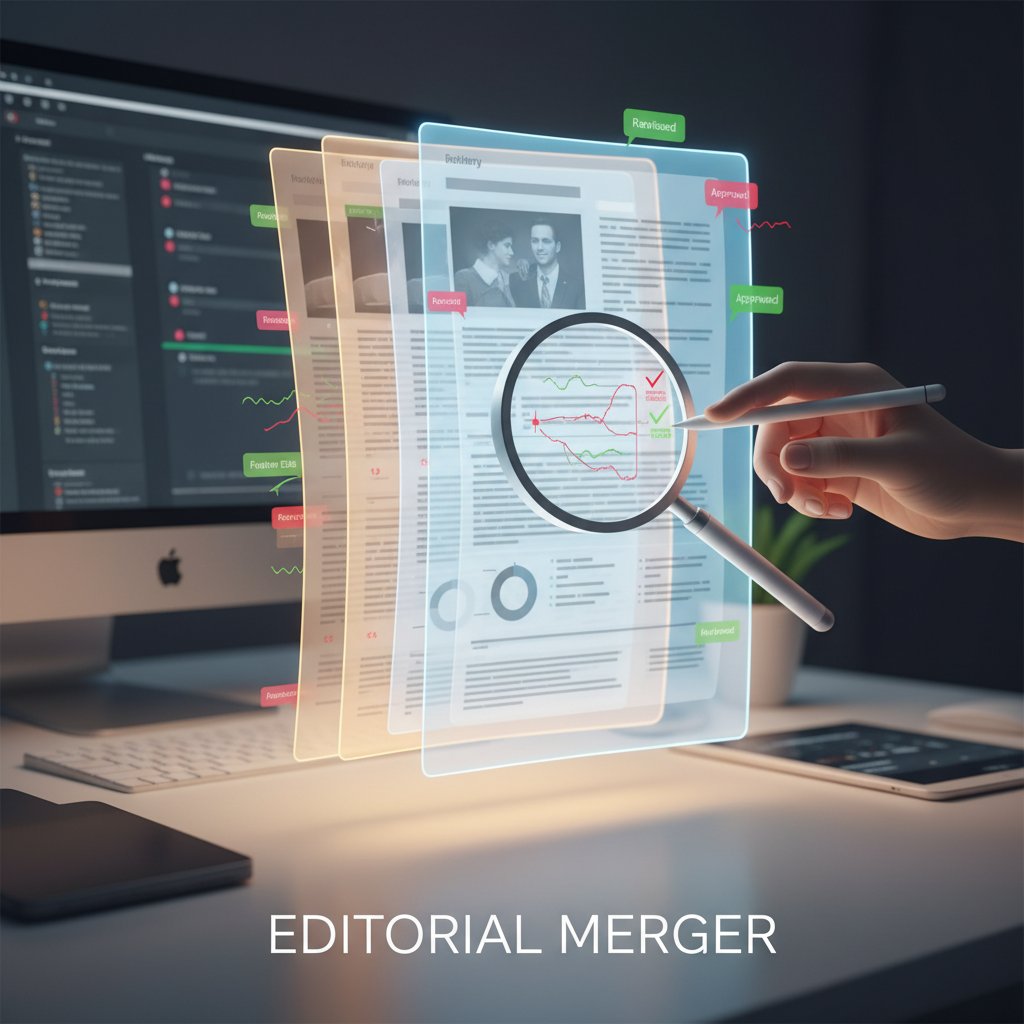
The lesson from creative workflows? Flexibility is non-negotiable. Tools that can handle diverse media, track changes visually, and export to multiple formats are prized. Filecreator.ai and similar platforms are gaining traction by meeting these non-traditional, high-stakes use cases.
Debunking document merging myths
Myth 1: All document merging tools are created equal
The gulf between reliable and unreliable tools is wider than most guides admit. Free tools may suffice for personal use, but in professional settings, the differences in output quality, security, and reliability are stark. Paid tools undergo regular updates, offer support, and comply with industry regulations—essentials that free tools often skip.
Believing that all tools are interchangeable is a recipe for risk.
“It’s not about price—it’s about trust.”
— Alex, Security Analyst [Industry Quote]
Myth 2: You’ll never lose data merging documents
The reality? Data loss and corruption still happen, especially with large or multi-format merges. According to Icecream Apps, nearly 20% of users report at least one instance of lost content per year—often due to untested or incompatible merging utilities.
The only defense is vigilance: keep backups of originals, use versioned cloud storage, and test merges on copies before running them at scale.

Myth 3: Anyone can master merging without training
Let’s dispel the myth right now: even the simplest tools have a learning curve. Merging documents at scale, integrating automation, or ensuring compliance isn’t plug-and-play. A few hours of training can save weeks of future errors.
Priority checklist for document merging software implementation:
- Audit your existing workflow and pain points.
- Define success metrics (accuracy, speed, compliance).
- Select a tool matching your technical capacity.
- Pilot with a controlled group before full rollout.
- Train all users, not just IT or admins.
- Implement regular testing and backup procedures.
- Review and update processes quarterly.
Don’t skip the investment in reputable training resources—many vendors (including filecreator.ai) offer detailed tutorials, webinars, and support communities.
The future of document merging: Trends to watch in 2025 and beyond
Regulatory shifts and compliance crackdowns
Data privacy and compliance are tightening. New regional rules—like the California Consumer Privacy Act and updated EU mandates—are raising the bar for how organizations handle, merge, and store documents.
| Region | Regulation | Key Impact |
|---|---|---|
| EU | GDPR Update | Stricter data handling |
| US (CA) | CCPA Expansion | More user data rights |
| Asia | Country-specific privacy | Localization required |
| Global | ISO 27001/2 | Certification incentives |
Table 5: Upcoming regulations impacting document merging in major regions. Source: Original analysis based on TechRadar 2025, Jotform Blog 2025.
The only way forward? Build merging workflows with compliance at the core, from encryption to metadata control.
AI, blockchain, and the end of manual merging?
Disruptive technologies like AI and blockchain are making waves—but not all change is useful yet. AI is already fixing formatting errors and flagging data gaps, but blockchain’s promise of tamper-proof audit trails is more hype than reality for most teams. Always distinguish between what’s technically possible and what actually delivers value in your workflow.

What users want: The next generation of merging software
Surveys and user feedback reveal a demand for three things: frictionless automation, bulletproof security, and deep integration across platforms. No one wants to babysit merges or chase format errors anymore.
Hidden benefits of document merging software experts won’t tell you:
- Reduces human error by automating repetitive merges
- Strengthens compliance with built-in audit trails
- Accelerates collaboration by merging feedback instantly
- Enhances client trust via secure, transparent processes
- Cuts overhead by streamlining admin workflows
- Boosts employee morale—less grunt work, more impact
- Improves document consistency and branding
- Delivers analytics on workflow efficiency
Tools like filecreator.ai are responding by focusing on adaptive automation, cross-platform support, and real-time error detection.
How to choose and implement document merging software like a pro
Self-assessment: What do you really need?
Before you buy (or switch) merging tools, map out your workflow. What file types do you handle? How many merges per week? Do you need compliance features, automation, or just basic batch processing?
Are you using the right document merging software?
- Your tool supports all file formats you use (PDF, DOCX, images)
- It integrates with your cloud or on-premise storage
- Audit trails and version control are non-negotiable
- Automation (batch, triggers, scheduling) is available
- Security certifications are current and visible
- User interface is intuitive for all team members
A quick reference guide—based on your answers—can help you choose software that matches your real challenges, not just marketing hype.
Implementation without the headaches
Rollout is where great tools die if you’re not strategic. Plan, pilot, and train before you standardize. Start small, gather feedback, and refine the process.
Timeline of document merging software evolution:
- Manual paper merging (pre-1990)
- Basic desktop software (1990s)
- Early PDF tools (late 1990s)
- Cross-format merging (2000s)
- Batch processing (2005+)
- Cloud integration (2010s)
- Automation and scripting (2015+)
- AI-powered merging (2020s)
- Compliance-first platforms (2023+)
- Real-time, cross-platform workflows (2025)
To minimize disruption, ensure support resources are on hand, and schedule regular review sessions during rollout. Avoid “big bang” deployments—incremental change wins.
Measuring success: Metrics that matter
You can’t improve what you don’t measure. Track key performance indicators like error rates, merge turnaround time, average file size handled, user satisfaction, and compliance audit pass rates.

Common pitfalls? Overcustomization leading to complexity, neglecting ongoing training, and ignoring user feedback. Stay agile—iterate, adapt, and let the data drive your next steps.
Conclusion: Rethinking what you know about document merging
The edge in today’s merging landscape is in the details. The software you pick, the workflows you build, and the discipline with which you execute—these determine whether document merging is a lightning-fast superpower or a lurking disaster. Don’t buy into “seamless” myths. Demand evidence, test thoroughly, and choose tools that have your back when things go sideways. Your documents—and your reputation—are only as strong as your merging software.
Got your own war story, a near-miss, or a hack that saved your team? Share it. The merging revolution is happening in real time, and every lesson learned keeps the whole community one step ahead of chaos.

Sources
References cited in this article
- FileCenter: Best PDF merging solutions 2025(filecenter.com)
- TechRadar: Best PDF merger tools 2025(techradar.com)
- Jotform Blog: PDF merge tools guide 2025(jotform.com)
- Icecream Apps: Top PDF mergers 2025(icecreamapps.com)
- Business.com(business.com)
- Future Market Insights(futuremarketinsights.com)
- FileCenter(filecenter.com)
- ResearchGate: Advanced Risk Assessment Techniques(researchgate.net)
- The ECM Consultant(theecmconsultant.com)
- JustAnswer: Word merge errors(justanswer.com)
- Exalt Zendesk checklist(exalt.zendesk.com)
- Windows Report(windowsreport.com)
- Chelsea Office Systems(chelseaofficesystems.com)
- WordRibbon Tips(wordribbon.tips.net)
- Pydio(pydio.com)
- Papermark(papermark.com)
- Reliaquest(reliaquest.com)
- LinkedIn: How can you compare and merge files?(linkedin.com)
- Geekflare: Diff and Merge Tools(geekflare.com)
- Hackread(hackread.com)
- Bluenotary(bluenotary.us)
- DocVu.AI(docvu.ai)
- Saxon AI(saxon.ai)
- UiPath(uipath.com)
- Solganick(solganick.com)
- GMI Insights(gminsights.com)
- Market Business News(marketbusinessnews.com)
- Business Wire(businesswire.com)
- Advanced Legal(advancedlegal.com)
- Xapien(xapien.com)
- Deployteq(deployteq.com)
- ResearchGate(researchgate.net)
- Google Workspace Marketplace(workspace.google.com)
- Udemy: Mastering Word 365(udemy.com)
- M&A Science(mascience.com)
Perfect Documents, Instantly
Filecreator.ai transforms the way you produce professional documents. Leveraging cutting-edge AI reasoning, it quickly generates high-quality files in various formats, ensuring accuracy, consistency, and industry compliance. Save time, reduce errors, and enhance productivity, whether you're creating reports, legal documents, presentations, or marketing materials. Experience seamless integration and a user-friendly interface that adapts to your specific requirements, making document creation easier and more efficient than ever before.
Get startedStart Creating Professional Documents Today
Join thousands of professionals who trust AI-powered document generation
Frequently Asked Questions
What percentage of organizations currently use document merging or automated combining tools?
According to TechRadar's 2025 report, over 94% of organizations use some form of document merging or automated combining tool as part of their standard workflow, a number that has risen steadily since the pandemic.
Which industries are most dependent on document merging software?
Law firms, hospitals, and publishers are heavily dependent on document merging software—law firms use it to close deals, hospitals use it to deliver care with patient intake forms and compliance records, and publishers use it to compile submissions and proofs.
What are some real consequences of document merging failures mentioned in the article?
The article mentions a law firm that lost a million-dollar deal because a signature page vanished during a bulk merge, and an HR team whose policy update became corrupted by a merge error, leaving confidential data exposed.
Why has document merging software become more critical in recent years?
Remote and hybrid work are now the baseline rather than trends, requiring document merging software to bridge teams across continents in real time so they can collaborate on documents simultaneously from different locations.
Continue Reading
Explore more from Professional Document Generator

Document Merging Tool Failures: Causes and Solutions
Document merging tool failures cost organizations time and data integrity. This article examines the hidden costs of manual merging and research-backed solutions.

Document Workflow Software: What Actually Works in 2026
Document workflow software can prevent missed deadlines and compliance disasters. This article examines the real costs of inefficient workflows and how modern tools transform document management.

Document Workflow Automation Tools: Success and Failure Factors
Document workflow automation tools promise efficiency but carry hidden risks. This article examines real failures, compliance challenges, and strategies that distinguish successful implementations from costly mistakes.

Document Collaboration Software: Promise Versus Messy Reality
Document collaboration software promises seamless teamwork but often creates friction. This article examines how these tools reshape work, expose organizational gaps, and separate myth from reality.

Document Collaboration Tools: What Leaders Get Wrong
Document collaboration tools promise productivity gains, but only 70% of employees use them effectively. This article reveals the real challenges teams face and how to address them.

Document Automation Tools: the Real Costs and Benefits
Document automation tools are projected to reach $24.3B by 2032. This article examines the real risks, actual benefits, and how to select the right solution for your business.