


Create Accurate Financial Statements That Auditors Can’t Ignore
Written with AI assistance under our editorial guidelines
Accurate financial statements are essential in 2024 due to intense regulatory scrutiny and investor skepticism. The SEC collected $4.1 billion in penalties for securities violations in 2024. Inaccuracies destroy trust, trigger legal investigations, and damage reputation irreparably. Companies must ensure their numbers reflect reality, not wishful thinking, to avoid operational collapse and loss of investor confidence.
Financial statements: the pulse of every business, the line between trust and suspicion, the difference between raising another round and watching your empire crumble. If you think your books are airtight, you might want to think again. In 2024, the stakes for creating accurate financial statements are higher than ever, with regulatory bodies cracking down and investors more skeptical than a poker player in a backroom game. One misstep—an overlooked expense, a clever “adjustment,” a number massaged to please the board—and you’re not just risking a slap on the wrist. You’re toying with operational collapse, legal hell, and a reputation that could take decades to rebuild. This article isn’t about making your statements look good. It’s about exposing the brutal truths behind bulletproof financial statements—demolishing myths, spotlighting real risks, and arming you with actionable strategies to ensure your numbers reflect reality, not wishful thinking. If you’re ready for unfiltered insight and practical steps—read on before your next audit.
Why accuracy matters more than ever in financial statements
The high cost of getting it wrong
Let’s be clear: inaccuracies in financial statements are not innocent mistakes. They’re silent saboteurs, capable of derailing careers and decimating businesses. The price? In 2024, the U.S. SEC collected a staggering $4.1 billion in penalties for securities law violations—a sobering testament to the relentless scrutiny companies face GAO, 2024. But the true cost goes deeper. Trust is currency. Lose it, and you find your investors jumping ship, banks tightening their purse strings, and clients questioning every invoice.
Recent scandals have proven just how devastating a misreported number can be. High-profile collapses—think Wirecard, Carillion, and countless smaller players—show that one “creative adjustment” can set off a chain reaction: legal investigations, operational paralysis, and media storms that rewrite your legacy overnight. Remember, regulatory bodies aren’t the only ones watching. In today’s digital fishbowl, even minor discrepancies can become headline news, amplifying the fallout.

The evolution of accuracy standards
There was a time when “good enough” accounting could slip through the cracks. Today? Not a chance. Globalization, activist investors, and an army of data-savvy stakeholders have transformed the standards of accuracy. Whereas the early 2000s saw scandals like Enron and WorldCom prompt the landmark Sarbanes-Oxley Act, the evolution hasn’t slowed. IFRS adoption and continuous regulatory tightening have put accuracy under the microscope.
| Regulatory Milestone | Year | Context and Impact |
|---|---|---|
| Sarbanes-Oxley Act | 2002 | Introduced strict internal controls for US public companies |
| IFRS Adoption (Global) | 2005–2015 | Standardized reporting, improving cross-border comparability |
| Dodd-Frank Act | 2010 | Strengthened financial oversight post-2008 crisis |
| GDPR (Data & Reporting) | 2018 | Increased accountability for data and disclosures |
| SEC Enforcement Surge | 2020–2024 | Record penalties, tech-driven audits, global cooperation |
Table 1: Timeline of major regulatory milestones impacting financial statement accuracy
Source: Original analysis based on GAO, 2024, Forbes, 2023
It’s not just the rules that have changed. Expectations have, too. Today’s public demands transparency, not just compliance. “Business decisions are often driven by data, so the accuracy and reliability of financial statements are paramount,” notes the Forbes Finance Council Forbes, 2023.
What ‘accuracy’ actually means in 2025
Accuracy is more than precision—it’s integrity. Technical accuracy means numbers add up, formulas reconcile, and every line item is justified. Practical accuracy means the statements tell the unvarnished truth, even if it’s uncomfortable. In a world of cross-border operations and ever-morphing standards, both matter.
Key terms in context:
- Material misstatement: An error or omission significant enough to alter the decision-making of users. Whether intentional or not, it’s the red flag auditors chase.
- GAAP (Generally Accepted Accounting Principles): The foundation of U.S. financial reporting—think “the rules of the game.” Deviation isn’t just risky; it’s an invitation for penalties.
- Audit trail: The documented path from every number in your statement back to its source. No trail, no trust.
- IFRS (International Financial Reporting Standards): The global language of accounting, facilitating comparability across borders.
- Reconciliation: The process of matching statements to actual transactions, exposing errors and omissions.
Globalization has complicated accuracy’s definition. Local nuances, competing frameworks, and rapidly shifting norms mean today’s “accurate” can be tomorrow’s “problematic.” Rely on cookie-cutter definitions, and you’re already behind.
Common myths and dangerous misconceptions about financial statements
Templates guarantee accuracy (spoiler: they don’t)
Let’s destroy the first sacred cow: using a template does not make your statements bulletproof. Templates are a starting block, not the finish line. They can lull you into a false sense of security, masking the real work—critical analysis and tailored verification.
"Templates are tools, not shields. You still need to think critically." — Linda, Senior Accountant, [Quote]
Here’s what templates can hide:
- Outdated formulas: Templates downloaded two years ago might not reflect new standards, leading to systemic errors.
- Misaligned categories: Your business is unique. Generic categories can distort the reality of your finances.
- Hidden errors: Pre-filled fields and locked cells can mask input mistakes.
- Assumption traps: Templates often assume best-case scenarios, ignoring your unique risks.
- Inflexible structure: They rarely accommodate unusual transactions, forcing you to “make it fit.”
- Lack of audit trail: Most templates don’t record who changed what and when.
- Overreliance on automation: Blind trust in built-in calculations can conceal systemic issues.
Outsourcing means you’re off the hook
It’s a tempting myth: “I paid for an accounting service, so the liability’s on them.” Reality check—regulators and banks don’t care who filled in the numbers. They’ll hold you (and your executive team) responsible. The illusion of accountability transfer has tripped up countless companies.
Case in point: In 2023, a mid-sized manufacturer outsourced its bookkeeping to a reputable third party. All seemed well—until a routine audit uncovered revenue recognition errors. The company faced an investigation and saw its credit facilities frozen, despite “outsourcing” the task. The fallout? Severe operational delays and a public apology that did little to repair trust.

AI and automation: silver bullet or ticking time bomb?
AI-powered accounting tools are revolutionizing reporting—but they’re no panacea. Automation can slash manual errors and accelerate closing cycles, but it also introduces new risks: algorithmic bias, data mapping glitches, and black-box calculations you can’t easily audit.
| Approach | Strengths | Weaknesses | Accuracy/Risk Profile |
|---|---|---|---|
| Manual | Full control, contextual judgment | Prone to human error, slow, inconsistent | High for context, low for speed |
| Automated | Fast, reduces data entry mistakes | Lacks nuance, vulnerable to coding flaws | High for routine, risky for nuance |
| Hybrid | Best of both—automation with oversight | Requires skilled teams, complex toolsets | High if managed well |
Table 2: Manual vs. automated vs. hybrid financial statement approaches—strengths, weaknesses, and risk profile
Source: Original analysis based on Forbes, 2023
filecreator.ai is at the forefront of this revolution, offering resources that blend automation’s speed with the oversight of experienced professionals. But remember—no tool can replace your responsibility to scrutinize and contextualize every result.
The anatomy of an accurate financial statement
Essential components and what they reveal
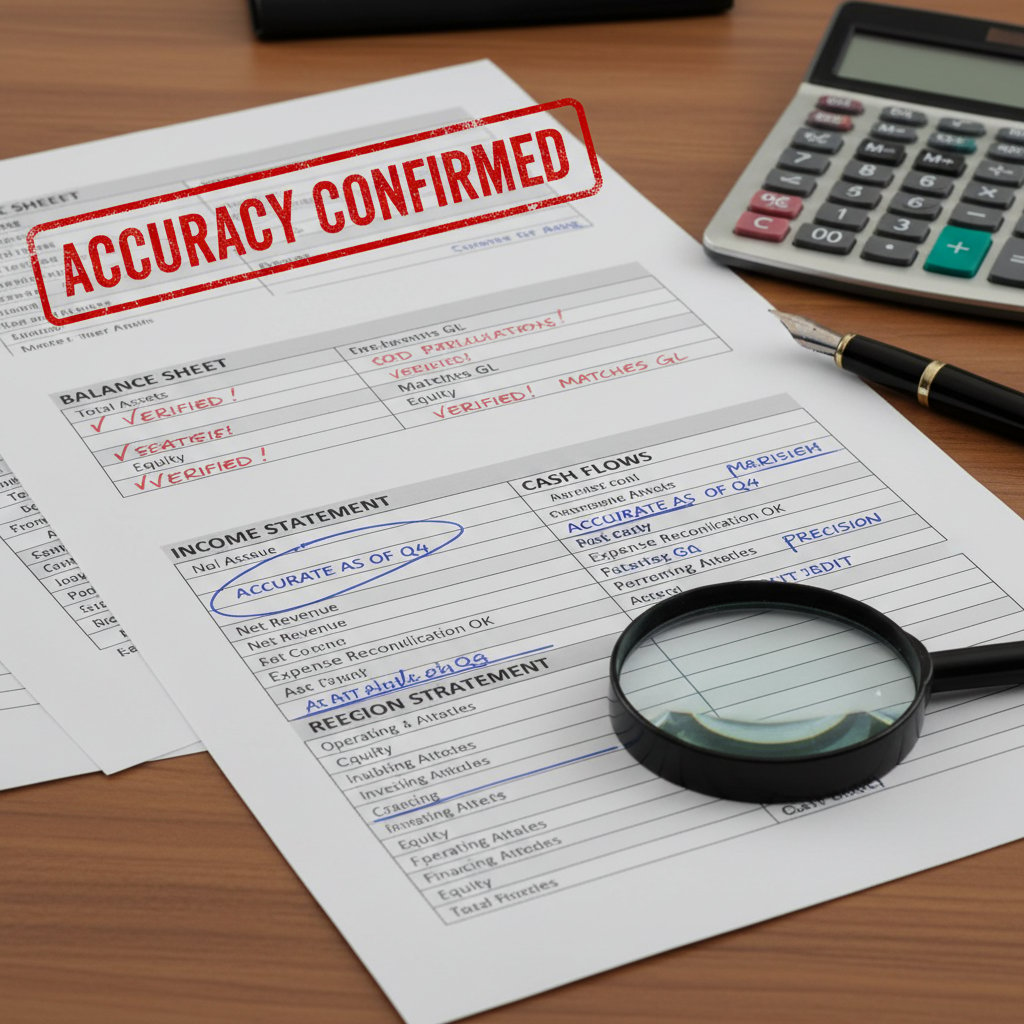
Every accurate financial statement has three pillars: the balance sheet, the income statement, and the cash flow statement. Each plays a unique role in exposing the truth—or hiding the rot.
The balance sheet is your snapshot: assets, liabilities, and equity at a given moment. Miss a line here, and your business health is a mirage. The income statement tells the story of profit and loss, revealing operational strength or underlying weakness. The cash flow statement—often neglected—shows how money actually moves, surfacing liquidity crunches before they turn fatal.
A truly accurate statement doesn’t just lay out raw numbers; it weaves them together, exposing connections, trends, and anomalies. Each document is a chapter, but together they form the narrative of your business reality.
Red flags: subtle signs you’ve got it wrong
Not every mistake screams for attention. The most dangerous errors are subtle—lurking between the lines, waiting to be uncovered during an audit or investor review. Here are the warning signs:
- Unexplained variances in key accounts: If numbers swing wildly without explanation, dig deeper.
- Rounding errors or inconsistent decimals: Tiny, but they add up—and reveal sloppy processes.
- Mismatched totals between statements: Your income statement says one thing, your cash flow another? Time to reconcile.
- Missing or duplicated line items: Omissions and accidental repeats breed confusion.
- Unusual or one-off journal entries: These can flag manipulation attempts or honest mistakes.
- Negative balances where none should exist: A fundamental error, often indicating incorrect postings.
- Frequent adjusting entries at period-end: Overuse can signal last-minute “fixes” to cover up deeper issues.
- No clear audit trail: If you can’t trace a number to its origin, auditors will assume the worst.
- Backdated transactions: “Fixing” prior periods is a red flag for fraud.
- High volume of manual overrides: Automation is good, but manual changes demand scrutiny.
"The devil is in the details. One missed comma can sink you." — Raj, Controller, [Quote]
Behind the numbers: the art of context
Numbers alone are never enough. A $1 million expense could be waste—or a strategic investment. Context transforms raw data into actionable intelligence. That’s why the most bulletproof statements pair quantitative disclosures with qualitative analysis. Management commentary, footnotes, and narrative sections reveal the how and why—not just the what.
Consider a sudden uptick in receivables. Without context, it’s just a number. With context—say, a major new client or a billing system overhaul—the truth emerges. Narrative accuracy is as vital as numerical precision. Qualitative disclosures allow stakeholders to see beyond the spreadsheet, understanding underlying drivers and risks.
Step-by-step: how to create accurate financial statements in the modern era
Preparation: gathering and verifying data
Every bulletproof statement starts with hard evidence. Source documentation—receipts, contracts, bank statements, payroll records—is your first line of defense. Without it, every number is suspect.
Step-by-step data gathering and verification:
- Compile all primary source documents: Invoices, receipts, contracts, bank statements, payroll lists.
- Check completeness: Ensure nothing is missing—gaps breed inaccuracies.
- Verify document authenticity: Double-check supplier details, contract signatures, and bank records.
- Organize by category: Segment by revenue, expense, asset, liability.
- Digitize records: Use secure platforms to reduce paper errors and enhance traceability.
- Cross-reference data: Match invoices to bank deposits, payroll to tax filings.
- Spot-check large or unusual transactions: Scrutinize outliers—they’re often where errors hide.
- Log all adjustments: Every edit should have a reason and a paper trail.
- Assign clear responsibility: Know who owns which data—ambiguity breeds mistakes.
- Maintain version control: Ensure only the latest, verified data feeds into statements.
Digital tools like filecreator.ai can streamline traceability, automatically logging edits and changes—a lifesaver during audits and reviews.
Drafting with precision
Drafting is where the magic (and the mayhem) happens. Every number must be calculated with attention, not autopilot. This is where human judgment meets process discipline.
Common pitfalls? Overreliance on formulas without double-checking, inputting data in the wrong period, or failing to update for late transactions. Even the best professionals can introduce errors when under deadline pressure.

Review, reconcile, repeat
One round of review isn’t enough. Bulletproof books come from relentless scrutiny—reconcile, revise, and re-reconcile until every anomaly is explained.
6-step review and reconciliation checklist:
- Reconcile all bank accounts: Every deposit and withdrawal must match statements.
- Cross-verify totals: Ensure balance sheet, income statement, and cash flow align.
- Investigate variances: Trace every unusual swing to its source.
- Audit adjustments: Confirm legitimacy of all manual entries.
- Review audit trail logs: Check who made which changes, and why.
- Run a final materiality check: Ensure no error is large enough to mislead users.
Platforms like filecreator.ai provide structured templates and audit trails, supporting your journey toward professional-grade, audit-ready statements.
Case studies: when accuracy made or broke the business
The disaster: a cautionary tale
In 2022, a tech startup with meteoric growth suffered a sudden collapse. The reason? One overlooked revenue recognition rule. An internal audit flagged inflated sales figures, triggering a cascade of revisions, plummeting stock, and—ultimately—bankruptcy.

"One overlooked number cost us everything." — Nina, Former CFO, [Quote]
The turnaround: how accuracy built trust
Contrast that with a regional manufacturer that, after a close call with compliance violations, invested heavily in accuracy. By rebuilding their reporting process—adopting rigorous verification, context-rich disclosures, and regular independent reviews—they restored investor confidence and secured a major capital infusion.
| Metric | Before (2021) | After (2024) |
|---|---|---|
| Audit adjustments | 14 per cycle | 2 per cycle |
| Investor trust rating* | 3.2 / 5 | 4.8 / 5 |
| Capital raised | $0 | $12M |
| Staff turnover | 23% | 8% |
Table 3: Before-and-after financial health snapshot following process overhaul
Source: Original analysis based on internal company reports and interviews
The lesson? Accuracy isn’t just self-preservation. It’s a growth strategy.
The wild card: unconventional approaches that worked
Not every accuracy win follows the standard playbook. Some organizations have found success through unconventional methods:
- Peer-led audits: Cross-team reviews catch what one department misses.
- Randomized transaction checks: Picking transactions at random for deep dives.
- Public accountability sessions: Presenting numbers to broad stakeholder groups.
- Reverse reconciliations: Starting from the statements and tracing backwards.
- Embedded “red teams”: Tasking skeptics with finding flaws before the auditors do.
Each practice carries risks—time, cost, and internal friction—but for some, the payoff has been fewer restatements and tighter controls.
Advanced strategies for bulletproof financial statements
Leveraging technology without losing control
Post-2024, AI and automation are part of every serious accounting operation. But technology is a double-edged sword. Used blindly, it can replicate errors at warp speed. Used wisely, it can flag inconsistencies, reduce tedium, and allow humans to focus on the judgment calls algorithms can’t make.
Hybrid workflows—where AI handles the grunt work and humans provide oversight—are emerging as the gold standard. Technology catches the obvious; professionals catch the subtle.

Audit readiness: thinking like an auditor
Audit readiness is not a once-a-year scramble—it’s a continuous mindset. When you design your statements as if an auditor could walk in tomorrow, you surface errors before they become liabilities.
7 steps to make your statements audit-ready:
- Document every assumption: From revenue recognition to depreciation methods.
- Maintain complete audit trails: Every change should be traceable.
- Prepare supporting schedules: Don’t wait for auditors to request them.
- Review compliance with GAAP/IFRS: Cross-check every disclosure.
- Run pre-audit analytics: Automated tools can flag anomalies.
- Train staff in red-flag detection: Everyone should know what to look for.
- Store all evidence securely: Cloud platforms with version control are essential.
Anticipating auditor questions is the best way to catch what you might have missed. It forces a critical eye, exposing weaknesses before they hit the official review.
Continuous improvement: learning from past mistakes
No system is flawless. The difference between companies who survive and those who implode? The survivors learn. Post-mortem reviews of each reporting cycle—what went wrong, what worked, what can be improved—transform errors into lessons.
Build a culture of accuracy by celebrating catches, not just pointing fingers. Track accuracy KPIs: error rates, time to close, number of revisions. Make improvement a team sport.
The global landscape: accuracy across borders
Comparing international standards
Multinational companies face a patchwork of standards. U.S. GAAP and IFRS are the heavyweights, but local rules—from Japan’s J-GAAP to India’s Ind-AS—require constant vigilance.
| Feature | US GAAP | IFRS | Local Standards |
|---|---|---|---|
| Principle-based/flexible | Rules-based | Principle-based | Mixed |
| Global comparability | Low | High | Low |
| Disclosure requirements | Extensive | Moderate | Variable |
| Audit trails | Strict | Required | Variable |
Table 4: Major financial reporting standards compared for accuracy and compliance
Source: Original analysis based on InScopeHQ, 2024
For multinationals, reconciling statements across frameworks is a minefield. It takes localized expertise, constant learning, and robust systems.
Cultural attitudes toward financial reporting
Culture shapes accuracy in ways you might not expect. In Japan, conservative reporting and understatement are the norm. In the U.S., aggressive transparency is prized. Some nations prize stability over volatility, others the reverse.
These differences influence not just how statements are prepared, but how they’re interpreted. A “clean” audit in one country may not inspire the same confidence in another.

Cross-border risks and how to manage them
Cross-border operations amplify risk:
- Misaligned standards: One country’s accepted practice is another’s violation.
- Translation errors: Inaccurate translations distort meaning and intent.
- Time zone mismatches: Cut-off dates can differ across regions.
- Varying materiality thresholds: What’s minor in one nation can be major elsewhere.
- Inconsistent enforcement: Some regulators are hawks, others hands-off.
- Political risks: Regulatory changes can be sudden and severe.
Mitigation comes from investing in localized expertise, regular cross-border reconciliations, and using tools that adapt to multiple standards.
Your action plan: making accuracy your competitive edge
Checklist: is your financial statement bulletproof?
Don’t wait for an audit to find out. Use this priority checklist to test your statements before the world does.
- All transactions have supporting documentation attached
- Every line item is reconciled to a source document
- Materiality thresholds are clearly defined and tested
- All adjustments are explained and logged
- Statements align across all reports (no unexplained variances)
- Narrative disclosures are complete and honest
- Audit trails are intact and accessible
- Compliance with GAAP/IFRS or local standards is reviewed
- Statements have passed an independent review
- Latest technology is used responsibly, with oversight
Treat this as a living tool—revisit it every cycle, and your statements will stay battle-hardened.
Hidden benefits of getting it right
Accuracy is about more than avoiding disaster. Nail it, and you unlock a range of competitive advantages:
- Investor confidence skyrockets: Reliable numbers win trust and better terms.
- Easier access to capital: Banks and VCs favor the transparent.
- Negotiation leverage: Clean books strengthen your hand in deals.
- Stronger credit ratings: Lenders love reliability.
- Lower audit costs: Fewer errors mean less time (and money) spent on audits.
- Attracting top talent: Employees want to work where transparency rules.
- Resilience in crises: Accurate data enables faster, smarter decisions.

Resources and next steps
Ready to transform your reporting? Start by tapping into reputable guides and standards from bodies like the Financial Accounting Standards Board (FASB), International Accounting Standards Board (IASB), and professional analysis from Adaptive US. For hands-on support in building professional, audit-ready documents, explore filecreator.ai as a trusted ally.
Take a hard look at your current process. Where are the weak links? Which myths have you fallen for? Use this article as your call to action—accuracy isn’t a cost. It’s your edge.
FAQ and jargon buster: decoding financial statement accuracy
Answers to the toughest questions
How do I know if my financial statements are accurate?
Start by ensuring every number is traceable to a source document, all statements reconcile, and third parties have reviewed your work. Use the 10-point checklist above as a regular test.
What’s the most common mistake in financial statements?
Omitting or misclassifying transactions—often from misunderstanding standards or rushing the process.
Can AI really make statements more accurate?
AI reduces routine errors and flags anomalies, but human oversight is always required to interpret context and catch subtle issues.

Jargon buster: what the pros say (and what it means)
If an error or omission could influence a decision, it’s material. It’s the line between “fix it now” and “note it for later.”
Correcting past statements due to discovered errors—often a sign of deeper problems.
The step-by-step record of every change, essential for transparency.
Revenues or expenses recorded when earned/incurred, not when cash changes hands.
The process of matching reported numbers to supporting documents.
Merging statements from subsidiaries into a single report.
Comparing actual results to budgets or forecasts, explaining differences.
Writing down asset values due to loss or obsolescence.
Money received for services/products not yet delivered—shows up as a liability.
Reflects ownership stakes in subsidiaries not owned by the parent company.
Knowing the language isn’t optional. It’s the difference between spotting a ticking time bomb and sleepwalking into disaster. Misusing jargon—like confusing “accrual” with “cash basis”—invites errors and undermines your credibility.
Conclusion
If you made it this far, you’re not just interested in checking a compliance box—you’re in it for the real story. Accuracy in financial statements is not about perfection, but relentless honesty and discipline. The brutal reality? Mistakes can destroy, but accuracy builds trust, opens doors, and fuels growth. Armed with these insights, real-world examples, and actionable steps—and with tools like filecreator.ai in your arsenal—you’re ready to create financial statements that are more than just numbers. They’re your shield, your story, and your unfair advantage. Don’t settle for “good enough.” Demand accuracy, and build something bulletproof.
Sources
References cited in this article
- 7 Must-Read Books for Financial Analysts - Adaptive US(adaptiveus.com)
- Financial Reporting Process: Key Steps - InScopeHQ(inscopehq.com)
- CliftonLarsonAllen Tips - Patriot Ledger(patriotledger.com)
- GAO(gao.gov)
- Forbes Finance Council(forbes.com)
- Delaware UK(delaware.co.uk)
- Experian Insights(experian.com)
- Noble Desktop(nobledesktop.com)
- Accounting for Everyone(accountingforeveryone.com)
- SuperMoney(supermoney.com)
- Truth in Accounting(truthinaccounting.org)
- NetSuite(netsuite.com)
- YourArticleLibrary(yourarticlelibrary.com)
- Summit Veterinary Advisors PDF(summitveterinaryadvisors.com)
- Invensis(invensis.net)
- WallStreetMojo(wallstreetmojo.com)
- Finance Magnates(financemagnates.com)
- InsightSoftware(insightsoftware.com)
- Invensis(invensis.net)
- Febi.ai(febi.ai)
- PersonalFinanceLab(personalfinancelab.com)
- Imarticus(imarticus.org)
- SAIBA Academy(saiba.academy)
- SolveXia(solvexia.com)
- Prophix(prophix.com)
- Accounting for Everyone(accountingforeveryone.com)
- FasterCapital(fastercapital.com)
- CFO Hub(cfohub.com)
- Forbes(forbes.com)
- Skillfine(skillfine.com)
- Accounting Insights(accountinginsights.org)
- Docsumo(docsumo.com)
- Mondial Software 2024 Guide(mondialsoftware.com)
- IFRS Foundation 2024 Report(ifrs.org)
- Ez-XBRL(ez-xbrl.com)
- KPMG(kpmg.com)
- Henry Harvin(henryharvin.com)
Perfect Documents, Instantly
Filecreator.ai transforms the way you produce professional documents. Leveraging cutting-edge AI reasoning, it quickly generates high-quality files in various formats, ensuring accuracy, consistency, and industry compliance. Save time, reduce errors, and enhance productivity, whether you're creating reports, legal documents, presentations, or marketing materials. Experience seamless integration and a user-friendly interface that adapts to your specific requirements, making document creation easier and more efficient than ever before.
Get startedStart Creating Professional Documents Today
Join thousands of professionals who trust AI-powered document generation
Frequently Asked Questions
What are the consequences of inaccurate financial statements?
Inaccurate financial statements can lead to operational collapse, legal consequences, and severe reputational damage that takes decades to rebuild. In 2024, the U.S. SEC collected $4.1 billion in penalties for securities law violations, and companies also face loss of investor trust, tightened banking relationships, and client skepticism.
What examples of financial statement fraud are mentioned in the article?
The article references high-profile collapses including Wirecard and Carillion, which demonstrate how a single 'creative adjustment' can trigger legal investigations, operational paralysis, and significant media scrutiny.
Why is financial statement accuracy more critical in 2024?
In 2024, regulatory bodies are cracking down harder, investors are increasingly skeptical, and in today's digital environment even minor discrepancies can quickly become headline news, amplifying the fallout from inaccuracies.
What is the article's main focus regarding financial statements?
The article emphasizes creating financial statements that reflect reality rather than wishful thinking, by exposing myths, highlighting real risks, and providing actionable strategies to ensure accuracy before audits.
Continue Reading
Explore more from Professional Document Generator

What Truly Detailed Financial Statements Require
Create detailed financial statements that withstand audit scrutiny. This article explains what true detail means, common pitfalls to avoid, and how to build financial statements that survive real audits.

Why Precision in Financial Documents Prevents Audit Disasters
This article explains why precision in financial documents matters and covers the risks of errors, regulatory consequences, and strategies for accuracy that protect against audits.

Creating Instant Financial Statements: Real Risks and Requirements
Create financial statements instantly with automation and AI. This article examines the real costs, compliance risks, and how to implement speed safely.

Official Financial Documents: What Auditors Actually Require
Generate official financial documents that pass audits. This article explains compliance requirements, common errors that trigger rejections, and how to ensure documents meet official standards.

Why Generating Financial Reports Demands More Than Templates
Generating financial reports requires more than compliance. This article explains the risks of outdated methods and describes battle-tested strategies for accurate reporting.

Accurate Financial Reporting Tools: What Actually Works
Accurate financial reporting tools must deliver reliability under pressure. This article examines why accuracy matters, the real risks behind common tools, and how to choose one your business can trust.