


Contract Template Generators in 2025: Power, Pitfalls, and Profit
Written with AI assistance under our editorial guidelines
Contract template generators using AI have fundamentally transformed how organizations create and manage agreements, shifting power from legal professionals to anyone with internet access. While these tools offer remarkable speed and scale benefits, they introduce significant risks including loss of nuance, accountability, and competitive advantage that businesses must carefully navigate before automating contracts.
If you think a contract template generator is just a shortcut for lazy businesses or gig workers too cheap to hire a lawyer, you’re about to get schooled. The contract revolution is here, and it’s hitting harder and faster than anyone expected. We’re not talking about swapping out a Word doc for a PDF template. This is a seismic shift in how organizations—from scrappy startups to global titans—create, manage, and (sometimes) destroy their most important agreements. The rise of AI-powered contract automation has cracked open a world where mistakes can vanish with a click, but so can nuance, accountability, or even your competitive edge. In 2025, the only thing riskier than automating your contracts is not knowing the brutal truths behind the tech—and the wild benefits lurking beneath the surface. Whether you’re a battle-hardened in-house counsel, a fearless freelancer, or a founder who’s learned the hard way, buckle up. We’re about to rip the lid off the realities, risks, and rewards of contract template generators—and show you what every pro must know before automating contracts this year.
The contract revolution nobody saw coming
From wax seals to AI: A brief, brutal history
The story of contracts is as old as civilization itself: from clay tablets pressed by Sumerian merchants to velvet-lined scrolls sealed with hot wax in candlelit chambers. For centuries, contracts were the exclusive domain of scribes, lawyers, and those with the power to enforce them. They were slow, deliberate, and carried the gravity of permanence—sometimes literally weighed down by their own seals. But as commerce scaled, so did the paperwork. The age of handwritten contracts gave way to typewriters, carbon copies, and, eventually, the digital word processor. What was lost? The intimacy and ritual of agreement. What was gained? Speed, scale, and eventually, the dangerous illusion that anyone could draft a bulletproof deal.
With the dawn of the internet, paper was burned in effigy. Fax machines coughed out signatures while email attachments blurred the line between “official” and “draft.” The next leap—AI and automation—was less about how contracts looked, and more about who held the pen. Suddenly, the power to generate contracts shifted from the legal elite to anyone with Wi-Fi and a browser tab. Societal shifts—remote work, gig economies, and the SaaS explosion—rendered the old rituals obsolete. Automation stopped being a luxury and became an existential requirement. As Ricky Spears bluntly put it, “AI and blockchain represent a paradigm shift in contract management.” The only question left: who adapts, and who gets left behind?

Why most contracts fail—and how generators aim to fix it
Most contracts don’t fall apart because of bad intentions; they fail because of bad process. According to a 2025 report by Zefort, a staggering 71% of companies can’t locate at least 10% of their active contracts—leaving them exposed to compliance risks, costly lapses, and legal landmines. The root causes? Ambiguous language, outdated templates, and human error. Even the best-intentioned teams get tripped up by copy-paste clauses and legalese no one understands.
Contract template generators promise to drag these ancient problems into the daylight. By standardizing language, automating error-checks, and integrating compliance rules, these tools don’t just speed up the paperwork—they fundamentally rewrite the contract lifecycle. AI-powered systems can flag missing signatures, detect contradictory terms, and even suggest industry-compliant language. But don’t mistake this for a magic bullet. As Millennial Magazine points out, manual contract drafting remains a time sink for organizations ignoring automation, and poor template hygiene continues to spawn legal disputes.
| Year | Key Milestone | Description |
|---|---|---|
| 1980 | Faxed contracts | First remote signature transmission |
| 1995 | Email attachments | Digital distribution of contracts grows |
| 2005 | E-signature legality | Laws passed recognizing electronic signatures |
| 2015 | Cloud contract storage | Centralized online repositories become standard |
| 2021 | AI clause suggestion | First AI-based clause recommendations appear |
| 2023 | Workflow integration | Contract tools connect with CRM, HR, and finance stacks |
| 2025 | Blockchain transparency | Immutability and audit trails for contracts via blockchain |
Table 1: Timeline of key innovations in contract technology. Source: Original analysis based on Zefort, Ricky Spears, Millennial Magazine, and DocuSign, 2023.
“Most contracts aren’t broken by bad intent, but by bad process.” — Alex, Legal Operations Analyst
What is a contract template generator, really?
Beyond fill-in-the-blank: The new breed of automation
The phrase “contract template generator” once conjured visions of fill-in-the-blank Word documents—basic, boring, and often dangerous in the wrong hands. The new breed is nothing like that. Think of a spectrum: on one end, static templates, barely a notch above manual drafting. In the middle, rule-based generators that offer logic-driven customization. At the sharp end, AI-powered engines that use natural language processing (NLP), machine learning, and dynamic compliance checks to build contracts that adapt to your business, jurisdiction, and risk profile.
Under the hood, these modern generators leverage advanced algorithms to parse user input, recommend clauses based on context, and cross-reference industry standards. User interfaces have evolved from clunky drop-downs to intuitive dashboards where code snippets fade into readable English clauses. The technology is as much about reducing friction as it is about risk management—and for many organizations, that’s the real game changer.

Debunking myths: Not all templates are created equal
There’s a dirty little secret in the world of contract automation: not all templates are created equal. Some “generators” are little more than prettified word processors. Others claim customization, but lock you into rigid frameworks that can’t adapt to your peculiar needs. The biggest myth? That any template is better than none. The reality is far messier.
- True contract template generators offer more than static forms. They use AI and logic flows to build documents tailored to your business, not just your blanks.
- Cloud-based tools can expose you to data privacy risks if not properly vetted. Vet your provider’s security certifications before you click “generate.”
- Legal ambiguity doesn’t vanish just because a template looks sleek. Poorly managed templates are a leading cause of contract disputes, according to Ricky Spears.
- Customization without expert oversight can introduce hidden compliance risks. Over-tweaking may break legal intent or violate regulations.
- Integration is everything. If your generator doesn’t play nicely with your CRM, HR, or finance systems, expect bottlenecks instead of breakthroughs.
- Templates crafted by legal experts ensure clarity and enforceability. DIY tools often skip this step, putting your business on shaky ground.
- Automation reduces manual errors, but AI isn’t infallible. Human review still matters, especially for high-risk deals.
Don’t confuse simple mail-merge tools or DIY word processors with true automation. The best contract template generators do the legal heavy-lifting, so your business doesn’t have to gamble on guesswork.
Inside the engine: How contract template generators actually work
The anatomy of a modern generator
A state-of-the-art contract template generator is a digital Swiss Army knife. The core features include intelligent clause selection (drawing on libraries vetted by legal professionals), automated compliance checks adapting to local and international regulations, and seamless integration with e-signature and workflow tools. The best solutions deploy dynamic fields, real-time collaboration, and audit trails for accountability.
Different industries call for different levels of complexity. In the legal sector, accuracy and compliance trump all, so generators lean on deep clause libraries and version control. In marketing, speed and design matter, which means smart branding and rapid assembly. Finance, healthcare, and HR each bring their own regulatory baggage, and robust generators can switch gears at the flip of a toggle.
| Feature | Static Template | Rule-based Generator | AI-powered Generator |
|---|---|---|---|
| Manual editing | Yes | Limited | Limited |
| Clause logic | No | Yes | Yes |
| Compliance checks | Manual | Basic | Advanced |
| Industry adaptation | No | Partial | Extensive |
| Integration | None | Limited | Advanced |
| E-signature | No | Optional | Seamless |
| Audit trail | No | Partial | Full |
Table 2: Feature matrix comparing contract template generator types.
Source: Original analysis based on Writify.AI, Zefort, BRYTER, and GatekeeperHQ, 2024.
Customization vs. compliance: Walking the tightrope
Customization is the holy grail of contract generation—but it’s a double-edged sword. Too little, and you’re stuck with cookie-cutter agreements that miss critical nuances. Too much, and you risk breaking compliance, introducing ambiguity, or creating a franken-contract that’s neither enforceable nor readable.
The chance that a contract fails to meet legal or regulatory standards, exposing the business to fines or litigation. Generators help manage this by embedding legal best practices and real-time checks.
A template enhanced with logic, dynamic fields, and sometimes AI, enabling context-sensitive contract assembly without manual intervention.
A clause that changes based on user input, risk profile, or external factors (like jurisdiction or deal size), improving precision and compliance.
Imagine a startup that lets sales staff customize payment terms without guardrails. One overzealous rep removes an indemnity clause—unaware it’s required by law in a key market. Six months later, the company is sued, armed with a “custom” contract that doesn’t hold up. Over-customization, without expert oversight, is not innovation—it’s a ticking time bomb.
Who’s using them—and why it matters more than you think
Cross-industry adoption: From rock bands to rocket science
Contract automation isn’t just for Fortune 500 legal teams. In 2025, users range from indie bands locking down gig agreements to aerospace engineers negotiating IP rights. Nonprofits, creative agencies, and SaaS startups rely on contract template generators to survive in a marketplace where one missed clause can mean the difference between mission accomplished and mission failed.
According to a recent analysis by Bonsai, free, customizable templates have unleashed a wave of accessibility for freelancers and SMBs, while centralized repositories offered by platforms like GatekeeperHQ have given larger enterprises the control and visibility they were missing. It’s not about industry anymore—it’s about survival.
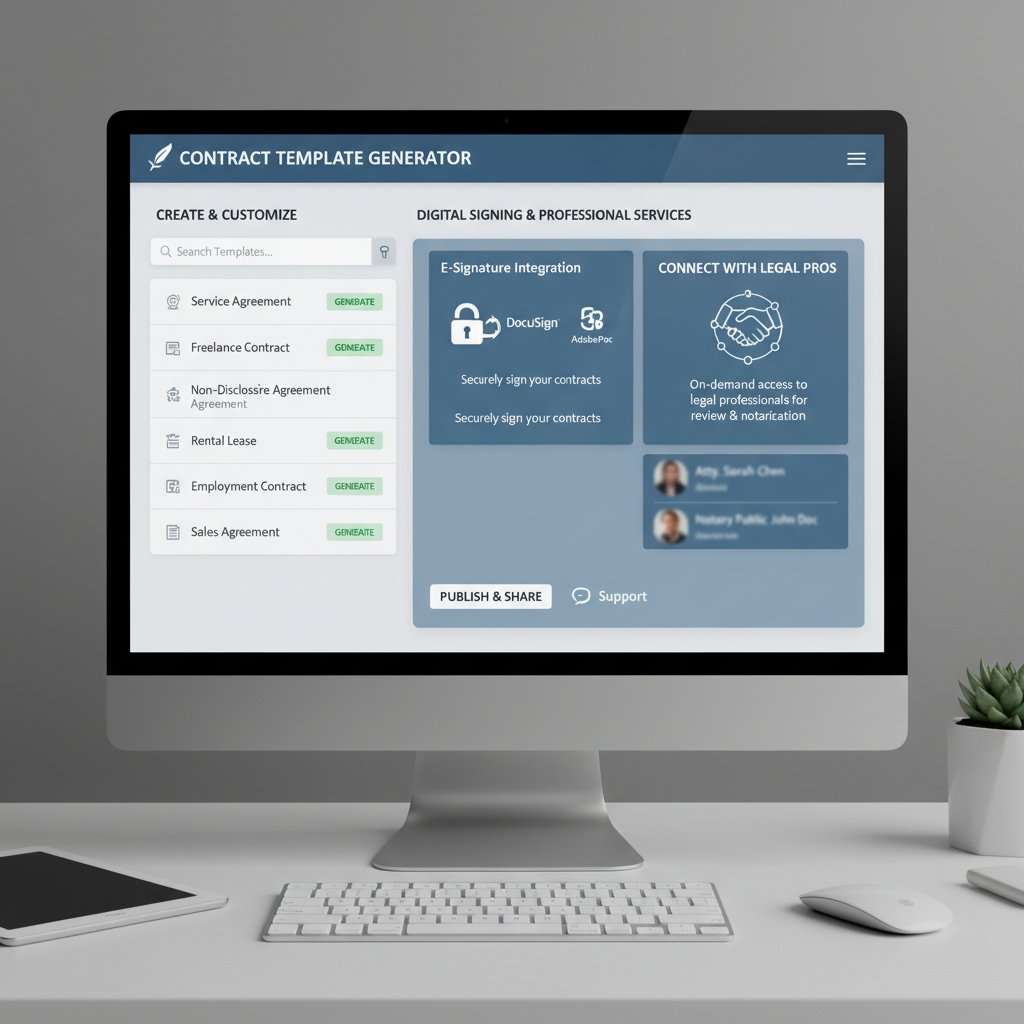
Take the case of a fast-growing tech startup: one botched NDA, hastily cobbled together from an outdated template, nearly cost them their intellectual property—and a multi-million-dollar partnership. The only thing that saved them? A last-minute review caught the missing confidentiality clause. The lesson: automation isn’t just about speed. It’s about having guardrails when stakes are highest.
Case study: How one bad contract almost tanked a business
Picture this: Jamie, founder of a boutique marketing agency, lands a lucrative contract with a national retailer. Rushed and overwhelmed, they grab a free online template, make a few tweaks, and hit send. Months later, the client refuses to pay, citing ambiguous deliverables. The template—never reviewed by a legal expert—doesn’t specify timelines, milestones, or remedies for breach. Arbitration drags on. Legal bills mount. The agency survives, but only barely.
Had Jamie used a robust contract template generator—one offering AI-driven clarity checks, milestone fields, and expert-vetted templates—the disaster could have been avoided. According to Coefficient.io, “Templates crafted by legal experts ensure compliance and clarity.” Tools like filecreator.ai are built to make these pitfalls less likely, offering accessible, professional-grade templates that don’t leave holes for disaster to slip through.
“We didn’t know what we didn’t know—until it cost us everything.” — Jamie, Agency Founder
The risks, the red flags, and the wild unknowns
Not all that glitters: Common pitfalls in contract automation
The promise of contract automation is seductive—speed, accuracy, and risk reduction. But there’s a dark side. Overreliance on AI, without human review, can create a false sense of security. Templates that look polished may still contain outdated or irrelevant clauses. Poorly secured cloud-based systems expose sensitive data to breaches—a nightmare scenario in regulated industries.
- Data privacy blind spots: Not all platforms encrypt data at rest or in transit. Check for SOC 2 or ISO 27001 certification.
- Incomplete customization: Some generators force users into rigid templates, ignoring business-specific needs.
- Lack of expert review: AI-powered tools aren’t a substitute for human legal oversight—especially for complex deals.
- Poor integration: Tools that don’t sync with your core business systems create bottlenecks, not efficiency.
- Hidden fees: “Freemium” models may lock essential features behind paywalls, driving up costs mid-process.
- Opaque clause libraries: If you can’t see who authored or last updated a clause, you can’t trust it.
- Workflow fragmentation: If the tool doesn’t cover the full lifecycle—from drafting to e-signature to archive—expect chaos.
- Jurisdictional blind spots: Many generators don’t account for local laws, exposing users to compliance risks.
The fix? Due diligence. Vet your provider’s security, compliance credentials, and template authorship. Always combine automation with periodic human review—especially for high-value agreements.
Are they really legally binding? The gray areas explored
Are AI-generated contracts worth the digital paper they’re printed on? In most jurisdictions, the answer is yes—if they meet the same requirements as traditional contracts: offer, acceptance, consideration, and mutual assent. The e-signature laws in the US (ESIGN Act), EU (eIDAS Regulation), and many Asian markets recognize digital agreements as enforceable.
But gray areas remain. Some courts scrutinize automated contracts more closely, especially if the language is ambiguous or lacks evidence of true consent. International deals raise the stakes, as local requirements for witnessing, notarization, or specific disclosures may not be covered by generic templates.
| Region | Digital Signature Legal? | AI-generated Contracts Accepted? | Notes |
|---|---|---|---|
| USA | Yes (ESIGN) | Yes, if compliant | State law may impose extra rules |
| EU | Yes (eIDAS) | Yes, strong legal framework | Varies by member state |
| UK | Yes | Yes | Guidance encourages best practice |
| Asia-Pacific | Mixed | Varies | Some require physical signatures |
| Middle East | Mixed | Limited | Some recognize only for certain deals |
Table 3: Global snapshot—legal acceptance of digital/AI-generated contracts by region.
Source: Original analysis based on Zefort, International Comparative Legal Guides, and DocuSign, 2023.
“Legal doesn’t always mean bulletproof.” — Morgan, Contract Law Specialist
How to choose—and actually master—a contract template generator
Step-by-step: From chaos to clarity
- Audit your current contracts: Identify gaps and pain points—missing clauses, compliance risks, or lost agreements.
- Define your must-haves: List the features and integrations your business can’t live without.
- Research providers: Compare tools based on compliance, customization, and integration—filecreator.ai is a good starting point for professional solutions.
- Vet security credentials: Look for SOC 2, ISO 27001 certifications, and robust encryption.
- Review template libraries: Ensure templates are crafted or reviewed by legal experts, not just generic algorithms.
- Run a test draft: Generate sample contracts and review for clarity, completeness, and relevance.
- Pilot with a small team: Gather feedback from real users—legal, sales, HR, finance.
- Integrate with workflows: Connect the generator to your e-signature tools, CRM, and cloud storage.
- Establish review protocols: Set up periodic audits to catch template drift or legal changes.
- Train your team: Offer training to ensure everyone uses the tool correctly and consistently.
Tip: Integrate your contract generator with popular platforms to turbocharge your workflow. Tools like filecreator.ai are designed for seamless connections, making the transition from chaos to clarity as painless as possible.
Priority checklist for contract generator implementation:
- Secure cloud storage for contracts with access controls.
- Legal expert-reviewed clause library.
- Robust customization with built-in compliance checks.
- Full lifecycle management: draft, e-sign, archive.
- Multi-format export (PDF, DOCX, etc.).
- Transparent audit trail for every document.
- Regular software updates and compliance monitoring.
- 24/7 support and user training resources.
Cost, value, and the hidden math of automation
Pricing for contract template generators ranges from freemium models to enterprise subscriptions or pay-per-use. While free tools lure small teams, professional solutions justify their price by slashing manual hours, reducing legal spend, and minimizing costly errors.
| Model | DIY Templates | Professional Generator | Traditional Lawyer |
|---|---|---|---|
| Upfront cost | Low | Medium | High |
| Customization level | Limited | High | Highest |
| Compliance assurance | None | Automated | Manual |
| Risk of human error | High | Low | Low |
| Total time investment | High | Low | High |
| Support & updates | None | Included | By request |
Table 4: Cost-benefit analysis—DIY vs. professional generator vs. traditional lawyer.
Source: Original analysis based on Writify.AI, Zefort, and Forbes, 2024.
But don’t get blinded by sticker price. The real value lies in reduced risk, fewer disputes, and the ability to scale your contract operations as your business grows. Support, regular updates, and compliance monitoring are non-negotiables for any serious user.
The future is now: AI, smart contracts, and what’s next
AI’s wild promise—and what keeps lawyers up at night
The contract template generator is no longer a novelty—it’s the new normal. AI-driven advances now enable real-time clause negotiation, self-executing “smart contracts” on blockchain, and risk scoring that flags dangerous terms before you hit send. According to Ricky Spears, “Blockchain integration enhances transparency and immutability,” offering an audit trail no human can fudge.
But the legal world isn’t sleeping easy. AI bias, lack of accountability, and ever-evolving standards keep even the most seasoned lawyers awake at night. The technology can catch contradictions faster than any paralegal, but it can just as easily miss context, intent, or a well-camouflaged loophole.

Disruption or democratization? Societal impacts revealed
Is this a revolution for the many, or a new risk for the unwary? The jury’s still out. Automation levels the playing field, making professional-grade contracts accessible to those who once couldn’t afford a lawyer. But it also introduces new risks: data privacy, over-automation, and the potential for mass-produced mistakes.
Experts like those at Zefort emphasize, “Automation is essential to reduce risk and improve efficiency in contract workflows.” Meanwhile, user stories abound of freelancers and SMBs winning big by switching to smart, customizable templates. Yet, some organizations have lost millions to poorly implemented automation—often due to neglecting human oversight.
- Automated NDAs for creative collaborations: Protect IP on the fly for artists, musicians, and agencies.
- Rapid vendor onboarding for supply chains: Slash weeks off procurement cycles with reusable templates.
- Freelancer onboarding in the gig economy: No more wrangling Word docs—just click, sign, and go.
- Global affiliate agreements: Generate compliant contracts for partners in dozens of countries.
- Equity splits for startups: Automate founder and investor agreements with smart templates.
- Healthcare consent forms: Secure, HIPAA-compliant patient agreements at scale.
- Influencer marketing deals: Standardize deliverables and payment terms for every campaign.
As automation spreads, expect regulators and industry bodies to step up—demanding better standards, transparency, and auditability. The question isn’t whether you’ll automate contracts. It’s how you’ll survive the wild unknowns that come with it.
The final verdict: Are contract template generators worth the hype?
What the experts and the data really say
After sifting through the hype, the data, and the scars of real-world contract disasters, one thing is clear: contract template generators are reshaping the way we form, execute, and enforce agreements. According to Zefort, organizations leveraging automation report up to 70% faster contract turnaround and far fewer compliance headaches. But the tech isn’t bulletproof. It demands due diligence, integration, and—yes—a healthy dose of skepticism.
A recent study from Millennial Magazine confirms, “AI-powered generators reduce drafting time by up to 70%,” but warns that overreliance without expert review remains risky. The best results come from combining technology with human expertise. For those willing to invest in training, integration, and periodic reviews, the ROI is undeniable.

Different users will take different paths: small businesses and freelancers win on speed and accessibility; enterprises win on risk reduction and control. For all, the right contract template generator—paired with smart policy—delivers a strategic edge.
Your next move: How to get started (without regrets)
Here’s the hard truth: if you’re still relying on outdated templates, manual drafting, or email chains, you’re gambling with your company’s future. Now is the time to rethink your contract process—before a single misstep costs you everything.
Start by auditing your needs and researching providers. Look for tools that combine expert-vetted templates, robust compliance, airtight security, and real integration. Use checklists and pilot programs to avoid costly surprises. Need a reliable resource? Platforms like filecreator.ai are a solid starting point for those seeking professional-grade solutions that don’t require a law degree to operate.
Challenge your assumptions. Ask hard questions. Don’t be afraid to break from tradition—because in the contract revolution, status quo is the riskiest move of all. Whether you’re ready to sign, seal, and automate, or still debating the leap, the evidence is clear: the wild future of contract template generators is already here. Are you ready to grab it by the horns?
Sources
References cited in this article
- Ricky Spears – The Ultimate Guide to Business Contract Templates 2025(rickyspears.com)
- Zefort – The State of Contract Management in 2025(zefort.com)
- Coefficient.io – Free Contract Templates(coefficient.io)
- Millennial Magazine – AI Contract Generator(millennialmagazine.com)
- Writify.AI – AI Contract Generator(writify.ai)
- BRYTER – Employment Contract Generator(bryter.com)
- Bonsai – Freelance Contract Templates(hellobonsai.com)
- Summize – Contract Management Trends 2024(summize.com)
- fynk – 40 Contract Management Trends for 2025(fynk.com)
- Sirion – CLM Market for 2025(sirion.ai)
- Aavenir – Top 7 CLM Trends 2025(aavenir.com)
- Concord – Contracting Trends 2025(concord.app)
- Signaturely – Free Contract Templates(signaturely.com)
- Juro – Automated Templates(juro.com)
- Zoho Contracts – Contract Templates(zoho.com)
- Indy – Contract Templates(weareindy.com)
- Juro – Contract Automation(juro.com)
- 0Hands – Top 5 Contract Generation Tools(0hands.com)
- ContractPodAI – Auto-Contract Desk(contractpodai.com)
- Precisely – Contract Templates and Workflow Automation(preciselycontracts.com)
- AcademyOcean – AI Employee Contract Generator(academyocean.com)
- PandaDoc – Official Contract Templates(pandadoc.com)
- Kata.ai – Customizing Legal Templates(kata.ai)
- SafetyCulture – Contract Management Template(safetyculture.com)
- BlueNotary – Contract Template Word(bluenotary.us)
- Grandview Research – Legal Technology Market(grandviewresearch.com)
- Verified Market Research – Contract Management Software(verifiedmarketresearch.com)
- SpotDraft – AI Contract Generator(spotdraft.com)
- Venngage – AI Contract Generator(venngage.com)
- Jotform – AI Contract Generator(jotform.com)
- MyDock365 – Poor Contract Management(mydock365.com)
- Weagree – Contract Automation Business Case(weagree.com)
- LegalVision UK – Risks of Poorly Drafted Agreements(legalvision.co.uk)
- CobbleStone Software – Consequences of Poor Contract Management(cobblestonesoftware.com)
- GatekeeperHQ – Contract Management Automation(gatekeeperhq.com)
Perfect Documents, Instantly
Filecreator.ai transforms the way you produce professional documents. Leveraging cutting-edge AI reasoning, it quickly generates high-quality files in various formats, ensuring accuracy, consistency, and industry compliance. Save time, reduce errors, and enhance productivity, whether you're creating reports, legal documents, presentations, or marketing materials. Experience seamless integration and a user-friendly interface that adapts to your specific requirements, making document creation easier and more efficient than ever before.
Get startedStart Creating Professional Documents Today
Join thousands of professionals who trust AI-powered document generation
Frequently Asked Questions
What is a contract template generator and how has it changed the way contracts are created?
A contract template generator is an AI-powered tool that shifts the power to create contracts from legal professionals to anyone with internet access. Rather than just providing Word documents or PDFs, it represents a fundamental change in how organizations—from startups to global companies—create, manage, and handle their agreements, automating what was once an exclusive domain of lawyers and scribes.
What are the main risks of using AI-powered contract automation?
While AI-powered contract automation can eliminate mistakes with a click, it can also strip away important nuance, accountability, and competitive advantages that human lawyers would preserve. The article emphasizes that not understanding the risks behind the technology is itself dangerous.
How did the ability to create contracts shift from lawyers to everyday users?
The rise of the internet, remote work, gig economies, and SaaS platforms made automation an existential requirement rather than a luxury, shifting the power to generate contracts from the legal elite to anyone with Wi-Fi and a browser tab. This democratization was driven by societal shifts that rendered traditional legal rituals obsolete.
What does the article suggest about the future of contract management?
According to the article, AI and automation in contract management represent a paradigm shift, and the key question is who will adapt to this new reality and who will be left behind. Organizations that understand both the power and pitfalls of contract template generators will have a competitive advantage.
Continue Reading
Explore more from Professional Document Generator

Contract Template Generator Online: What the Risks Really Are
Contract template generator online tools offer speed but carry risks. This article examines why 80% of small businesses use them, the hidden dangers, and what to know before signing.

Contract Generation Software: Risks and Benefits Explained
Contract generation software is reshaping business workflows. This article examines eleven core realities

Customizable Contract Templates: Where the Real Risks Lie
Customizable contract templates offer convenience but carry hidden risks. This article examines the pitfalls, why exposure occurs, and how to use them safely.

Nine Critical Truths About Generating Business Contracts
Generating business contracts involves hidden risks most guides omit. This article covers nine key truths about contract generation, from AI pitfalls to common DIY mistakes.

Automated Customized Contracts: Benefits, Risks, and Implementation
Generate automated customized contracts efficiently while managing risks. This article explains how automation works, what pitfalls to avoid, and where real business gains appear.

Contract Document Creator Vs Lawyer: the Actual Tradeoffs
Contract document creators are reshaping business agreements with AI automation. This article explains the real tradeoffs, the risks professionals overlook, and when each tool works best.


