

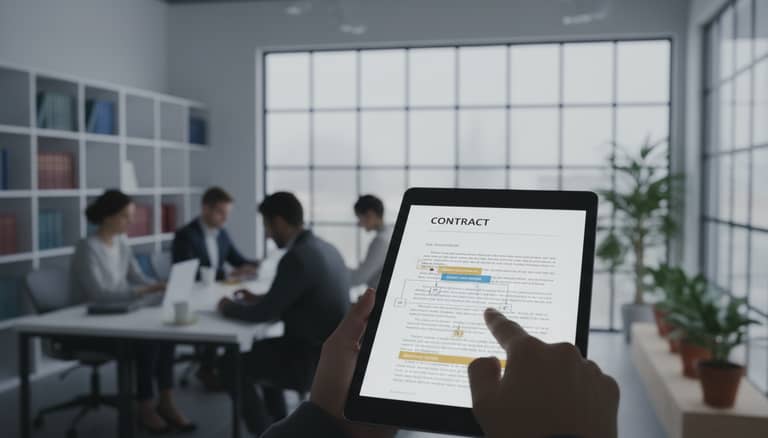
Contract Drafting Software Solutions That Prevent Million‑dollar Mistakes
Written with AI assistance under our editorial guidelines
Contract drafting software solutions automate agreement creation and reduce costly errors that can damage businesses. The market, valued at $2.4 billion in 2023, is projected to triple within a decade as AI-powered tools proliferate. Bad contracts cost organizations over 9% of annual revenue, making software adoption increasingly critical for protecting business interests and preventing million-dollar mistakes.
Staring down a contract, pen poised or cursor blinking, is a universal business ritual. But what if the biggest risk isn’t what’s in the fine print—but who, or what, drafts it? Contract drafting software solutions have detonated onto the scene, promising to automate the grind, eliminate errors, and maybe even out-think your legal team. The market—worth around $2.4 billion in 2023—is on a tear, with projections threatening to triple within a decade. AI-powered tools are everywhere, and the hype machine is relentless. But beneath the sleek dashboards and bold ROI claims, there’s a story no one wants to tell you. This is the unvarnished guide to the raw realities, the hidden costs, and the shocking upsides of contract drafting software solutions in 2025. Whether you’re a legal rebel, a risk-averse CFO, or a founder just trying to keep the lights on, welcome to the dealmaking revolution—warts and all.
Why your next contract could make or break your business
The true cost of one bad contract
It’s a dirty secret: most businesses will, at some point, sign a contract that backfires—often spectacularly. According to a 2024 Slack survey, over 40% of small business owners admit this year could be “make or break” for their organizations. Contracts, far from mere formalities, define obligations, risks, and revenue. Yet, a single poorly drafted agreement can tank a deal, trigger lawsuits, or bleed cash through missed protections. The Institute for Supply Management estimates that bad contracts cost organizations more than 9% of annual revenue—a figure that should make every decision-maker’s blood run cold.

“People underestimate the silent damage of badly drafted contracts—they’re like termites, eroding trust and profit from the inside out.” — Jane Millar, Contract Risk Analyst, Global Info Research, 2024
Manual drafting: a relic in a digital world
For generations, contract drafting was a painstaking, manual process. Hours lost to retyping clauses, copy-paste errors, and version control nightmares. In 2023, over 60% of new contract drafting solutions were cloud-based, signaling a sharp pivot away from Word docs and local folders. The gulf between traditional and modernized approaches isn’t just cosmetic—it’s existential.
| Factor | Manual Drafting | Software Solutions | Cloud AI-Powered Tools |
|---|---|---|---|
| Average Drafting Time | 3-8 hours | 1-2 hours | 10-20 minutes |
| Error Rate (per doc) | 8-15% | 3-6% | 1-2% |
| Version Control | Manual, high risk | Automated, moderate risk | Real-time, low risk |
| Accessibility | Office-only | Local network/cloud hybrid | Anywhere, anytime |
| Compliance Checks | Manual | Rule-based | AI-driven, continuous |
Table 1: Comparing manual, software-based, and AI-powered contract drafting approaches. Source: Original analysis based on Verified Market Reports, 2024, Global Info Research, 2024.

The new stakes: speed vs. accuracy
The heart of the contract drafting revolution is a tension as old as business: speed versus accuracy. Automation can cut drafting time by more than 80%, according to data aggregated from leading contract management providers in 2024. But shaving hours off the process means nothing if errors slip through.
Speed is seductive—especially when deadlines loom—but accuracy keeps you out of court. Here’s where most organizations get it wrong:
- Underestimating the risk: Rushed drafts often miss critical protections or introduce ambiguity.
- Overreliance on “template” clauses: What’s fast isn’t always fit-for-purpose.
- Ignoring context: Contracts are as much about nuance as they are about clauses—something AI still struggles with.
Contract drafting software solutions: what they actually do (and don’t)
Beyond templates: how smart is your software, really?
The days of static templates are numbered. Today’s contract drafting software solutions, especially those leveraging AI, promise dynamic clause suggestions, risk flagging, and even plain-language summaries. Over 40% of providers now tout AI-powered features, particularly for clause creation and simplification. But here’s the uncomfortable truth: not all “smart” software is built the same.
Some vendors essentially slap a search-and-replace interface on a glorified template library. The best solutions—like those integrating with CLM (Contract Lifecycle Management) systems—actually learn from your past deals, surfacing preferred language for specific scenarios and highlighting deviations from norm. Yet, even the most advanced algorithms can miss the subtlety of a crafty negotiation or the intent buried in a single phrase.

The myth of the one-click contract
No matter what the glossy marketing claims, there’s no such thing as the “one-click contract.” Drafting deals is messy, contextual, and riddled with exceptions. According to a 2024 analysis by Verified Market Reports, 30–40% of businesses hesitate to adopt these tools, driven by fear of hidden risks and implementation headaches.
“Automation is a lever—not a silver bullet. The idea that software can replace judgment, especially in high-stakes negotiations, is pure fantasy.” — Mark Dalton, Legal Tech Analyst, Verified Market Reports, 2024
- Software can automate structure, not strategy: It can build the skeleton but can’t divine your commercial priorities.
- Review is still essential: AI catches patterns, but humans catch intent.
- Edge cases will always exist: The 5% of “we’ve never seen this before” scenarios are where businesses lose (or win) big.
What contract drafting software can’t replace
Even the best software is not a substitute for lived experience or deep legal acumen. Consider:
- Negotiation instincts: No algorithm can sense hesitation in a counterpart’s voice or infer pressure behind a late-night clause change.
- Business context: Software doesn’t know your company’s appetite for risk, only what’s statistically “normal.”
- Regulatory nuance: While AI can flag common compliance pitfalls, it won’t interpret the latest regulatory shifts overnight.
Key terms:
Refers to the use of machine learning algorithms and natural language processing tools to automate or assist in drafting legal agreements. Not a replacement for legal review.
A digital repository of pre-approved contract language, enabling faster drafting but only as good as the updates and oversight it receives.
A software module that checks drafted contracts against internal policies and regulatory standards. Relies on rulesets that must be actively maintained.
Inside the machine: how AI really drafts your contracts
Machine learning, clause libraries, and the illusion of ‘smart’
AI contract drafting isn’t magic—it’s the result of years of feeding millions of clauses into algorithms hungry for patterns. Most systems rely on massive clause libraries, statistical analysis, and supervised learning. The software highlights “standard” versus “risky” phrases, suggests alternative wording, and flags missing sections. But the “illusion of smart” is real: if the data is outdated, biased, or shallow, so are the outputs.

| Capability | Basic Software | AI-Powered Solutions | Predictive Analytics Tools |
|---|---|---|---|
| Clause Suggestions | Template-based | Dynamic, context-aware | Predictive, risk-adjusted |
| Risk Flagging | Rule-based | Machine learning | Forecasting impact |
| Outcome Prediction | Absent | Limited | Present, scenario modeling |
Table 2: Levels of intelligence in contract drafting platforms. Source: Original analysis based on Global Growth Insights, 2024, Global Info Research, 2024.
Data bias: when your software brings its own baggage
If you feed a machine learning model a steady diet of old contracts skewed toward a certain risk profile, don’t be shocked when it perpetuates those same biases. According to Global Growth Insights, 2024, predictive analytics is on the rise—yet the results are only as good as the data behind them.
“AI is only as unbiased as its training set. Garbage in, garbage out isn’t just a cliché—it’s a multimillion-dollar risk.” — Priya Venkataraman, Data Ethics Specialist, Global Growth Insights, 2024
And because so many early adopters are large enterprises with specific legal preferences, the software can skew toward their practices, potentially making it a poor fit for startups or nontraditional industries.
Can you trust AI with your most sensitive deals?
Here’s where the bravado meets the brick wall. Trusting a black-box model with your critical contracts is a leap—not a step. Among the biggest concerns, as flagged by a 2023–2024 cross-industry study, are data security, privacy, and unexpected AI failures.
- Data exposure: Cloud-based tools transmit your sensitive deal terms over the internet. Are you comfortable with that?
- Opaque logic: Even the vendors themselves sometimes struggle to explain why the algorithm flagged (or missed) certain issues.
- Brittle under pressure: Unique or high-stakes deals can trip the software, producing bland or even dangerous outputs.
Choosing the right contract drafting software: a ruthless guide
Core features that actually matter
Don’t get dazzled by dashboards. Focus on features that move the needle for your business:
- Integration with CLM systems: Ensures all your contracts live in one ecosystem, boosting ROI.
- AI-powered clause suggestions: Not just templates, but context-aware recommendations.
- Robust version control: For auditing, negotiation, and compliance.
- User permissions and audit trails: Vital for security and accountability.
- Scalable cloud infrastructure: Especially important with remote teams and cross-border agreements.

Spotting red flags: marketing hype vs. reality
If you want to avoid buyer’s remorse, scrutinize the vendor’s claims. Here’s what to watch for:
- “One size fits all” messaging: Real contract workflows are messy—avoid tools that pretend otherwise.
- Opaque AI claims: “Powered by AI” is meaningless without specifics on data sources and model transparency.
- Hidden implementation fees: Many solutions bury setup or integration costs deep in the fine print.
“The most dangerous software is the one that promises everything and delivers little. Ask tough questions, demand real demos, and talk to reference clients.” — Lila Nguyen, Legal Tech Buyer, Global Info Research, 2024
- Check for ongoing support: Post-sale service is where many vendors vanish.
- Insist on security certification: Especially for cloud-based solutions—ask for ISO or SOC 2 documentation.
- Probe update schedules: Stale clause libraries are a silent liability.
Checklist: are you really ready for automation?
Taking the plunge? Here’s what you must nail down before rolling out software at scale:
- Define your business needs: What types of contracts, what volume, what complexity?
- Audit your existing processes: Where do errors, delays, or bottlenecks occur?
- Secure executive buy-in: Change management lives or dies by top-down commitment.
- Plan for training: Even intuitive software requires onboarding.
- Establish feedback loops: Keep tuning the solution as your contracting evolves.
The hidden costs (and surprise savings) nobody tells you about
Implementation headaches: what the sales team won’t say
You won’t hear it on a vendor webinar, but deployment is rarely seamless. Integration with legacy systems, data migration, and user resistance can sap momentum and budget.

| Cost Category | Typical Range | Often Overlooked? |
|---|---|---|
| Initial Licensing | $5K–$100K+ | No |
| Setup & Integration | $1K–$50K | Yes |
| Training | $500–$20K | Yes |
| Change Management | $2K–$30K | Yes |
| Downtime | Varies | Yes |
Table 3: Common (and hidden) costs in contract drafting software deployment. Source: Original analysis based on Verified Market Reports, 2024.
Training, change management, and the human factor
Even the best tech can flop if people aren’t on board. Ignore training and change management at your peril.
- User inertia: People cling to old workflows; pushback is inevitable.
- Misaligned incentives: If legal and sales teams aren’t aligned, adoption fizzles.
- Knowledge decay: Without ongoing training, users revert to dangerous workarounds.
Ultimately, the human factor determines whether new software soars or sinks. Culture eats strategy for breakfast—and tech for lunch.
How to calculate ROI when the numbers don’t add up
Calculating ROI on contract drafting software is notoriously tricky. Vendors love to tout time saved, but hidden costs can erode gains. Here’s a real-world methodology:
- Track baseline metrics: Time to draft, error rate, dispute frequency.
- Quantify all costs: Licensing, integration, downtime, training.
- Monitor impact: Assess not just speed but error reduction and deal outcomes.
- Factor in surprises: Did you need extra IT support? Was user adoption slower than planned?
- Revisit regularly: The ROI math will shift as your business and software evolve.
Case studies: when contract drafting software saved (or wrecked) the deal
The $2 million oversight: a cautionary tale
An international manufacturer deployed AI contract drafting, eager to save time. But when a critical indemnity clause was omitted due to a misconfigured rule, a supply chain dispute spiraled into a $2 million legal payout. Human review had become a box-ticking exercise.

“Automation is a powerful tool, but it cannot replace the value of critical thinking. Our mistake was treating software output as gospel.” — Anonymous General Counsel, Manufacturing Sector, 2024 (case data anonymized)
How a startup scaled with automation (and what nearly went wrong)
A fintech startup, scrambling to onboard clients faster, integrated cloud-based contract drafting software. Automation slashed contract turnaround from days to minutes, propelling rapid growth. But the initial rollout led to several near-misses: legacy clause libraries didn’t match new regulatory requirements, and user training lagged.
- Lesson #1: Speed is worthless if compliance is outpaced.
- Lesson #2: Customization is essential. One-size-fits-all clauses nearly cost the company a major client.
- Lesson #3: Ongoing feedback from users and legal counsel is non-negotiable.
filecreator.ai in the real world: a quiet revolution
Professional Document Generators like filecreator.ai are quietly transforming how companies draft contracts. By leveraging advanced AI for document creation, organizations report reduced drafting time, minimized errors, and improved compliance. In one case, a mid-size consultancy cut contract cycle time by 70%, freeing up legal resources for strategic work. While not a substitute for expertise, such platforms amplify it—making contract creation a lever for growth, not a bottleneck.

Debunking the biggest myths about contract drafting software solutions
Myth 1: ‘AI will replace lawyers’
Let’s torch this myth once and for all. While automation can handle grunt work—drafting, flagging, formatting—it cannot replace the judgment, context, and nuance that experienced lawyers bring.
“AI is a tool, not a replacement for professional judgment. The best results come from collaboration, not competition.” — Tania Foster, Legal Automation Consultant, Global Info Research, 2024
- AI accelerates routine tasks: It’s a force multiplier, not a disruptor of expertise.
- Lawyers focus higher: With automation, legal professionals can zero in on negotiation and risk.
- Regulation still rules: Only a human can interpret evolving laws in context.
Myth 2: ‘All software is basically the same’
This myth is deadly—and expensive. The contract drafting software solutions landscape is wildly heterogeneous.
Platforms using machine learning and natural language processing for advanced clause suggestions and risk analysis. Not all AI is equal.
Rely on static clause libraries and minimal automation. Often lack integration and adaptability.
Full-suite platforms for drafting, negotiation, storage, and analytics. Integration complexity varies.
Feature checklists don’t tell the full story. Look beneath the surface for integration, analytics, and support quality. Don’t confuse a shiny UI with substance.
Myth 3: ‘You can set it and forget it’
This is the shortest route to disaster. Contract drafting software requires ongoing tuning, oversight, and user engagement.
- Regular updates: Clause libraries and compliance rules must be refreshed often.
- Continuous training: Users need periodic refreshers and onboarding for new features.
- Feedback loops: Software should evolve with your business—not the other way around.
The future of contract drafting: trends, threats, and opportunities
The rise of hybrid human-AI teams
The most effective organizations don’t pick sides—they blend human expertise with AI horsepower. Legal professionals oversee strategy, while software crunches the grunt work. This hybrid model is already boosting productivity in forward-thinking companies, according to aggregated reports from 2024.

| Team Composition | Pros | Cons |
|---|---|---|
| Human-only | Context, judgment | Slow, error-prone |
| AI-only | Fast, scalable | Risk of critical oversights |
| Hybrid human + AI | Best of both, scalable, safe | Requires coordination |
Table 4: Analyzing contract drafting team models. Source: Original analysis based on Global Growth Insights, 2024.
New threats: cybersecurity, deepfakes, and digital forgery
As contract drafting migrates online, the threat landscape morphs.
- Cyberattacks targeting contract data: Hackers covet sensitive deal terms and personal data.
- Deepfake signatures and digital forgeries: AI can now mimic handwritten signatures and generate fake documents with chilling realism.
- Phishing via automated contract notifications: Malicious actors exploit trusted software to trick users.
The upshot? Security is not optional—it’s existential. Companies must vet software partners ruthlessly and train staff for digital hygiene.
The paradox: as defenses improve, so do the tactics of bad actors. Staying ahead is a forever game.
What’s next: predictions for 2025 and beyond
Forget the hype—focus on what’s really happening:
- AI gets better at language but not context: Expect smarter drafting, but not sentient negotiation partners.
- Predictive analytics move mainstream: Risk modeling and outcome forecasting are now table stakes.
- Regulatory pressure intensifies: Governments are scrutinizing AI-generated documents for compliance (and liability).
- Vendors consolidate: Expect shakeouts as leaders emerge and weak players fold.
- User experience becomes the battleground: Tools that are powerful yet intuitive will dominate.
Your action plan: how to get the most from contract drafting software solutions
Step-by-step guide to implementation
Rolling out contract drafting software is a marathon, not a sprint. Here’s a proven path:
- Map your existing workflows: Identify pain points, redundancies, and must-have integrations.
- Select a pilot group: Start with a small, motivated team to iron out wrinkles.
- Customize clause libraries: Tailor language and rules to your business needs.
- Train your users: Invest in onboarding, not just product demos.
- Monitor and iterate: Collect feedback, track metrics, and refine processes continuously.

Checklist: is your team ready?
- Team understands current contract pain points and goals.
- Executive sponsors are engaged and supportive.
- IT and legal are aligned on security and compliance.
- Training resources and schedules are in place.
- Feedback mechanisms are ready for continuous improvement.
Getting buy-in across silos is the difference between a failed rollout and a gamechanger.
Quick reference: jargon decoded
The AI discipline enabling machines to understand and generate human language. Powers contract clause recognition and summarization.
The rule set that determines which alternative clauses are inserted when standard provisions don’t fit.
Automated assessment of contract terms for deviation from policy, often using color-coded dashboards.
A little jargon goes a long way. Knowing the lingo accelerates adoption and helps you ask sharper questions of vendors.
—
In the end, contract drafting software solutions are not just another SaaS checkbox—they’re a mirror for your business’s risk tolerance, process rigor, and appetite for change. Under the gloss, there are brutal truths: implementation stings, AI can trip up, and no one-click solution can ever replace critical thinking. But for those willing to grapple with the real costs—and the real opportunities—the rewards aren’t just measured in dollars saved or hours gained. They’re found in sharper deals, safer partnerships, and a business that’s ready for whatever the market throws next. So before you sign that next contract, ask not just what your software can do, but what you’re willing to demand of it.
Want to see what modern document generation and contract drafting can really do? Explore filecreator.ai—where the future is being written, one smart document at a time.
Sources
References cited in this article
- Global Info Research(globalinforesearch.com)
- Verified Market Reports(verifiedmarketreports.com)
- Global Growth Insights(globalgrowthinsights.com)
- TylerPaper(tylerpaper.com)
- Weissman Law Firm(idwlaw.com)
- ContractSafe(contractsafe.com)
- Richmond Journal of Law and Technology(jolt.richmond.edu)
- ContractWorks(contractworks.com)
- Oneflow(oneflow.com)
- V7Labs(v7labs.com)
- Thomson Reuters(legal.thomsonreuters.com)
- Cloud Contracts 365(cloudcontracts365.com)
- PandaDoc(pandadoc.com)
- Icertis(icertis.com)
- Slashdot(slashdot.org)
- SentinelOne(sentinelone.com)
- Forbes(forbes.com)
- Software Connect(softwareconnect.com)
- DraftWise(draftwise.com)
- Canadian Lawyer(canadianlawyermag.com)
- Thomson Reuters(legal.thomsonreuters.com)
- QYResearch(qyresearch.com)
- Gartner(legalsupportworld.com)
- Concord(concord.app)
- ContractSafe(contractsafe.com)
- Berkman Solutions(berkmansolutions.com)
Perfect Documents, Instantly
Filecreator.ai transforms the way you produce professional documents. Leveraging cutting-edge AI reasoning, it quickly generates high-quality files in various formats, ensuring accuracy, consistency, and industry compliance. Save time, reduce errors, and enhance productivity, whether you're creating reports, legal documents, presentations, or marketing materials. Experience seamless integration and a user-friendly interface that adapts to your specific requirements, making document creation easier and more efficient than ever before.
Get startedStart Creating Professional Documents Today
Join thousands of professionals who trust AI-powered document generation
Frequently Asked Questions
How much does contract drafting software contribute to the market economy?
The contract drafting software market was worth around $2.4 billion in 2023 and is projected to triple within a decade.
What percentage of revenue do bad contracts cost organizations?
According to the Institute for Supply Management, bad contracts cost organizations more than 9% of annual revenue.
What percentage of small business owners believe their current year is critical for their survival?
According to a 2024 Slack survey, over 40% of small business owners admit that the current year could be 'make or break' for their organizations.
What technology trend emerged in contract drafting solutions in 2023?
Over 60% of new contract drafting solutions in 2023 were cloud-based, marking a significant shift away from traditional Word documents and local folder storage.
Continue Reading
Explore more from Professional Document Generator

Automated Contract Drafting Software: Benefits and Risks Explained
Automated contract drafting software is reshaping legal document creation. This article examines the genuine advantages, the real risks, and how the technology is changing contract work.

Automatic Contract Drafting Software: What Works and Where Risks Emerge
Automatic contract drafting software is reshaping legal workflows. This article examines how the technology works, where risks emerge, and what businesses need to know before implementation.

Fast Contract Drafting Tools: Speed Versus Safety
Fast contract drafting tools balance speed with accuracy. This article examines how automation affects contract quality and which approaches actually reduce legal risk.

Contract Drafting Apps: What AI Can and Cannot Do
Contract drafting apps automate legal work, but this article explains the hidden risks and limitations AI still cannot address in business deals.

Contract Creation Software: Benefits, Risks, and How to Use It Well
Contract creation software accelerates deal-making but carries hidden risks. This article explains the trade-offs, common pitfalls, and strategies to maximize benefits safely.

Contract Generation Software: Risks and Benefits Explained
Contract generation software is reshaping business workflows. This article examines eleven core realities