


Contract Document Creator or Lawyer: What Matters Most in 2025
Written with AI assistance under our editorial guidelines
AI-driven contract document creators are rapidly automating deal-making and paperwork management, offering businesses speed and efficiency while introducing new risks. By 2026, organizations must decide whether to rely on these tools or maintain traditional lawyer involvement, balancing automation benefits against potential compliance and accuracy gaps that require human expertise.
The contract document creator isn’t some boring widget buried on a legal website—it's the engine quietly rewriting the rules of business in 2025. If you’ve ever wasted a day hunting down the latest contract version, or felt your heart sink reading a lawyer’s invoice, you already get the problem. But now, AI-driven contract tools are making deals faster, paperwork lighter, and—if you’re not careful—opening up new risks nobody talks about. This isn’t another product plug or a dry rundown. Instead, let’s crack into the real story: why digital contract creation is shaking up entire industries, the traps that even the pros stumble into, and the hidden wins that could put you miles ahead—or one misclick away from disaster. Whether you’re an entrepreneur, in-house counsel, or a freelancer hustling between gigs, understanding the brutal truths and unexpected benefits of modern contract automation is the difference between running your business and having it run you.
The digital contract revolution: how we got here and why it matters
From handshake deals to digital signatures: a brief history
In the not-so-distant past, trust was sealed with a handshake, and contracts were scribbled on napkins or hammered out over long-winded meetings. Over decades, as business scaled and risk multiplied, the simple handshake gave way to mountains of paperwork, legalese, and—finally—the digital contract. What began with faxed signatures evolved into today’s AI-powered document creators, where complex agreements can be generated, reviewed, and signed from a smartphone in a coffee shop. This transition wasn’t just about speed; it was about survival. Businesses that lagged behind in digitization struggled with lost documents, compliance nightmares, and legal bottlenecks.

| Year | Key Milestone | Impact on Contracting |
|---|---|---|
| 1970s | Photocopiers & Fax | First digital exchange of signed documents |
| 1999 | ESIGN Act (US) | Legalized electronic signatures |
| 2010 | Cloud document storage | Enabled remote contract management |
| 2020 | Mainstream AI contract creators | Automated drafting, review, and compliance |
| 2023 | 80% of Fortune 500 use AI contract tools | Industry-wide shift to automation |
Table 1: Timeline of technological and legal milestones in contract history. Source: Original analysis based on ContractSafe, 2024, Aavenir, 2024
Why traditional contracts failed a generation
Traditional contract creation was agony: endless redlines, Word doc chaos, and the perpetual dread that the "final version" wasn’t actually final. According to recent research, 89% of organizations rate their contracting process as ineffective, and professionals waste up to two hours just searching for contract language. It’s no wonder that nearly 40% of organizations can’t even pinpoint who is responsible for contract management. As Alex, a startup founder, bluntly put it:
"We used to spend days just formatting documents. Now it’s minutes—or seconds." — Alex, startup founder
The pressure to modernize is real. Outdated methods mean lost deals, compliance failures, and skyrocketing costs—basic contracts can run $7,000 in manual hours, while complex ones hit $50,000. Staying old-school is a risk that’s harder to justify every year.
The rise of AI: what changed in the last five years
Since 2020, AI has muscled into contract creation, slashing manual review times by up to 80%. Giants like IBM proved the model: their AI cut contract review time by 80%, accelerating deal closures and reducing risk. Suddenly, platforms like Professional Document Generator and filecreator.ai weren’t just conveniences—they became competitive necessities. Today’s contract document creators leverage natural language processing (NLP), machine learning, and clause libraries to deliver instant, compliant documents that used to take entire teams days to produce.

What is a contract document creator—and what is it really doing?
Under the hood: how these platforms actually work
A contract document creator is not just a glorified template library. Under the hood, advanced platforms combine natural language processing, legal logic engines, and dynamic template systems. NLP allows these tools to "understand" user input and map it to appropriate contract clauses, while template engines assemble documents in real-time. Clause libraries, vetted by legal experts, ensure compliance across industries and jurisdictions. The best platforms bake in e-signature integration, audit trails, and even AI-driven risk analysis.
Definition List: Key tech terms explained
-
Natural Language Processing (NLP)
NLP refers to algorithms that interpret and generate human language. In contract creators, NLP parses your instructions (e.g., "Add a non-compete clause") and maps them to the right legal language, reducing manual editing. -
Template Engine
A system that dynamically assembles contract sections based on user input. For example, a template engine can swap in industry-specific terms for healthcare or finance contracts, ensuring relevance. -
Clause Library
A curated, regularly updated database of pre-approved contract clauses, compliant with prevailing laws and best practices. These are the building blocks of reliable automated contracts.
But even with all this horsepower, there’s a catch: automation has limits. Human oversight is non-negotiable, especially when stakes are high or contract terms are non-standard. As any seasoned legal professional will tell you, judgment and context can’t be fully automated.
Not all creators are created equal: features that matter
The modern AI contract generator marketplace is crowded. The true difference isn’t just in the number of templates, but in features like customizable clauses, embedded compliance checks, and seamless e-signature workflows. Must-haves include:
- Custom clause editing—because no two deals are identical
- E-signature integration for remote closing
- Automated compliance verification (GDPR, HIPAA, industry-specific requirements)
- Dynamic audit trails for transparency
- Multi-format export (PDF, DOCX, etc.)
Nice-to-haves? User permissions, third-party integrations, and AI-driven risk scoring. Beware platforms that promise “one-click contracts” without offering granular control or transparency. If a tool can’t show you what’s happening behind the scenes, it’s overpromising.
| Platform | Custom Clauses | E-signature | Compliance Checks | Multi-format Export | Risk Scoring | User Ratings |
|---|---|---|---|---|---|---|
| filecreator.ai | Yes | Yes | Automated | Full support | Yes | 4.8/5 |
| Professional Doc Generator | Yes | Yes | Automated | Full support | Yes | 4.7/5 |
| Competitor X | Limited | Yes | Basic | PDF only | No | 4.2/5 |
| Competitor Y | No | No | Manual | DOCX only | No | 3.9/5 |
| Competitor Z | Yes | Yes | Manual | Limited | Limited | 4.0/5 |
Table 2: Feature matrix comparing leading contract document creators. Source: Original analysis based on Aavenir, 2024, Procurement Tactics, 2024
Debunking the myths: what these tools cannot do
No matter how slick the marketing copy, contract document creators aren’t magic wands. Myths abound—believing them can cost you big.
- "Set it and forget it" contracts? Dangerous fantasy; every deal needs review.
- Guaranteed legal enforceability? Only if the input matches the law and the facts.
- 100% error-free? AI reduces mistakes, but can’t anticipate every nuance.
- Total replacement for lawyers? Not even close—automation is an aide, not a substitute.
- No risk of bias or omission? AI reflects the data it’s trained on, biases included.
- Universal compliance? Regulations shift fast; static clauses quickly go stale.
- Instant customization for all scenarios? If only contracts were that simple.
"No tool can replace judgment. At best, it’s a smart sidekick." — Maya, AI ethicist
The anatomy of a smart contract: breaking down the essentials
Core elements every contract must include
A legally valid contract—digital or not—requires more than just swapping out names and dates. At its core, every contract should include:
- Offer: Clear statement of what’s being exchanged.
- Acceptance: Explicit confirmation by both parties.
- Consideration: The “what’s in it for me” factor—goods, money, or services.
- Legal purpose: Agreement must not break the law.
- Competent parties: All signers must have legal capacity.
- Mutual consent: No duress, fraud, or confusion.
- Definite terms: Who, what, when, how, and how much.
- Signature/Authentication: Handwritten or digital, it seals the deal.
Step-by-step guide: Building a bulletproof contract with a document creator
- Define the transaction: Identify what’s being exchanged, using plain language.
- Select the right template: Choose an industry-specific base document.
- Customize key clauses: Add, remove, or edit terms for clarity and relevance.
- Incorporate compliance checks: Integrate industry and jurisdictional requirements.
- Specify deliverables and deadlines: Avoid ambiguity at all costs.
- Assign roles and responsibilities: Clearly define each party’s obligations.
- Add signature fields and digital verification: Enable secure e-signing.
- Final review by a qualified professional: Human oversight ensures enforceability.
Customization vs. compliance: the balancing act
Automated contracts are seductive for their speed and ease, but customization is a double-edged sword. Lean too far into customization, and you risk breaking compliance; stick too closely to templates, and you sacrifice nuance. The best contract document creators give you guardrails—flexibility within limits—so you can tailor agreements without tripping legal wires.

To walk this line, always ensure custom fields are reviewed for legal accuracy and compliance. Platforms like filecreator.ai and Professional Document Generator are known for balancing these demands, but the final responsibility always rests with the user.
E-signatures, encryption, and the future of trust
E-signatures are now the backbone of digital contracting. Legally binding in most jurisdictions since the early 2000s, they offer speed and auditability. However, not all e-signature solutions are created equal. The best tools blend ease of use with robust encryption, ensuring contracts can’t be tampered with and every action is logged for future audits.
Table 3: E-signature adoption and security incidents
| Year | E-signature Adoption (%) | Reported Security Incidents |
|---|---|---|
| 2021 | 62 | 17 |
| 2022 | 74 | 12 |
| 2023 | 80 | 8 |
| 2024 | 83 | 6 |
Table 3: E-signature adoption rates and related security incidents in recent years. Source: Original analysis based on Weshare, 2024, ContractSafe, 2024
Modern contract creators employ end-to-end encryption and multi-factor authentication, making digital contracts arguably more secure than their paper ancestors.
When contract document creators go wrong: stories from the edge
Real-world case studies: disasters and near misses
Automation isn’t infallible. In one widely publicized incident, a large retailer adopted a contract generator without proper oversight. The platform’s default terms omitted a critical liability clause, resulting in multi-million-dollar exposure when a supplier failed to deliver. The fallout was ugly: lawsuits, headlines, and a compliance overhaul.

But it’s not all horror stories. In another instance, a finance startup caught a potentially ruinous error—mislabeling of payment terms—seconds before signing, thanks to an AI-powered flag in their document creator. The ability to instantly generate, review, and revise a new contract turned disaster into a near-miss, reinforcing why technology plus human attention beats either alone.
Red flags most users overlook
Most users fixate on price and speed, but ignore these warning signs:
- Vague or missing audit trails—if you can’t see who made changes, you’re exposed.
- Lack of regular legal updates—the tool is only as current as its last compliance refresh.
- "Universal" templates that ignore jurisdiction—laws are local, not global.
- Weak encryption or no two-factor authentication—easy prey for bad actors.
- Overly complex UIs that encourage misuse or incomplete inputs.
- No human review option—full automation is a fantasy for high-stakes deals.
- Poor customer support or lack of transparent documentation—predicts trouble when (not if) things go sideways.
Can you really trust AI with your business deals?
Debate rages over AI trustworthiness in legal automation. Critics point to algorithmic bias, training data gaps, and the risk of "black box" decisions. For many, the answer is vigilance. As Jordan, a veteran contract lawyer, put it:
"I’d rather double-check every clause than hand over control to an algorithm." — Jordan, contract lawyer
AI excels at speed and pattern recognition, but business deals are rarely one-size-fits-all. The best users treat automation as an ally, not a replacement.
Picking the right tool: comparison, checklists, and power moves
Critical comparison: what the top platforms get right (and wrong)
Not all contract document creators are built the same. While tools like filecreator.ai and Professional Document Generator lead on automation, compliance, and user experience, competitors often lag in advanced features or up-to-date compliance. User satisfaction hinges on more than flashy dashboards—it’s about reliable output, robust support, and transparent pricing.
| Platform | User Ratings | Core Features | Pricing Tier | Compliance Support |
|---|---|---|---|---|
| filecreator.ai | 4.8/5 | AI, templates, e-sign, audit | Moderate | Automated |
| Professional Doc Generator | 4.7/5 | AI, compliance, integrations | High | Automated |
| Competitor X | 4.2/5 | Templates, e-sign | Low | Basic |
| Competitor Y | 3.9/5 | Templates only | Low | Manual |
| Competitor Z | 4.0/5 | AI, limited templates | Moderate | Limited |
Table 4: Comparison table of user satisfaction, features, pricing, and compliance. Source: Original analysis based on Aavenir, 2024, ContractSafe, 2024
Priority checklist: what to vet before you commit
Serious about picking the right contract document creator? Here’s your due diligence checklist:
- Assess your industry’s compliance requirements—Don’t assume “one size fits all.”
- Demand transparent audit trails—Make every edit traceable.
- Test template flexibility—Can you genuinely customize?
- Verify e-signature legality in your jurisdiction—No shortcuts.
- Check frequency of legal updates—Stale templates are lawsuits waiting to happen.
- Scrutinize encryption and security protocols—Ask about certifications.
- Examine integration options—Works with your existing stack?
- Read real user reviews—Ignore paid testimonials.
- Try before you buy—Insist on a demo or trial period.
- Confirm customer support accessibility—Problems never wait for business hours.
Unconventional uses you haven’t considered
Contract document creators aren’t just for NDAs and vendor agreements. Power users leverage them in creative ways:
- Automating partnership agreements for influencer campaigns
- Simplifying licensing contracts for digital creators
- Streamlining employee onboarding with custom HR docs
- Managing intellectual property transfers for startups
- Standardizing freelance agreements in the gig economy
- Archiving and versioning historical contracts for compliance audits
The only real limit? Your willingness to experiment.
The hidden costs—and unexpected benefits—of automation
What you save (and what you risk losing)
Going digital slashes wasted hours, axing manual drafting and review. According to ContractSafe, AI can cut contract review times by 80%, and organizations who digitize reduce supply chain emissions by 20%. But all that speed brings risk: generic language can strip nuance, personalization is hard to automate, and compliance errors creep in if you’re not vigilant.
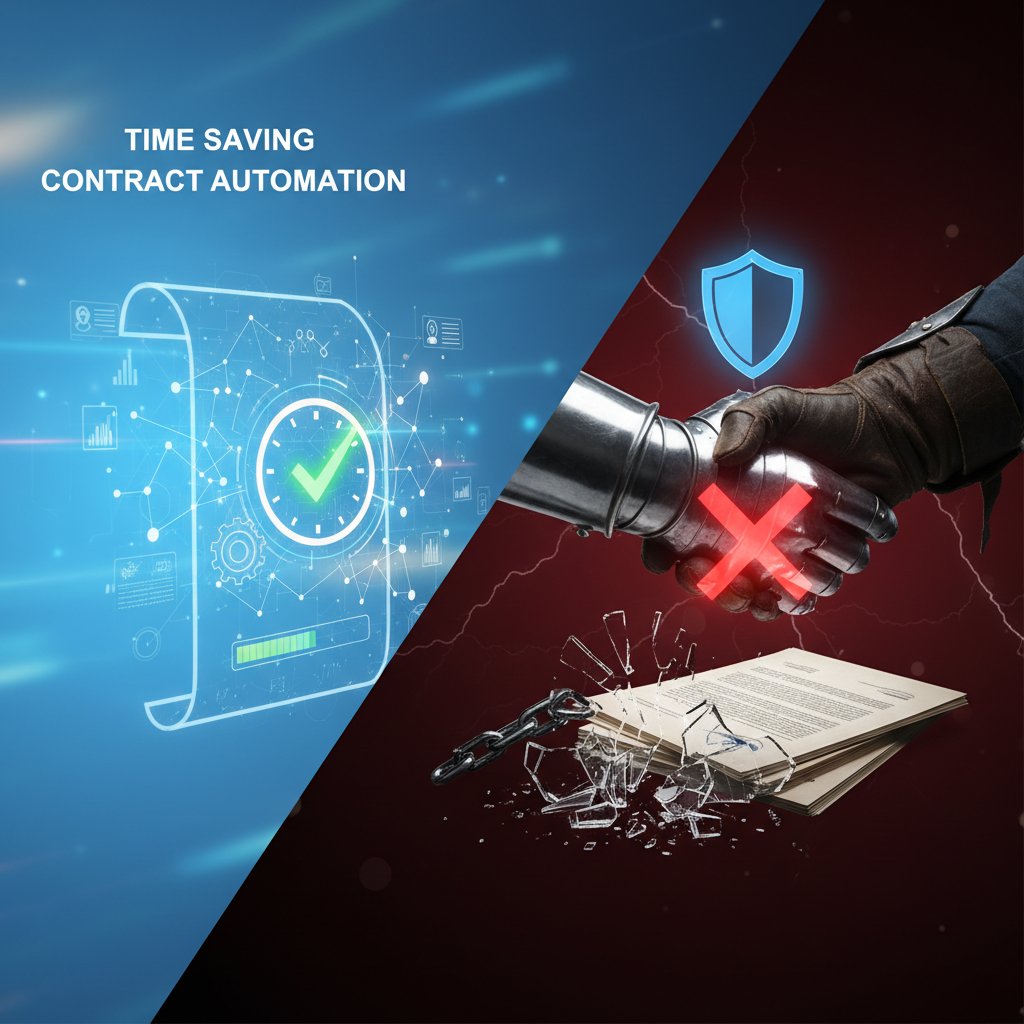
The bottom line? Automation is a force multiplier—but only if you maintain human oversight.
ROI and the real math behind automation
Calculating ROI means more than just subtracting manual hours. Factor in risk reduction, fewer compliance failures, and the opportunity cost of faster deal cycles.
| Cost Factor | Manual Process (avg) | Automation (avg) |
|---|---|---|
| Basic contract creation | $7,000 | $1,800 |
| Complex contract creation | $50,000 | $10,000 |
| Time spent per contract | 8-20 hours | 1-2 hours |
| Compliance error rate | 15% | 5% |
Table 5: Cost-benefit analysis: contract document creator vs. traditional legal services. Source: Original analysis based on Aavenir, 2024, ContractSafe, 2024
You don’t just save on dollars—risk exposure and stress drop, too.
The psychological impact: do we trust digital contracts?
Skepticism runs deep. For generations, a “wet” signature symbolized trust. Yet adoption rates for digital contracts keep surging as education and transparency improve. The more users understand audit trails, encryption, and compliance checks, the more they trust digital contracts. It’s a cultural shift—one that platforms like filecreator.ai help drive by putting security and clarity front and center.
Contract creation across industries: one size never fits all
Startups vs. enterprises: wildly different needs
Startups crave velocity. Every hour spent on paperwork is an hour lost building product or courting investors. Contract document creators are oxygen, letting founders spin up NDAs, SaaS agreements, or partnership contracts in minutes. But for enterprises, the game is about scale and governance: hundreds of templates, granular permissioning, and automated compliance checks. The right tool adapts—never dictates.

Freelancers and gig economy: the new contract frontier
Freelancers need speed and protection. A contract document creator lets them automate essential bits—scope of work, payment terms, IP clauses—leveling the playing field with larger clients.
Contract essentials every freelancer should automate:
- Clear project scope
- Defined payment terms
- Intellectual property ownership
- Revision and feedback process
- Deadline and deliverable schedule
- Confidentiality and non-disclosure
- Termination and dispute resolution terms
These essentials shield freelancers from scope creep and slow payments, letting them focus on what matters.
Regulated industries: compliance is non-negotiable
In healthcare, finance, and similar regulated sectors, compliance isn’t a checkbox—it’s mission-critical. Fines for non-compliance can reach millions. Leading contract document creators address this head-on, offering built-in clause libraries vetted for HIPAA, GDPR, and SOX requirements. Yet, not all tools are equal; some require manual compliance reviews, exposing companies to costly oversights.
Compliance terms explained:
- HIPAA (Health Insurance Portability and Accountability Act): U.S. regulation dictating how healthcare information is protected.
- GDPR (General Data Protection Regulation): European Union’s standard for personal data privacy and protection.
- SOX (Sarbanes-Oxley Act): U.S. law mandating rigorous reporting and audit trails for financial data.
For the uninitiated, these acronyms look like alphabet soup, but for insiders, they spell "lawsuit" if ignored.
2025 and beyond: the future of contract document creators
Emerging trends: AI, blockchain, and the next frontier
Breakthroughs in AI have already redefined contract creation, but the next leap is convergence with blockchain. Smart contracts—self-executing agreements coded on blockchain—promise ironclad automation and tamper-proof audit trails. The ability to instantly verify, execute, and record agreements on decentralized ledgers is no longer sci-fi.

This convergence means even less friction, stronger security, and new possibilities for businesses ready to adapt.
Will lawyers become obsolete—or just evolve?
Automation hasn’t killed the legal profession, but it’s forced a hard pivot. Lawyers now focus less on boilerplate drafting, more on complex negotiations and risk analysis. As Maya, an AI ethicist, observes:
"We’re not being replaced—we’re being refocused." — Maya, AI ethicist
Legal professionals increasingly act as strategists and advisors, harnessing AI tools to sharpen their edge rather than cede ground.
How to stay ahead: skills and strategies for the next decade
Mastering automated contract creation means blending tech fluency with legal literacy. Critical skills include:
- Understanding how AI and template engines shape contracts
- Interpreting compliance requirements for dynamic contexts
- Evaluating security, privacy, and risk in digital workflows
Ongoing education is non-negotiable—webinars, legal tech bootcamps, and resources like filecreator.ai offer practical ways for professionals to stay on the cutting edge.
Making your move: actionable takeaways and final provocations
Key lessons from the contract document creator revolution
The contract document creator is no longer a novelty—it's a necessity. The biggest takeaways?
- Speed isn’t everything—context still wins
- Automation frees talent for strategy, not just cost-cutting
- Compliance must be built-in, not bolted-on
- Human oversight is your last, best line of defense
- Customization adds value but demands diligence
- Trust grows with transparency—show your work, don’t just promise it
Hidden benefits of contract document creators experts won’t tell you:
- Deeper audit trails make regulatory investigations less painful
- Version control means no more “wrong document” disasters
- Eco-friendly digital contracts shrink your carbon footprint
- AI-driven risk alerts flag trouble before lawyers do
- Staff bandwidth refocuses on business, not paperwork
- Instant access turns contract management into a strategic asset
Your next step: how to choose, deploy, and thrive
Ready to step up your contract game? Evaluate your needs, test tools like Professional Document Generator or filecreator.ai, and demand transparency on compliance, security, and customization. Start small—pilot with a single contract type, gather feedback, and iterate. The goal isn’t just faster paperwork; it’s bulletproof, agile agreements that power your business forward.
The bottom line: why this matters more than ever
In a world where deals move at the speed of text messages, the contract document creator is your shield and sword. Technology can’t replace trust—but it can fortify it if used wisely. The next time you sign a digital contract, ask not just how fast it arrived, but what risks and opportunities are glowing beneath that digital seal.

Sources
References cited in this article
- ContractSafe(contractsafe.com)
- Aavenir(aavenir.com)
- Procurement Tactics(procurementtactics.com)
- Weshare(weshare.net)
- Summize(summize.com)
- Morae(morae.com)
- Openware(openware.com)
- Ozeki(ozeki.ai)
- Notch(notch.so)
- LinkedIn(linkedin.com)
- Lexagle(lexagle.com)
- ContractSafe(contractsafe.com)
- Wiley Online Library(onlinelibrary.wiley.com)
- ScienceDirect(sciencedirect.com)
- Documentero(blog.documentero.com)
- ContractWorks(contractworks.com)
- Juro(juro.com)
- V7Labs(v7labs.com)
- Richmond Journal of Law and Technology(jolt.richmond.edu)
- CoinMetro(coinmetro.com)
- Ethereum.org(ethereum.org)
- World Economic Forum(weforum.org)
- Zycus iContract(zycusicontract.com)
- DocuSign(docusign.com)
- DLA Piper(dlapiper.com)
- Wambeti Legal(wambetilegal.com.au)
- ASCE(asce.org)
- GatekeeperHQ(gatekeeperhq.com)
- Futrovsky(futrovsky.com)
- JWSuretyBonds(jwsuretybonds.com)
- ContractWorks(contractworks.com)
- PandaDoc(pandadoc.com)
- Morgan Lewis(morganlewis.com)
- Document Crunch(documentcrunch.com)
- SoftwareConnect(softwareconnect.com)
- GAIA Law(gaia.law)
- Money.com(money.com)
- Itransition(itransition.com)
- ContractCosting(contractcosting.com)
- BigleLegal(blog.biglelegal.com)
- Constrafor(constrafor.com)
- Legito(legito.com)
- Fynk(fynk.com)
- Aavenir(aavenir.com)
- Pixelplex(pixelplex.io)
- Zegal(zegal.com)
Perfect Documents, Instantly
Filecreator.ai transforms the way you produce professional documents. Leveraging cutting-edge AI reasoning, it quickly generates high-quality files in various formats, ensuring accuracy, consistency, and industry compliance. Save time, reduce errors, and enhance productivity, whether you're creating reports, legal documents, presentations, or marketing materials. Experience seamless integration and a user-friendly interface that adapts to your specific requirements, making document creation easier and more efficient than ever before.
Get startedStart Creating Professional Documents Today
Join thousands of professionals who trust AI-powered document generation
Frequently Asked Questions
What is a contract document creator and how does it work?
A contract document creator is an AI-driven tool that automates the generation, review, and management of contracts. It enables users to create, modify, and sign complex agreements quickly from digital devices, replacing the traditional time-consuming process of manual drafting and lengthy meetings.
Why did the shift from handshake deals to digital contracts matter for businesses?
The shift to digital contracts was essential for business survival as operations scaled. Businesses that adopted digitization avoided problems like lost documents, compliance issues, and legal bottlenecks, while those that lagged behind struggled with these risks.
When did electronic signatures become legally recognized?
The ESIGN Act in 1999 legalized electronic signatures in the United States, marking a pivotal moment that enabled the broader adoption of digital contracting practices.
What is the significance of 2023 in the contract automation timeline?
In 2023, 80% of Fortune 500 companies adopted AI contract tools, signaling an industry-wide shift to automation and mainstream acceptance of AI-powered contract creation.
What are the main risks mentioned about using AI-driven contract tools?
The article warns that AI contract tools can open up new risks and potential traps that even professionals stumble into, and cautions that one misclick could lead to disaster, though specific risks are not detailed in the provided excerpt.
Continue Reading
Explore more from Professional Document Generator

Legal Document Creators: How They Work and Their Real Risks
Legal document creator tools automate contract generation but carry compliance and validity risks. This article examines how they work, their limitations, and when professional legal review matters.

Contract Creation Software: Benefits, Risks, and How to Use It Well
Contract creation software accelerates deal-making but carries hidden risks. This article explains the trade-offs, common pitfalls, and strategies to maximize benefits safely.

Contract Template Generators: Benefits and Risks Explained
Contract template generators are transforming how organizations create agreements. This article examines the benefits, risks, and realities of AI-powered contract automation.

Generating Legal Agreements Online: Risks Versus Reliable Methods
Generating legal agreements has moved online, but not all digital tools protect your interests equally. This article examines the risks, myths, and methods that actually work.

Online Contract Tools: Capabilities, Risks, and What to Check
Contract making tool online platforms offer speed and reach, but also legal gaps and security risks. This article explains what works, what doesn't, and what to verify.

Automated Contract Drafting Software: Benefits and Risks Explained
Automated contract drafting software is reshaping legal document creation. This article examines the genuine advantages, the real risks, and how the technology is changing contract work.