Business Proposal Generator in 2025: Power, Pitfalls, and Proof
Written with AI assistance under our editorial guidelines
By 2026, business proposal generators have become critical tools for competitive organizations, with 77% deploying AI in some form. These systems can rapidly create personalized, data-driven proposals that significantly boost win rates, especially for existing clients at 62% versus cold prospects. However, success requires understanding both their power to automate persuasion and the risks of generic, inaccurate, or ethically problematic outputs that could sabotage deals.
In 2025, the business proposal generator is no longer a niche software for overworked sales teams. It’s a weapon—wielded in boardrooms, startup huddles, and multimillion-dollar negotiations worldwide. Yet, in this high-stakes digital arena, the line between breakthrough and bankruptcy is a single document away. With 77% of organizations deploying AI in some form and nearly every industry facing brutal competition, the business proposal isn’t a formality—it’s the thin veil separating survival from oblivion. This guide exposes the raw truths, machine-driven miracles, and lurking risks of proposal automation. Packed with gritty case studies, sharp comparisons, and field-tested advice, you’ll learn how to use a business proposal generator to win when it matters—and spot the traps that could sabotage your next deal. Read on, because in the world of proposals, ignorance is extinction.
Why business proposals matter more than ever
The high-stakes world of modern proposals
Business proposals have evolved from polite formalities into high-risk maneuvers with careers, companies, and livelihoods on the line. Today’s hyper-competitive markets don’t forgive sloppy paperwork or generic pitches. A single business proposal can secure game-changing funding, cement a long-term partnership, or get lost in a sea of algorithmic rejections. No pressure, right?

"I never realized one document could decide my future—until it did." — Jamie
It’s not just startups with everything at stake. Multinational giants, scrappy agencies, and nonprofit visionaries alike stake their next move on a few well-crafted (or disastrously generic) pages. According to data from QorusDocs, proposals aimed at existing clients boast a staggering 62% win rate—20% higher than those sent to cold prospects. In this zero-sum game, proposal quality is a key differentiator, not a box-ticking exercise.
From handshake deals to algorithmic persuasion
Business proposals have come a long way from smoke-filled rooms and handshake agreements. In the 1980s, a proposal was often a printed letter with a price. Fast forward to today: proposals are digital dossiers, packed with analytics, multimedia, and targeted persuasion—often built by AI in minutes. The rise of data-driven decision-making and the demand for personalization forced this evolution.
| Era | Format | Key Features | Typical Pitfalls |
|---|---|---|---|
| 1980s | Typed letters, faxes | Formality, brevity, manual customization | Slow turnaround, little personalization |
| 2000s | Word templates, PDFs | Mass templates, e-signatures | Generic content, formatting errors |
| 2015-2020 | Online editors, cloud tools | Some automation, collaboration | Overused templates, siloed data |
| 2021-2025 | AI-powered generators | Dynamic content, NLG, data integration | Over-automation, loss of nuance |
Table 1: Timeline comparison of business proposal formats from 1980 to 2025. Source: Original analysis based on QorusDocs, 2023
The digital transformation wasn’t just cosmetic. It changed the very DNA of business proposals, introducing algorithmic persuasion and programmable storytelling. Stakeholders expect laser-sharp targeting, not recycled boilerplate.
Common misconceptions and the cost of getting it wrong
Many still cling to myths that can tank their deals before the first paragraph. The idea that “a proposal is just filler” or “templates always work” is not only outdated—it’s dangerous. Here are the hidden risks of underestimating your business proposal:
- Assuming templates guarantee success: Overreliance on templates leads to generic, forgettable pitches that blend into the background noise—never a prescription for winning.
- Ignoring the audience: Proposals that fail to address the specific needs and pain points of recipients are quickly dismissed as irrelevant.
- Underestimating compliance needs: Missing regulatory or legal details can not only lose deals but trigger audits or legal exposure.
- Neglecting data security: Proposal content often contains sensitive pricing, product, or client data. Sloppy handling can mean leaks or breaches.
- Skipping personalization: Failing to tailor your pitch signals laziness and lack of commitment—fatal in an era of hyper-personalization.
- Confusing length with impact: Long-winded proposals aren’t persuasive; they’re exhausting.
- Believing automation alone will save you: Automated tools speed things up, but they can’t fix bad strategy or missing value propositions.
The cost of getting it wrong? Lost revenue, eroded reputations, and closed doors that may never open again.
What is a business proposal generator (and what isn’t)?
Redefining the generator: Beyond templates
If you still think a business proposal generator is just a fancy template, you’re living in the past. In 2025, the best generators are complex, AI-powered engines capable of weaving personalized narratives, adapting in real-time, and pulling from vast data repositories. These tools don’t just fill in blanks—they build proposals that flex to your client’s pain points, your industry’s jargon, and even your brand’s tone of voice. Automation now means much more than mail merges.
Definition list:
- Generator: A software tool (often cloud-based) that creates business proposals quickly by merging user inputs, pre-defined content, and, in advanced cases, real-time data and AI-driven insights. Example: filecreator.ai’s Professional Document Generator.
- Automation: The use of algorithms or scripts to replace manual tasks in the proposal creation process—think sections auto-filled with client data, dynamic pricing tables, or compliance checks.
- Personalization: Customizing content, structure, and visuals based on recipient data, industry, previous interactions, and desired outcomes. Modern generators use AI to achieve true personalization at scale.
This evolution means users must understand what these tools can and can’t do—and where human expertise is still nonnegotiable.
How AI disrupts the proposal game
AI-powered proposal generators are the real disruptors. Leveraging natural language generation (NLG), they craft compelling narratives with consistency and speed that no human team can match. Some integrate directly with CRMs and market data feeds, allowing real-time content adaptation. Imagine a tool that not only writes your executive summary but also tailors your case studies to match each client’s sector and recent news.

These advances aren’t just hype. According to Statista, the global AI market hit $184 billion in 2024, with 77% of companies now integrating AI into their daily workflows. Proposal generation sits at the intersection of this trend and the demand for rapid, flawless communication. But every revolution creates new blind spots.
The limits of automation: Where humans win
Despite the firepower of modern generators, there’s no substitute for human nuance. Stories resonate because they’re authentic, and AI can’t (yet) fake passion or read the room. A proposal built by a generator may tick every technical box, but it’s only as persuasive as the empathy, insight, and strategic thinking behind it.
"Automation is powerful, but it can’t fake passion—or read the room." — Riley
A business proposal generator is a scalpel, not a miracle cure. The sharpest tools still need skilled hands.
The anatomy of a killer business proposal
Essential ingredients for 2025
High-converting proposals in 2025 follow a strict recipe: data-driven insights, concise storytelling, crystal-clear value propositions, bulletproof compliance, and attention to emotional resonance. Gone are the days when you could skate by with a few pie charts and a list of services.
Step-by-step guide to structuring a modern business proposal:
- Cover page: Clean branding, project title, and recipient’s name.
- Executive summary: Address the client’s pain point and your unique value—no fluff, just sharp relevance.
- Problem statement: Articulate the client’s challenge in their language, based on research.
- Proposed solution: Show exactly how your service solves the problem, backed by data and past results.
- Project timeline: Set realistic milestones and deliverables.
- Budget and pricing: Transparent, with optional add-ons explained.
- Credentials: Brief team bios, relevant experience, and social proof.
- CTA and next steps: Clear instructions on how to accept, schedule, or request revisions.
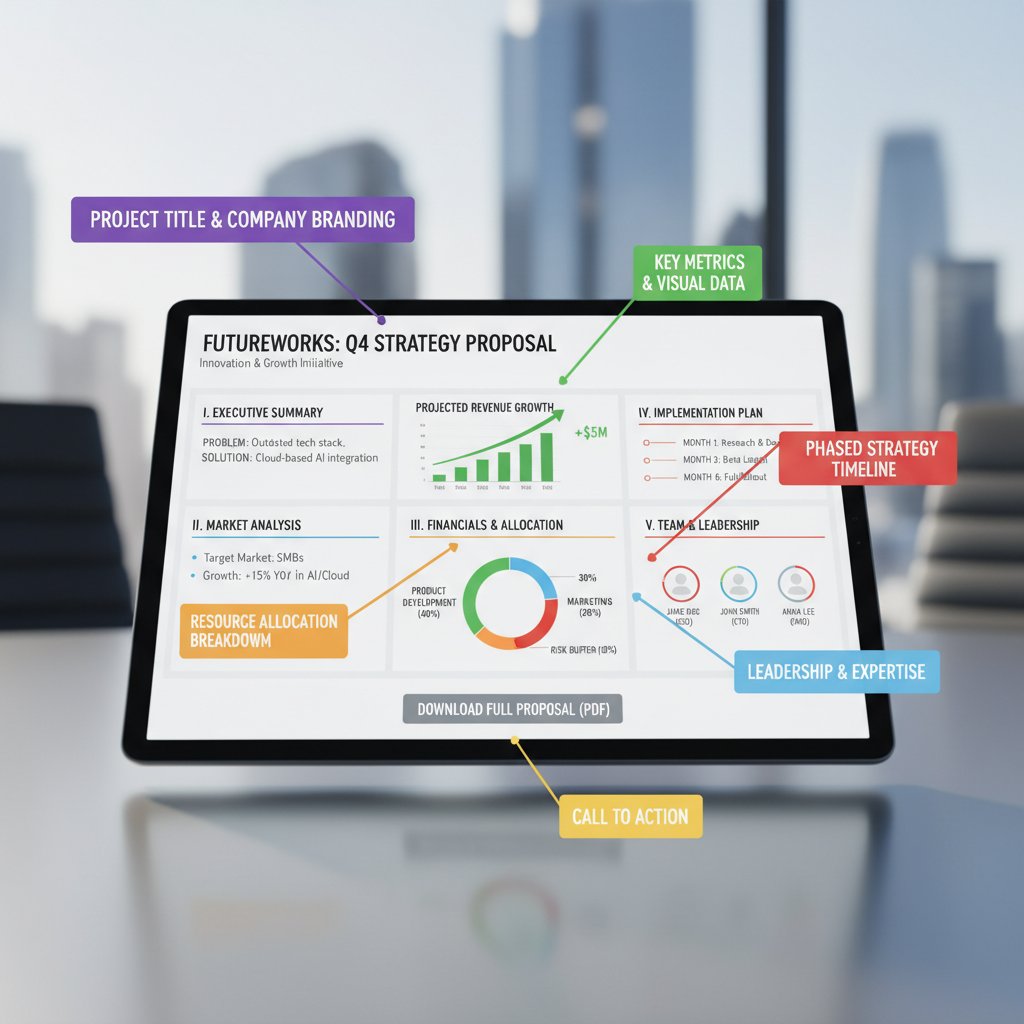
A killer proposal is more than just a collection of sections. It’s a narrative that hooks, builds trust, and removes all doubt.
What makes proposals fail (AI or not)
Even with cutting-edge tools, most proposals stumble over the same obstacles: generic language, missing value, or poor targeting. According to recent research from IgnitionApp, “Personalized, well-crafted proposals that showcase expertise are critical as AI-generated content becomes common.” In other words, automation magnifies both strengths and flaws.
| Feature | Successful Proposals | Failed Proposals | Results |
|---|---|---|---|
| Tone | Personalized, confident, empathetic | Generic, robotic, salesy | Higher win rates, stronger trust |
| Value proposition | Explicitly stated, unique, relevant | Vague, boilerplate | Fast decisions, repeat business |
| Targeting | Tailored to recipient’s context and pain | One-size-fits-all | High engagement, few rejections |
| Use of data | Includes relevant, current statistics | Outdated, no data | Seen as credible, authoritative |
| Storytelling | Uses case studies, real examples | Dry, lacks narrative | Emotional connection, recall |
Table 2: Comparison of successful vs failed proposals. Source: Original analysis based on IgnitionApp, 2024
Debunking the ‘magic template’ myth
If you’re chasing a “magic template” that guarantees wins, you’re setting yourself up for disappointment. Overused layouts and boilerplates aren’t shortcuts—they’re red flags for decision-makers who see dozens of proposals weekly.
Red flags to watch for in proposal generators:
- No customization options: Rigid templates you can’t adapt for your brand or client.
- Outdated language: Content that sounds like it was written a decade ago.
- Lack of compliance checks: No safeguards for regulatory or industry standards.
- Missing collaboration features: No way to invite team input or review changes.
- No security protocols: Proposals sent over unsecured channels or stored without encryption.
- “AI” that’s just a glorified mail merge: Tools that promise intelligence but only automate cut-and-paste.
- No analytics or tracking: You can’t see who opened or engaged with your proposal.
Smart operators avoid these pitfalls by choosing tools that balance automation with flexibility and compliance.
Inside the black box: How business proposal generators work
Tech under the hood: AI, data, and design
Peel back the layers of a top-tier business proposal generator and you’ll find a symphony of algorithms, UX design, and secure data management. Natural language processing (NLP) powers everything from personalized greetings to executive summaries. Machine learning recommends relevant sections and even flags compliance gaps. Meanwhile, UX experts ensure templates don’t just look good—they drive action.

Most advanced platforms connect with CRMs, financial tools, and third-party data sources, automatically updating proposals with the latest figures and client details. Data security is non-negotiable—encryption, access controls, and GDPR compliance are standard for reputable tools.
What sets professional tools apart
The difference between a free generator and a professional platform like filecreator.ai isn’t just bells and whistles—it’s fundamental capabilities. While free tools may offer basic templates, enterprise-ready solutions bring AI-driven reasoning, compliance checks, and real-time collaboration.
| Feature | Free Generators | Paid/AI-powered Tools | Clear Winner |
|---|---|---|---|
| Templates | Basic, static | Dynamic, industry-specific | Paid/AI-powered |
| Personalization | Limited | Deep, data-driven | Paid/AI-powered |
| Compliance | User-dependent | Automated, real-time | Paid/AI-powered |
| Export formats | PDF only | DOCX, PPTX, PDF, more | Paid/AI-powered |
| Collaboration | Minimal or none | Real-time, multi-user | Paid/AI-powered |
| Security | Inconsistent | Enterprise-grade | Paid/AI-powered |
| Analytics | None | Engagement tracking | Paid/AI-powered |
Table 3: Feature matrix—free vs paid, AI-based vs template-driven business proposal generators. Source: Original analysis based on Statista, 2024
Free tools are fine for hobbyists. For high-stakes deals, only the best pass muster.
Real-world impact: Case studies and cautionary tales
Startup survival: How proposals won (or lost) funding
Consider the story of a SaaS startup on the brink—bootstrapped, running on fumes, and facing rejection after rejection. Their fortunes turned only when they ditched generic templates and used an AI-powered proposal generator to create a hyper-personalized document. By integrating real-time market data, customizing every section to the VC’s portfolio, and embedding compliance statements, they clinched a $2M seed round. It wasn’t magic—it was strategy, executed at scale.

On the flip side, startups have lost out by submitting proposals riddled with recycled jargon and outdated numbers—no matter how slick the PDF looked.
Corporate efficiency: When automation changed the game
A mid-sized logistics firm used to spend weeks wrangling spreadsheets and formatting endless Word docs for RFPs. After switching to a professional business proposal generator, turnaround time dropped from 14 days to less than 48 hours. The impact? More bids submitted, higher win rates, and a massive morale boost for the team.
"We went from chaos to clarity. Suddenly, our proposals actually closed deals." — Morgan
Time isn’t just money in the proposal game—it’s the margin between winning big and falling behind.
Unintended consequences: When automation backfires
Automation isn’t a free lunch. Risks include plagiarism (when tools scrape public templates), tone-deaf messaging (when AI misreads the audience), and generic output that blends into the noise. Sophisticated competitors and evaluators spot these flaws instantly.
| Risk | Reward | Mitigation |
|---|---|---|
| Plagiarism | Fast draft generation | Use original content, run checks |
| Tone-deaf messaging | Consistent style | Human review, edit for context |
| Data leaks | Centralized information management | Choose secure, compliant tools |
| Over-automation | Rapid turnaround | Balance AI with human oversight |
Table 4: Risk vs reward analysis of automation in proposal writing. Source: Original analysis based on FTC, 2024
Smart teams use automation as a booster, not a crutch.
How to choose the right business proposal generator
Must-have features vs. nice-to-haves
With dozens of options on the market, choosing your tool is as strategic as the proposals you write. All the AI in the world won’t help if you can’t customize a section or protect your client’s data. Prioritize features that match your workflow and risk profile.
Checklist for evaluating proposal generators:
- Customizable templates for your industry and brand.
- AI-driven content suggestions, not just static text blocks.
- Real-time collaboration and version control.
- Robust security—encryption, access controls, GDPR compliance.
- Automated compliance/legal checks for your sector.
- Data integrations (CRM, finance, analytics).
- Multi-format export options (PDF, DOCX, PPTX).
- Advanced analytics—who viewed, how long, which sections.
- Responsive support and detailed documentation.
- Transparent pricing—no hidden fees or usage caps.
If a tool falls short on any of these, it’s not built for 2025.
Cost-benefit analysis: Free vs premium tools
Free proposal generators can be tempting, but the hidden costs—lost deals, compliance gaps, security lapses—quickly add up. Premium tools often pay for themselves in a single won contract.
| Tool Type | Up-Front Cost | Time Saved | Win Rate Impact | Security | Support | Best For |
|---|---|---|---|---|---|---|
| Free | $0 | Low | None/slight | Varies | Limited | Hobbyists, solo freelancers |
| Mid-tier | $20-50/mo | Moderate | Noticeable | Good | Standard | SMEs, agencies |
| Premium/AI | $75-150/mo | High | Significant | Excellent | Priority | Enterprises, high-stakes |
Table 5: Cost-benefit comparison of free, mid-tier, and premium proposal generators. Source: Original analysis based on Credibly, 2024
If you're betting your company’s future on proposals, the math is obvious.
Spotting empty promises and marketing hype
The proposal automation space is full of flashy claims and buzzwords. Here’s how to see through the hype:
Marketing buzzwords decoded:
- “Powered by AI”: Is it true NLG or just a fancy template? Dig deeper.
- “Unlimited proposals”: Often capped by hidden terms or throttled speed.
- “Enterprise-ready”: Means nothing without compliance and security certification.
- “Plug-and-play”: Still requires setup for meaningful results.
- “One-click personalization”: No tool can truly know your client’s soul at the click of a button.
- “Guaranteed win rates”: Run, don’t walk—there are no guarantees in business proposals.
A little skepticism keeps your budget (and reputation) intact.
Beyond business: Unconventional uses for proposal generators
Surprising industries and creative hacks
Proposal generators aren’t just for closing million-dollar deals. Their logic and structure have been hijacked for everything from grant writing to creative pitches.
Unconventional applications:
- Nonprofits crafting grant proposals for fast-moving funding cycles.
- Freelancers pitching projects to global clients in multiple languages.
- Artists framing exhibition proposals or public art submissions.
- Academics streamlining research grant applications.
- Consultants creating onboarding kits for new clients.
- Event planners responding to RFPs with visually stunning details.
- HR departments assembling policy documents and internal memos.
- Sales teams in niche markets creating hyper-targeted outreach.
- Entrepreneurs iterating on investor decks and crowdfunding pitches.
These hacks prove the flexibility of modern business proposal generators—creativity is the only limit.
Proposal generator as a learning tool
Business schools and universities now incorporate proposal generators into curricula, teaching students not just to write, but to structure, analyze, and personalize their arguments. The instant feedback and real-world templates help bridge the gap between theory and execution.

As digital literacy becomes nonnegotiable, proposal tools are as relevant in the classroom as they are in the boardroom.
Risks, red flags, and how to protect yourself
Data privacy and intellectual property
Not all proposal generators treat your data with equal respect. Many free or low-cost tools mine your input for marketing, or store sensitive files on unsecured servers. Before uploading client lists or pricing tables, demand transparency on data storage, encryption, and legal jurisdiction.
"You’re only as safe as the data you surrender." — Alex
Always read the fine print and choose tools with clear privacy policies and robust compliance certifications.
Avoiding the ‘copy-paste’ trap
If your proposal reads like everyone else’s, you’re asking to be ignored—or worse, accused of plagiarism. Even the smartest business proposal generator needs oversight: your voice, your judgment, your final sign-off.
Steps to personalize and audit AI-generated proposals:
- Review and rewrite critical sections (e.g., executive summary, value proposition).
- Cross-reference facts, statistics, and case studies for accuracy and originality.
- Check tone and language—ensure it matches your brand and audience.
- Use plagiarism checkers to scan for duplicate content.
- Solicit team feedback and incorporate industry-specific insights.
- Save and document each version for compliance and continuous improvement.
Automation is a tool, not a shortcut to trust.
The future of business proposal generation
Upcoming trends and innovations
Generative AI, real-time collaboration, and industry-specific intelligence are setting the pace. The expectation? Proposals that are living documents: updating as client needs shift, integrating with market data feeds, and supporting multi-user editing from anywhere. As barriers between departments break down, proposal generation becomes a cross-functional, value-driving effort.

What’s clear: only the nimble, tech-savvy, and security-conscious will thrive.
Will AI replace the human touch?
Despite the relentless march of automation, experts agree—AI isn’t ready to replace human ingenuity. Here’s what humans still do best:
- Build authentic relationships and trust.
- Detect unspoken signals and emotional cues.
- Tell stories that resonate with unique audiences.
- Exercise ethical judgment and adapt to ambiguity.
- Negotiate creative solutions beyond the algorithm.
- Advocate with passion and conviction.
The best business proposals blend the efficiency of AI with the artistry of human persuasion.
The ultimate checklist: Are you ready to win with a business proposal generator?
Self-assessment and next steps
Before you entrust your next big deal to a business proposal generator, evaluate your readiness, expectations, and workflow. Investing in the right tool pays off only when coupled with a winning mindset and strategy.
Self-assessment checklist:
- Have I clearly defined my proposal goals and target audience?
- Do I have up-to-date data and case studies ready for integration?
- Am I prepared to customize each proposal, not just fill in the blanks?
- Is my team trained to use and review generated content critically?
- Have I vetted the tool’s data security policies?
- Can I track and measure proposal performance?
- Do I have a process for compliance and legal review?
- Am I willing to iterate and improve with each proposal cycle?

If you answered “no” to any of the above, take a step back—your next proposal (and deal) may depend on it.
Expert tips for maximizing your results
Want to make your business proposal generator your unfair advantage? Here’s what industry insiders recommend:
- Always start with clear, client-focused goals—don’t just rely on the tool’s defaults.
- Feed the generator with up-to-date data, not marketing fluff.
- Use analytics to identify which sections resonate (and which fall flat).
- Layer in your company’s stories, wins, and culture—AI can’t invent these.
- Schedule periodic audits for compliance and originality.
- Integrate with your CRM and analytics platforms for seamless workflow.
- Create templates for different sectors or use cases to speed up customization.
- Never send a proposal without a human review—even the smartest AI makes mistakes.
For professionals who demand the best, platforms like filecreator.ai are setting new standards in speed, compliance, and adaptability. But even the best tech is only as powerful as the team behind it.
In a world where every proposal is a high-stakes bet, the business proposal generator is both your sword and shield. Used wisely, it transforms hours of drudgery into minutes of persuasive brilliance, giving you more time to strategize, connect, and close. But no tool is a silver bullet. Master the tech, trust your instincts, and never lose sight of the human story behind every deal. The next win—or loss—starts with what you generate now.
Sources
References cited in this article
- Credibly(credibly.com)
- Statista(quantive.com)
- LBMC(lbmc.com)
- Exploding Topics(explodingtopics.com)
- NAWBO(nawbo.org)
- QorusDocs(qorusdocs.com)
- IgnitionApp(ignitionapp.com)
- WEF Global Risks Report 2024(weforum.org)
- Journal of Information Architecture(journalofia.org)
- Strikingly(strikingly.com)
- Prospero(goprospero.com)
- BetterProposals(betterproposals.io)
- ContractsCounsel(contractscounsel.com)
- Feedough(feedough.com)
- Proposify(proposify.com)
- VisibleThread(visiblethread.com)
- Medium(medium.com)
- Digital Vidya(digitalvidya.com)
- Piktochart(piktochart.com)
- Proposify(proposify.com)
- Morning Dough(morningdough.com)
- WriteCream(writecream.com)
- Launch Consulting(launchconsulting.com)
- Google Cloud(cloud.google.com)
- Gartner(gartner.com)
- Google Cloud(cloud.google.com)
- Deloitte(www2.deloitte.com)
- Microsoft Research(microsoft.com)
- Salient Process(salientprocess.com)
- Forbes(forbes.com)
- Templafy(templafy.com)
- Forbes(forbes.com)
- Rootly VOID Report(rootly.com)
- Gartner(wwps.microsoft.com)
- BetterProposals(betterproposals.io)
- Canva(canva.com)
- Business.com(business.com)
- Decktopus(decktopus.com)
- Jotform(jotform.com)
Perfect Documents, Instantly
Filecreator.ai transforms the way you produce professional documents. Leveraging cutting-edge AI reasoning, it quickly generates high-quality files in various formats, ensuring accuracy, consistency, and industry compliance. Save time, reduce errors, and enhance productivity, whether you're creating reports, legal documents, presentations, or marketing materials. Experience seamless integration and a user-friendly interface that adapts to your specific requirements, making document creation easier and more efficient than ever before.
Get startedStart Creating Professional Documents Today
Join thousands of professionals who trust AI-powered document generation
Frequently Asked Questions
What percentage of organizations are currently using AI in their business operations?
According to the article, 77% of organizations are deploying AI in some form as of 2025.
What is the win rate difference between proposals sent to existing clients versus cold prospects?
Proposals aimed at existing clients have a 62% win rate, which is 20% higher than those sent to cold prospects, according to data from QorusDocs.
How have business proposals changed from the 1980s to today?
In the 1980s, proposals were typically printed letters with a price, while today they are digital dossiers packed with analytics, multimedia, and targeted persuasion, often built by AI in minutes.
Why are business proposals considered more critical in modern business than in the past?
Today's hyper-competitive markets do not forgive sloppy paperwork or generic pitches, and a single proposal can secure game-changing funding, cement partnerships, or get lost in algorithmic rejections, making proposal quality a key differentiator rather than a formality.
Continue Reading
Explore more from Professional Document Generator

How to Generate Business Proposals Online That Close Deals
This article examines how to generate business proposals online effectively. It covers what AI tools do well, their limitations, and the tactics that close real deals.

How Automatic Business Proposal Generators Reshape Deal-Making
Automatic business proposal generator tools promise efficiency but bring hidden risks. This article examines how AI automation changes proposal creation and competitive advantage.

How to Generate Business Proposals Templates That Win
Most business proposals fail because they're forgettable and formulaic. This article explains how to generate business proposals templates that persuade, stand out, and win deals.

Why Most Business Proposals Fail and How to Fix It
Most business proposals never get read. This article explains why deals fail, what makes proposals stand out, and the strategies that actually close deals.

How Automatic Business Proposal Software Reshapes Deal Strategy
Automatic business proposal software automates proposal creation and reduces manual errors. This article explains how automation changes deal-winning, the real risks involved, and what separates effective tools from hype.

Online Proposal Builder: Benefits, Risks, and Effective Strategies
Online proposal builders have become essential to modern sales. This article examines their real benefits, hidden costs, security risks, and how to master them effectively.