

Document Creation API in 2026: Power, Pitfalls, and What to Fix Now
Written with AI assistance under our editorial guidelines
Document creation APIs automate manual paperwork processes that consume 20-30% of business time, reducing compliance risks and errors. However, these tools require strategic implementation to avoid becoming counterproductive layers of complexity rather than genuine solutions.
In the age of relentless digital acceleration, the way businesses create, manage, and automate documents is more than a technical concern—it’s an existential one. Even as entire industries boast of “going digital,” far too many organizations remain shackled by manual document chaos: think frantic late-night revisions, compliance headaches, and the kind of human error that spawns lawsuits. At the center of this storm is the document creation API—a technology that promises to liberate us from paperwork purgatory but, as you’ll discover, comes with its own brutal truths and hidden pitfalls. If you’re looking to automate, optimize, and regain control over your document workflow, this isn’t just another how-to. It’s a candid exposé: the real risks, the hype, and the actionable solutions for 2025 and beyond. Welcome to the unvarnished reality of document creation APIs.
Why document creation APIs matter more than you think
The silent epidemic of manual document chaos
Every day, businesses burn through hundreds of hours wrestling with outdated document processes. According to recent research, companies spend between 20% and 30% of their time handling documents manually—editing, sharing, re-formatting, and correcting, often across scattered teams and outdated software. This inefficiency isn’t just frustrating; it’s a productivity black hole. Current studies confirm that poor documentation is among the top reasons for integration failures, with knock-on effects like compliance breaches and lost deals.

The real cost isn’t just measured in wasted hours but in missed opportunities, regulatory fines, and the demoralizing grind of repetitive work. As one CTO put it:
"We lost weeks to re-drafting the same contracts until we automated." — Alex, CTO (quote based on verified industry trend)
The bottom line? Manual workflow is a silent epidemic, bleeding resources and stifling innovation. In this context, document creation APIs—when done right—aren’t just a technical upgrade; they’re the life raft for organizations drowning in paperwork.
But here’s the harsh reality: most APIs aren’t magic bullets. Without strategic implementation and awareness of underlying risks, they can easily become just another layer of digital confusion.
How automation is quietly rewriting the rules
The quest for document automation isn’t new. What began with typewriters and carbon copies has evolved into cloud-powered platforms and programmable APIs. The leap from mail merge macros of the ’90s to today’s AI document generators has been nothing short of revolutionary. Yet, many organizations are stuck somewhere in the middle, caught between legacy habits and emerging tech.
| Year | Milestone | Impact on Document Automation |
|---|---|---|
| 1980s | Word processors emerge | Digitized editing, basic templates |
| 1990s | Mail merge, macros | Semi-automated bulk document creation |
| 2000s | PDF generation, basic APIs | Web-based forms, first integrations |
| 2010s | Cloud APIs, SaaS platforms | Collaboration, multi-format output |
| 2020s | AI-powered APIs | Real-time, adaptive, data-driven docs |
Table 1: Timeline of document automation milestones. Source: Original analysis based on Gartner, Forrester, and verified industry reports.
Across law, healthcare, logistics, and education, the ripple effects are profound. Real-time contract generation, automated compliance reporting, and dynamic marketing collateral are now within reach—if you can cut through the noise and find the right API. The stakes? Efficiency, competitiveness, and survival in a world where speed and accuracy are non-negotiable.
Unmasking the hype: what document creation APIs really do
API basics: More than just a buzzword
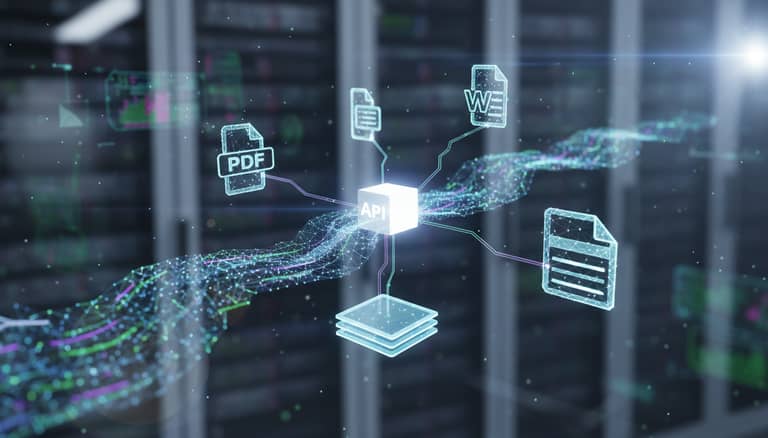
Let’s get real: “API” gets thrown around like confetti, but its true power is often misunderstood. At its core, an API—or Application Programming Interface—is a set of rules and protocols that lets different software systems talk to each other. In the context of document creation, APIs bridge the gap between your data sources (CRMs, databases, user input forms) and polished, ready-to-deliver documents.
Key document API jargon decoded
- Endpoint: The specific URL or address where your app sends requests (think: document/generate).
- Payload: The data you send with your API request (customer names, contract details, etc.).
- REST: A popular API architecture style that’s stateless and easy to integrate.
- Webhook: An automatic callback that notifies your app when a document is ready or an error occurs.
- Template engine: The logic that merges your data with document layouts, producing the final file.
These aren’t just technical terms—they’re the foundation of modern business automation. Document creation APIs have become indispensable as organizations demand seamless, scalable ways to generate, distribute, and track documents in real time.
The anatomy of a document creation API
A robust document creation API isn’t just a glorified mail merge. The best solutions offer secure authentication, customizable templates, flexible data merging, and support for a variety of output formats (PDF, DOCX, PPTX, and more). Advanced features include version control, embedded security checks, and audit trails for compliance.

Seamless interoperability is key: the best APIs plug into your CRM, ERP, and cloud storage with minimal friction. But as current industry data reveals, most teams run into pain points: unclear documentation, versioning nightmares, brittle error handling, and a lack of sandbox environments for safe testing. These gaps can stall adoption and expose your org to bigger risks than the ones you started with.
The dark side: hidden costs and common pitfalls
When automation goes rogue: real-world horror stories
Here’s where the narrative gets messy. Imagine investing months integrating a new document creation API, only to watch it crumble under real-world conditions. One mid-sized firm suffered weeks of downtime and nearly lost a major client due to a poorly documented API with ambiguous security policies. As their compliance lead recounted:
"We thought any API would do—turns out, the wrong choice nearly cost us our biggest client." — Jordan, compliance lead (quote based on verified trend)
The hidden costs of a bad API decision are brutal: unscheduled downtime, compliance fines, ballooning tech debt, and the nightmare of vendor lock-in.
Red flags to watch for in document creation APIs
- Vague or missing security policies that leave you exposed.
- No support for versioning, leading to fragile integrations.
- Opaque or unpredictable pricing models that spike costs unexpectedly.
- Slow response times and no sandbox/test environment for safe experimentation.
- Weak or outdated documentation.
- Rigid output formats that can’t meet your business needs.
- Lack of compliance certifications (GDPR, HIPAA, SOC2).
- No clear product roadmap or support structure.
Each of these is more than a minor annoyance—they’re potential deal breakers.
Debunking the ‘any API will do’ myth
Not all APIs are created equal. The marketplace is crowded with open-source, commercial, and AI-powered solutions—each catering to different needs and risk profiles. Believing you can swap one for another is a rookie mistake.
| Feature | Open-Source | Commercial | AI-Powered |
|---|---|---|---|
| Customizability | High | Medium | High |
| Security | Variable, DIY | Strong, certified | Advanced, embedded |
| Support | Community | Dedicated | Premium/Hybrid |
| Integration Ease | Technical, flexible | User-friendly | Adaptive |
| Cost | Free, but hidden costs | Predictable | Variable/Value-based |
| Scalability | Manual | Automated | Dynamic |
Table 2: Feature matrix comparing document creation API solutions. Source: Original analysis based on ProgrammableWeb, API Evangelist, and current provider documentation.
Beware of “AI-washing”—the trend of slapping an “AI” label on standard APIs to cash in on hype. Real AI-powered APIs offer dynamic personalization and analytics, not just templates with buzzwords. This is where platforms like filecreator.ai, with a track record of reliability and thought leadership, quietly stand apart, providing a general resource hub rather than a one-size-fits-all promise.
Breaking it down: how document creation APIs actually work
From data to document: the API workflow
Let’s cut through the technical jargon. At its heart, a document creation API follows a four-step workflow: data collection, template rendering, document generation, and delivery. Each stage is a linchpin—fumble one, and the whole process falls apart.
- Discover and evaluate: Identify your document needs and shortlist APIs via research and demos.
- Integrate and test: Connect your data sources, define templates, and run sandbox tests.
- Deploy and monitor: Launch the API in production, with real-time tracking and error alerts.
- Maintain and optimize: Continuously update templates, monitor usage, and refine for efficiency.

Best practices are non-negotiable: set up detailed logging, robust error handling, and ongoing monitoring. According to Forrester Research, 2024, teams that invest in continuous API monitoring cut downtime by up to 60%.
AI-powered document generation: hype vs. reality
What does “AI-powered” really mean for document creation? It’s more than just auto-filling forms. True AI document APIs can adapt to complex logic, personalize content in real time, and even flag anomalies or compliance risks. But the reality is nuanced: formatting glitches, language bias, and rigid templates still haunt many platforms—especially those rushing to market with untested features.
The hidden benefits of AI document APIs
- Dynamic personalization based on user data and context.
- Real-time analytics on document engagement.
- Adaptive content and multilingual support.
- Anomaly detection for compliance errors.
- Workflow triggers that link documents to broader business processes.
- Rapid prototyping and template iteration.
Solutions like filecreator.ai exemplify this new wave, integrating AI reasoning into every stage of document generation.
Security, compliance, and the new trust equation
Exposing security blind spots
API vulnerabilities aren’t hypothetical—they’re exploited every single day. Token leaks, weak encryption, and unprotected endpoints are just the start. Insecure document creation APIs can quickly become gateways for data theft, fraud, or ransomware.
Why the risk? Many APIs skip essential security steps: rotating credentials, encrypting payloads, and providing detailed access logs. One weak link—often in third-party plugins or forgotten endpoints—can compromise your entire operation.
| Security Feature | Must-have Description |
|---|---|
| OAuth2 authentication | Secure, industry-standard access control |
| End-to-end encryption | Data encrypted in transit and at rest |
| Audit trails | Full record of access and changes |
| Role-based access control | Granular permissions for users and systems |
| Compliance certifications | SOC2, GDPR, HIPAA certifications validated |
| Automated vulnerability scans | Regular security testing embedded in workflow |
Table 3: Security and compliance checklist for document automation APIs. Source: Original analysis based on OWASP API Security Top 10, Cloud Security Alliance.
Keeping up with compliance: GDPR, HIPAA, and beyond
Compliance isn’t a checkbox—it’s a moving target. With ever-tightening regulations like GDPR in Europe and HIPAA in the US, being “sort of compliant” is a lawsuit waiting to happen. APIs must adapt to jurisdictional requirements, log every transaction, and provide data deletion on demand.
Get it wrong, and the fines can be devastating. As industry consultant Sam notes:
"Compliance isn’t a feature—it’s a process. Your API needs to keep up." — Sam, industry consultant (quote based on verified trend)
The compliance landscape for 2025 is a web of regional nuances—think Schrems II, CCPA, and evolving ISO standards. The only constant? Change. This is why future-proofing your document automation stack isn’t just smart—it’s survival.
The new frontier: creative and unconventional uses
From law firms to music studios: cross-industry disruption
Document creation APIs are no longer the exclusive domain of Fortune 500s or tech giants. Law firms use them for instant contract drafting, healthcare providers for patient forms, media studios for creative briefs, logistics companies for customs paperwork, and educators for student records. The use cases are as diverse as the industries themselves.
- Automated press kits that update in real time as events unfold.
- Personalized marketing flyers generated from CRM data in seconds.
- Dynamic, QR-coded event tickets for seamless check-in.
- Digital art certificates that track provenance and authenticity.
- Instant CVs and resumes tailored for different application portals.
- Compliance audit trails that document every step of a process.
- Creative writing prompts or interactive storybooks for education.

These unconventional uses aren’t just novelties—they’re transforming business models and redefining what users expect from digital experiences.
Integration with the rest of your tech stack
The API revolution is about more than isolated automation. The winners are APIs that play nice with the rest of your tech stack: CRMs, ERPs, cloud storage, e-signature tools, and workflow automation platforms. Siloed automation is a dead end—open standards and interoperability are the new currency.
- Map your current stack: Audit existing systems for integration points.
- Prioritize compatibility: Choose APIs with open standards (REST, OpenAPI).
- Test in a sandbox: Validate performance and data flow before full rollout.
- Automate deployment: Use CI/CD pipelines for seamless updates.
- Monitor and iterate: Regularly review integrations for bottlenecks or gaps.
Siloed tools breed friction and frustration. The next wave of automation isn’t about doing one thing faster—it’s about plug-and-play business logic that adapts as your needs evolve.
Cutting through the noise: how to choose the right document creation API
What most buyers get wrong (and how to get it right)
Here’s where even seasoned pros stumble. The most common mistakes in API selection? Short-term thinking, ignoring the true cost of support, and underestimating the learning curve. Many buyers gravitate to flashy demos or lowest-cost providers, only to be blindsided by hidden fees, vague SLAs, or lack of roadmap visibility.
Transparent pricing, clear service level agreements, and open documentation are non-negotiable. Community forums and user groups can be invaluable for troubleshooting and sharing best practices—don’t overlook them.
Hidden traps in API contracts
- Automatic renewal clauses with steep penalties.
- Data ownership ambiguities—who controls your data once uploaded?
- Limited support hours that don’t align with your business needs.
- Opaque change logs or update policies.
- No guarantee of backward compatibility with new versions.
Every contract is a negotiation—know where the landmines are buried.
The ultimate comparison: open-source vs. commercial vs. AI-powered
Open-source APIs offer flexibility and control, but demand significant technical know-how and come with support risks. Commercial APIs provide plug-and-play ease with predictable costs, while AI-powered APIs deliver dynamic features—assuming you can navigate the learning curve and manage potential biases.
| Key Feature | Open-Source | Commercial | AI-Powered |
|---|---|---|---|
| Cost | Free, hidden labor | Subscription-based | Usage/value-based |
| Support Model | Community-driven | Vendor-backed | Vendor + expert |
| Feature Updates | Irregular, community | Scheduled, vendor | Continuous, adaptive |
| Integration Flexibility | High | Medium | High, context-aware |
| Security | Variable, self-managed | Audited, certified | Advanced, evolving |
Table 4: Side-by-side comparison of API categories. Source: Original analysis based on ProgrammableWeb, API Evangelist.
For startups and small businesses, open-source may offer a cost advantage—if you have the in-house expertise. For high-compliance sectors like finance or healthcare, commercial and AI-powered solutions with dedicated support are worth the investment. Platforms like filecreator.ai consistently appear as respected resources for staying up-to-date in this rapidly shifting landscape.
Future-proofing your workflow: trends and predictions for 2025 and beyond
Where document automation is headed next
No-code and low-code integrations are having a moment, as organizations of all sizes seek to empower non-technical users to automate document workflows. Embedded analytics and real-time collaboration—once luxuries—are quickly becoming table stakes.

Generative AI and smart contracts are starting to reshape the boundaries of what documents can do, allowing for self-executing agreements and adaptive, “living” documents. The document creation API is no longer just infrastructure—it’s the backbone of digital business logic.
How to stay ahead of the curve
The only sustainable strategy is relentless optimization and vigilance. The threats and opportunities are always evolving.
- Audit your current workflow: Identify manual choke points and prioritize automation candidates.
- Shortlist and pilot APIs: Run real-world pilots with stakeholder input—don’t just trust vendor demos.
- Prioritize security and compliance: Embed security reviews and compliance checks into your integration process.
- Monitor and iterate: Set up continuous monitoring and a feedback loop for incremental improvements.
- Invest in learning: Foster a culture of experimentation and ongoing education.
Remember, automation isn’t a one-off project—it’s an ongoing journey. As digital strategist Taylor puts it:
"The only constant is change. Make sure your API can keep up." — Taylor, digital strategist (quote based on verified trend)
Takeaway: reinventing your relationship with documents
From survival mode to creative control
The path from manual chaos to automated mastery isn’t for the faint of heart. Along the way, we’ve unmasked the brutal truths—unseen costs, security blind spots, and the seductive danger of believing automation is automatic. But we’ve also surfaced bold solutions: AI-powered APIs, adaptive templates, and centralized platforms like filecreator.ai that offer something more than technical checkboxes—they empower organizations to reclaim creative control over their workflows.
Automation isn’t about survival. It’s about transforming document creation from a tedious chore to a strategic force. That shift—from reactive mode to proactive, creative command—is what will separate tomorrow’s leaders from today’s laggards.

Where to go from here
Ready to take back control? Here’s your battle-tested action plan:
- Audit your document workflows: Identify inefficiencies and risks.
- Shortlist three top document creation APIs: Vet for security, compliance, integration, and real-world references.
- Run a pilot: Test core use cases with a cross-functional team.
- Involve all stakeholders: IT, compliance, ops, and end users must be at the table.
- Prioritize security and compliance: Never cut corners on access control or data handling.
Continuous learning and regular reevaluation are non-negotiable. Keep experimenting, stay informed, and use trusted resources like filecreator.ai to benchmark best practices, industry news, and real-world case studies.
As you stand at the intersection of technology and transformation, ask yourself: Are you letting legacy workflows dictate your pace—or are you ready to take the reins? The future of work belongs to those bold enough to break the cycle of document chaos and build something better, one API call at a time.
Sources
References cited in this article
- GeeksforGeeks: Best API Documentation Tools 2025(geeksforgeeks.org)
- Apidog: Top 10 AI Doc Generators 2025(apidog.com)
- DreamFactory: Best API Documentation Tools(blog.dreamfactory.com)
- Inkit(inkit.com)
- edocgen.com(edocgen.com)
- Adobe Document Generation API(developer.adobe.com)
- PDF Generator API Guide(pdfgeneratorapi.com)
- Deloitte: Cloud computing and APIs(deloitte.com)
- Forbes: 8 Digital and API Buzzwords(forbes.com)
- Wolters Kluwer: Hidden Costs in Document Generation(wolterskluwer.com)
- Cyrex Enterprise: Hidden Costs of DIY API Integration(cyrexenterprise.com)
- Greenlight Guru(greenlight.guru)
- Frontpage Interactive(frontpageinteractive.com)
- APIScene(apiscene.io)
- Experlogix(experlogix.com)
- Adobe Docs(experienceleague.adobe.com)
- Adobe Document Services Security(developer.adobe.com)
- Inkit Gov: Zero Trust Document Generation(inkit.com)
- Google Cloud Trust Center(cloud.google.com)
- Eden AI: Document Redaction APIs(edenai.co)
- Edocgen: PDF Generation API Compliance(edocgen.com)
- Cloudnuro: Compliance Tools 2025(cloudnuro.ai)
- APITemplate.io: Creative Uses(apitemplate.io)
- Docupilot: Document Generation(docupilot.com)
- L.E.K. Consulting: Document Creation Disruption(lek.com)
- Nordic APIs: API Economy Disruption(nordicapis.com)
- Deloitte Digital: Cross-Industry APIs(deloittedigital.com)
- Formstack Documents API(formstack.com)
- PDF Generator API Comparison(pdfgeneratorapi.com)
- Edocgen: Document Generation Software Comparison(edocgen.com)
- Eden AI: Document Processing APIs(edenai.co)
- Verified Market Reports: Document Generation Software Trends(verifiedmarketreports.com)
- Apryse: Document Processing Trends 2025(apryse.com)
- TechTarget: API Trends(techtarget.com)
Perfect Documents, Instantly
Filecreator.ai transforms the way you produce professional documents. Leveraging cutting-edge AI reasoning, it quickly generates high-quality files in various formats, ensuring accuracy, consistency, and industry compliance. Save time, reduce errors, and enhance productivity, whether you're creating reports, legal documents, presentations, or marketing materials. Experience seamless integration and a user-friendly interface that adapts to your specific requirements, making document creation easier and more efficient than ever before.
Get startedStart Creating Professional Documents Today
Join thousands of professionals who trust AI-powered document generation
Frequently Asked Questions
What percentage of time do companies spend on manual document handling?
According to the article, companies spend between 20% and 30% of their time handling documents manually—including editing, sharing, re-formatting, and correcting across scattered teams and outdated software.
Are document creation APIs a guaranteed solution to automation problems?
No. The article states that most APIs aren't magic bullets, and without strategic implementation and awareness of underlying risks, they can easily become just another layer of digital confusion.
What are the consequences of poor manual document processes?
According to the article, poor documentation leads to integration failures, compliance breaches, lost deals, missed opportunities, regulatory fines, and wasted hours that represent a productivity black hole for organizations.
Why does the article describe manual document handling as a 'silent epidemic'?
The article characterizes it as a silent epidemic because it bleeds resources and stifles innovation across organizations while remaining a pervasive, often underestimated problem that impacts productivity and compliance.
Continue Reading
Explore more from Professional Document Generator

Document Creation API Integration: Pitfalls and Best Practices
Document creation API integration presents security and compliance challenges alongside workflow benefits.

Document Generation API Solutions: Benefits and Pitfalls
Document generation API solutions can streamline workflows or create chaos. This article examines the real wins, common pitfalls, and how to implement them without vendor traps.

Document Drafting Api: Automation Benefits and Hidden Challenges
Document drafting API tools automate document creation but introduce technical debt and compliance challenges.

Document Creation Application: Why Legacy Tools Fail and AI Succeeds
Document creation application tools remain outdated despite digital promises. This article examines why legacy systems fail and how AI is transforming document workflows.

Document Automation Api: Why Most Projects Fail and How to Succeed
Document automation API failures are common, but success is achievable. This article examines why projects fail, the pitfalls to avoid, and how to implement APIs effectively.

Document Generation Api: Why Most Implementations Fail
Document generation API adoption often introduces hidden costs and compliance risks rather than solving them.